Beliefs, omens and superstitions
Luck and unluck, the evil eye, knocking on wood and the small customs people keep without asking why.
Beliefs, omens and superstitions are the small customs people keep without asking why: knocking on wood, salt over the shoulder, avoiding the number thirteen, the evil eye, a black cat crossing the road, a first visitor of the new year. They are found on every continent and are rarely tied to a priest or book. This page looks at where they come from, what the word superstition hides, and why they persist.
What they look like
Beliefs differ by place. The number four is avoided in China, Japan and Korea because it sounds like the word for death, while thirteen is avoided in much of the West. In India, a sneeze before leaving home may delay a journey, and a lemon and chillies are hung over a shop. The evil eye is feared under many names: nazar, mal de ojo, ayin hara. First-footing at new year in Scotland is said to bring luck to a house.
Whose word is superstition
The word superstition has a history. Roman writers used it for religion they disliked, and Christian writers for forbidden practice. Today it often means someone else's belief. Many religions regard some of their own customs as faith and others as superstition, and where the line falls depends on the speaker. Using the word can mark a speaker as modern and a neighbour as backward. Tests of common superstitions show that people who hold them are not less educated or less rational than others, and many hold them lightly.
Why people keep them
Psychologists find that superstition rises with uncertainty and stakes, which is why athletes, sailors, students and gamblers are known for them. Anthropologist Bronislaw Malinowski observed in the 1920s that Trobriand fishermen used rites in dangerous deep-sea fishing and not in safe lagoon fishing. Most people who follow small customs say they do so partly in jest and partly just in case. Similar customs turn up in places that have never met each other, which suggests that people everywhere respond to risk in similar ways.
When belief causes harm
Most superstitions are harmless. Some are not: beliefs about witchcraft have led to killings in parts of Africa, India and Papua New Guinea, and beliefs about albinism have led to attacks in Tanzania and Malawi. Others cost people money, as when a fee is demanded to lift a bad omen. Education, law and trusted community leaders have all been part of reducing harm. Campaigns by health workers, teachers and community radio have been effective where they listen first and explain later.
Belief on EveryJaadu
The entries written up so far, best known first.
 🇿🇦 South Africa and 4 moreWitch doctor
A traditional healer who identifies supernatural causes of illness and performs rituals to restore balance.Tradition · Healing · Protection Living
🇿🇦 South Africa and 4 moreWitch doctor
A traditional healer who identifies supernatural causes of illness and performs rituals to restore balance.Tradition · Healing · Protection Living
 🇳🇬 Nigeria and 4 moreJuju
A West African spiritual belief system involving charms and ritualsTradition · Healing · Luck and prosperity Living
🇳🇬 Nigeria and 4 moreJuju
A West African spiritual belief system involving charms and ritualsTradition · Healing · Luck and prosperity Living
 🇳🇬 NigeriaOsun-Osogbo Sacred GroveOsun-Osogbo
A sacred forest in Nigeria dedicated to the river goddess Osun, celebrated with an annual festival.Tradition · Speaking with spirits and the dead · Protection Living
🇳🇬 NigeriaOsun-Osogbo Sacred GroveOsun-Osogbo
A sacred forest in Nigeria dedicated to the river goddess Osun, celebrated with an annual festival.Tradition · Speaking with spirits and the dead · Protection Living
 🇸🇳 Senegal and 5 morePentagramπεντάγραμμον
A five-pointed star figure used across history for protection, ritual, and cosmologyCharm · Protection · Binding and oaths Living
🇸🇳 Senegal and 5 morePentagramπεντάγραμμον
A five-pointed star figure used across history for protection, ritual, and cosmologyCharm · Protection · Binding and oaths Living
 🇪🇹 Ethiopia and 4 moreBudaቡዳ
An Ethiopian and Eritrean belief in the evil eye and hyena transformationBelief · Cursing and harm · Protection Living
🇨🇩 Democratic Republic of the CongoKindoki
A belief in spirit possession that leads to abuse and abandonment in the Congo regionBelief · Cursing and harm Living
🇪🇹 Ethiopia and 4 moreBudaቡዳ
An Ethiopian and Eritrean belief in the evil eye and hyena transformationBelief · Cursing and harm · Protection Living
🇨🇩 Democratic Republic of the CongoKindoki
A belief in spirit possession that leads to abuse and abandonment in the Congo regionBelief · Cursing and harm Living
 🇧🇯 Benin and 3 moreZangbeto
A masked night-guardian tradition among the Ogu people of West AfricaTradition · Protection · Cursing and harm Living
🇧🇯 Benin and 3 moreZangbeto
A masked night-guardian tradition among the Ogu people of West AfricaTradition · Protection · Cursing and harm Living
 🇨🇫 Central African Republic and 5 moreWitchcraft in Africa
Beliefs about supernatural harm and the social responses to accusations across the continentBelief · Cursing and harm · Protection Living
🇨🇫 Central African Republic and 5 moreWitchcraft in Africa
Beliefs about supernatural harm and the social responses to accusations across the continentBelief · Cursing and harm · Protection Living
 🇲🇬 MadagascarMalagasy mythology
The oral traditions and ancestral beliefs of the Malagasy people in MadagascarTradition · Speaking with spirits and the dead · Protection Living
🇲🇬 MadagascarMalagasy mythology
The oral traditions and ancestral beliefs of the Malagasy people in MadagascarTradition · Speaking with spirits and the dead · Protection Living
 🇬🇭 GhanaWitchcraft in Ghana
Beliefs in harmful magic and the social violence that follows accusations in GhanaBelief · Cursing and harm Living
🇿🇦 South Africa and 5 moreMurder for body parts
The killing of people to harvest body parts for traditional medicine or the illegal organ trade.Belief · Cursing and harm · Power and authority Living
🇬🇭 GhanaWitchcraft in Ghana
Beliefs in harmful magic and the social violence that follows accusations in GhanaBelief · Cursing and harm Living
🇿🇦 South Africa and 5 moreMurder for body parts
The killing of people to harvest body parts for traditional medicine or the illegal organ trade.Belief · Cursing and harm · Power and authority Living
 🇸🇸 South Sudan and 1 moreAzande witchcraft
A Zande belief that certain people harm others by an inherited power, judged by oraclesBelief · Cursing and harm · Seeing and foretelling Living
🇸🇸 South Sudan and 1 moreAzande witchcraft
A Zande belief that certain people harm others by an inherited power, judged by oraclesBelief · Cursing and harm · Seeing and foretelling Living
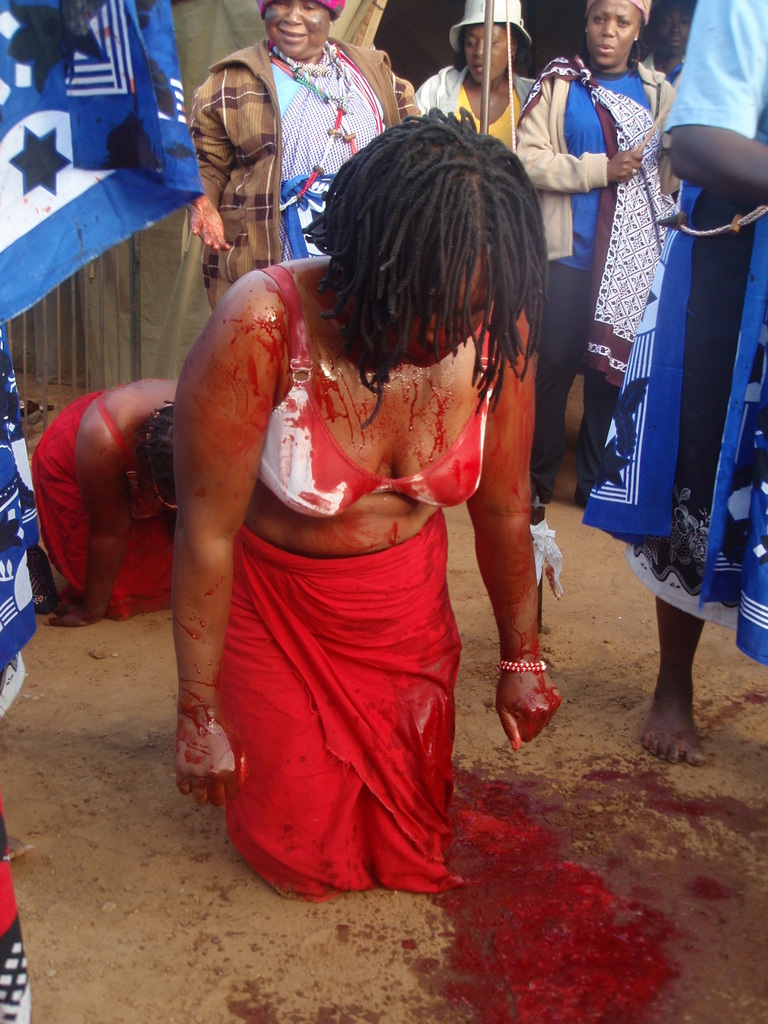 🇿🇦 South AfricaUkuthwasa
A spiritual calling and initiation process for traditional healers in Southern Africa.Rite · Healing · Speaking with spirits and the dead Living
🇿🇦 South AfricaUkuthwasa
A spiritual calling and initiation process for traditional healers in Southern Africa.Rite · Healing · Speaking with spirits and the dead Living
 🇮🇳 India and 5 moreSnake worship
Veneration of serpents as divine or ancestral beings across global culturesTradition · Protection · Healing Living
🇮🇳 India and 5 moreSnake worship
Veneration of serpents as divine or ancestral beings across global culturesTradition · Protection · Healing Living
 🇲🇿 Mozambique and 1 moreNdau witchcraft and sorcery
A system of spirit belief and traditional healing among the Ndau people of Mozambique and ZimbabweTradition · Healing · Protection Living
🇿🇦 South Africa and 4 moreModern witch-hunts
Contemporary violence against people accused of using magic to cause harmBelief · Cursing and harm Living
🇳🇬 Nigeria and 5 moreWitchcraft accusations against children in Africa
Violent persecution of children blamed for misfortune across Sub-Saharan Africa and beyondBelief · Cursing and harm Living
🇲🇿 Mozambique and 1 moreNdau witchcraft and sorcery
A system of spirit belief and traditional healing among the Ndau people of Mozambique and ZimbabweTradition · Healing · Protection Living
🇿🇦 South Africa and 4 moreModern witch-hunts
Contemporary violence against people accused of using magic to cause harmBelief · Cursing and harm Living
🇳🇬 Nigeria and 5 moreWitchcraft accusations against children in Africa
Violent persecution of children blamed for misfortune across Sub-Saharan Africa and beyondBelief · Cursing and harm Living
 🇲🇬 MadagascarFady
Malagasy cultural taboos regulating daily life and ancestor relationsBelief · Protection · Speaking with spirits and the dead Living
🇨🇲 CameroonNyongo society
A witch legend from Cameroon used to explain sudden wealth and unexplained deathBelief · Cursing and harm · Luck and prosperity Living
🇲🇬 MadagascarFady
Malagasy cultural taboos regulating daily life and ancestor relationsBelief · Protection · Speaking with spirits and the dead Living
🇨🇲 CameroonNyongo society
A witch legend from Cameroon used to explain sudden wealth and unexplained deathBelief · Cursing and harm · Luck and prosperity Living
Photo credits on this page
The small pictures above come from Wikimedia Commons under free licences. Some are cropped to fit.
- European witchcraft: Unknown author, CC BY 4.0, source
- Ukuthwasa: Mycelium101, CC BY-SA 3.0, source
- Pentagram: Tomruen, Attribution, source
- Buda: Aberdeen Bestiary, Public domain, source
- Zangbeto: Grete Howard, CC BY 3.0, source
- Famadihana: Saveoursmile (Hery Zo Rakotondramanana), CC BY-SA 2.0, source
- Witchcraft in Ghana: SALTN, CC BY-SA 4.0, source
- Azande witchcraft: Unknown author, CC BY 4.0, source
- Snake worship: Alexandermcnabb, CC BY-SA 4.0, source
- Witch doctor: Lucjan Wędrychowski, Public domain, source
- Juju: ILN Staff, after special artist correspondent Mr Harries F.R.G.S., Public domain, source
- Osun-Osogbo Sacred Grove: Cheeka 2.0, CC BY-SA 4.0, source
- Fady: Robin Taylor, CC BY 2.0, source
- Ndau witchcraft and sorcery: Mycelium101, CC BY-SA 3.0, source