🇹🇼 Magic in Taiwan
32 entries from Taiwan, best known first, across 17 places of magic.
Traditional spiritual life across Taiwan blends ancestral reverence with teachings from Taoism, Buddhism, and Confucianism. Local communities also honor regional figures, historical soldiers, and indigenous spirits alongside these established paths. These folk customs operate side by side with organized faiths, creating a layered landscape where everyday rituals and temple devotion share the same cultural ground.
- Nearly ninety-three percent of residents combine Buddhist, Confucian, and Taoist observances.
- Wang Ye deities receive dedicated shrines to guard communities against disease.
- Spirit writers use trance sessions to deliver written guidance for seekers.
- Non-Taoist ritual masters perform boundary clearing using specialized hand gestures.
- Altars for fallen soldiers help calm restless spirits in local neighborhoods.
Overview
Spiritual practice on the island grew from traditions carried over from southern Chinese provinces. Immigrants brought their family altars and temple customs, which later mixed with Buddhist teachings, Taoist cosmology, and Confucian family ethics. The local landscape absorbed new figures over time, including honored soldiers and community founders who received shrine status after death. Indigenous groups maintain their own ancestral and nature-focused customs alongside these imported systems. This blended approach shares many structural elements with mainland Chinese village religion, particularly the way household shrines and neighborhood temples operate together. Both traditions treat the sacred as accessible through daily offerings and seasonal gatherings rather than isolated monastic retreats.
Practices and beliefs
Devotees frequently visit neighborhood shrines to leave incense and food offerings for household ancestors and local protectors. A distinctive custom involves honoring Wang Ye, a group of plague deities believed to guard against illness when properly appeased. Communities also establish small altars for forgotten dead or fallen soldiers, known locally as Wanshan Ye, to ensure restless spirits remain calm. Spirit communication occurs through tongji sessions, where trained writers channel messages during trance states to answer questions about health or fortune. Household wards and paper talismans are common tools used to mark doorways and maintain harmony within the home.
Rites and charms
Temple festivals typically begin with morning cleaning and the arrangement of fresh fruit, tea, and roasted meats on wooden altars. Priests chant classical texts while burning joss sticks and paper replicas meant to provide comfort to wandering spirits. During spirit writing ceremonies, participants kneel before a central table while a medium enters a focused state to receive written guidance. Ancestor veneration follows a steady rhythm, with families placing bowls of rice and steamed buns at home shrines during regular meal times. Processions move through streets carrying decorated palanquins, accompanied by drummers and brass bands that signal the presence of visiting deities.
Who practises
Ritual work falls to several distinct groups who train through formal apprenticeships or lineage inheritance. Sanju daoshi belong to the Zhengyi Taoist tradition and lead temple services, bless households, and oversee major festival schedules. Fashi operate outside standard Taoist hierarchies, focusing on protective rites and boundary clearing using specialized hand seals and staff movements. Tongji mediums undergo years of discipline to learn the precise postures and breathing methods required for spirit communication. These roles carry social respect, though practitioners often balance temple duties with ordinary employment to support their families.
Regions and communities
Customs shift noticeably depending on which coastal province first settled an area. Southern communities preserve older maritime protection rites and maintain strong ties to portside shrines. Urban centers in the west host larger temple complexes that blend multiple deity lineages under one roof. Historical sites like Tainan feature prominent halls dedicated to local guardians, reflecting centuries of civic development. Indigenous mountain villages retain distinct nature veneration practices that occasionally merge with nearby Han customs. Some frontier areas still honor foreign military personnel who died during earlier conflicts, showing how local memory shapes shrine dedication across different districts.
Today
Contemporary spiritual life remains highly active, with nearly all residents participating in some form of traditional observance alongside other faiths. Temple attendance stays high, and family altars continue to serve as daily focal points for prayer and remembrance. Migration patterns have spread these customs to overseas neighborhoods, where displaced communities rebuild shrines to maintain cultural continuity. Commercial markets supply incense, paper goods, and decorative statues to meet steady demand, while heritage programs document fading oral histories and carving techniques.
The facts in this overview come from the Wikipedia article "Taiwanese folk beliefs", written by its contributors and used under the CC BY-SA 4.0 licence. EveryJaadu rewrote the text in its own words, with AI assistance, and compares every page with the article to make sure no passage is copied. It may be reused under the same CC BY-SA 4.0 licence with a link back.
 🇳🇿 New Zealand and 5 moreFace tattoo
Marks inked on the face for spiritual protection, identity, rank, and rite of passageTradition · Protection · Power and authority Living
 🇨🇳 China and 2 moreEight Immortals八仙
Eight legendary Taoist figures of China, each with a power and a vesselFigure · Protection · Healing Living
 🇨🇳 China and 5 moreQingming Festival清明节
A spring day for sweeping graves, feeding the dead and honouring ancestorsTradition · Speaking with spirits and the dead · Protection Living
 🇨🇳 China and 5 moreSky lantern天燈
A paper hot air balloon lifted by flame to carry wishes and blessingsRite · Luck and prosperity · Protection Living
🇨🇳 China and 4 moreKitchen God灶君
The Chinese hearth deity who reports domestic conduct to the Jade EmperorBeing · Protection · Luck and prosperity Living
🇨🇳 China and 3 moreZi Wei Dou Shu紫微斗數
A Chinese natal astrology system mapping stars across twelve life palacesTradition · Seeing and foretelling Living
🇨🇳 China and 4 moreQimen Dunjia奇門遁甲
An ancient Chinese divination system mapping time and space for strategic decision-makingOracle · Seeing and foretelling · Power and authority Revived
 🇨🇳 China and 2 moreOnomancy
Divination based on the letters, numbers, or written strokes of a person's nameOracle · Seeing and foretelling · Luck and prosperity Living
 🇨🇳 China and 3 moreTang-ki童乩 (tóngjī); 乩童 (jītóng)
A Chinese folk-religion medium whose body a deity is held to take overTradition · Speaking with spirits and the dead · Seeing and foretelling Living
 🇨🇳 China and 1 moreYue Lao月下老人
The Chinese deity of marriage who binds destined couples with red cordsBeing · Love and attraction · Binding and oaths Legendary
 🇨🇳 China and 2 moreDiyu地獄
The underworld realm of trial, atonement, and rebirth in Chinese mythologyBelief · Cleansing and purification · Change and initiation Living
 🇨🇳 China and 1 moreDongyue Dadi東嶽大帝
The Chinese mountain god of Mount Tai who rules lifespans and underworld recordsBeing · Speaking with spirits and the dead · Power and authority Living
 🇨🇳 China and 5 moreChinese fortune telling算命 (Suànmìng)
Reading faces, palms, birth hours and places to map a person's luck through lifeTradition · Seeing and foretelling · Luck and prosperity Living
 🇨🇳 China and 1 moreMoon blocks筊杯
A pair of wooden blocks thrown to ask a deity a yes or no questionOracle · Seeing and foretelling Living
 🇨🇳 China and 5 moreJoss paper金紙
Paper burned as money and goods for ancestors, gods and the deadCharm · Speaking with spirits and the dead · Luck and prosperity Living
 🇨🇳 China and 1 moreAncestor veneration in China
Rites for dead kin who are thought to watch over the familyTradition · Protection · Speaking with spirits and the dead Living
 🇨🇳 China and 1 moreChinese shamanism巫教 (Wūjiào)
Spirit-mediums of China who dance and trance to carry messages between people and godsTradition · Speaking with spirits and the dead · Seeing and foretelling Living
 🇨🇳 China and 4 moreFuji扶乩
Chinese planchette writing: gods and ancestors reply through a stylus on sandRite · Speaking with spirits and the dead · Seeing and foretelling Living
 🇹🇼 TaiwanKuai Kuai culture乖乖文化
A Taiwanese custom of placing obedient snacks on machines to ensure smooth operationBelief · Protection Living
 🇨🇳 China and 1 moreJiaobei筊杯 (jiǎobēi)
Wooden crescent blocks thrown in pairs to ask temple deities yes or no questionsOracle · Seeing and foretelling · Speaking with spirits and the dead Living
 🇹🇼 Taiwan and 1 moreOng Yah王爺 (Ông-iâ)
Royal Lord deities of Fujian and Taiwan who tour the land, driving out diseaseBeing · Protection · Healing Living
🇹🇼 TaiwanMo-sin-a魔神仔
A short, furry forest demon from Taiwanese folklore said to lure travelers into the mountains.Being · Cursing and harm Legendary
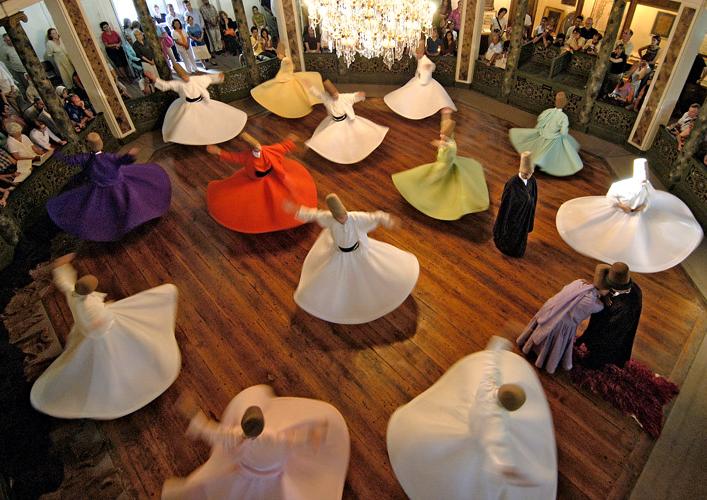 🇹🇷 Turkey and 4 moreSufi whirlingSemazen
A spinning meditation practiced by Sufi dervishes to reach spiritual connection through music and movement.Rite · Speaking with spirits and the dead · Change and initiation Living
 🇨🇳 China and 5 moreChinese numerology中国数术
A system of interpreting numbers as lucky or unlucky based on their pronunciation in Chinese dialects.Belief · Luck and prosperity Living
 🇹🇼 Taiwan and 1 moreTiangong censer天公爐
An incense burner for the Jade Emperor in Chinese folk religionCharm · Speaking with spirits and the dead Living
🇹🇼 Taiwan and 3 moreHanitu
A spirit concept from the Bunun people of Taiwan, found in all living and non-living things.Being · Cursing and harm · Healing Historical
 🇹🇼 Taiwan and 1 moreAuspicious train ticket吉祥語車票
Train tickets with station names that form lucky phrases through wordplay.Charm · Luck and prosperity Living
🇰🇷 South Korea and 3 moreCorner Game구석놀이
A four-player summoning game told as an urban legend across East AsiaRite · Speaking with spirits and the dead Legendary
 🇨🇳 China and 6 moreRed envelope红包 (hóngbāo)
A cash gift in a red paper cover given during holidays and weddings to share good fortuneTradition · Luck and prosperity · Protection Living
🇹🇼 TaiwanLui-kong-tsiau雷公鳥
A Taiwanese thunder-creature said to summon storms from treetopsBeing · Wonder and entertainment Legendary
 🇨🇭 Switzerland and 5 moreFédération Internationale des Sociétés Magiques
Global body uniting magic clubs and organizing world competitionsTradition · Wonder and entertainment Living
 🇹🇼 TaiwanYin miao陰廟
Temples for wandering spirits in Taiwanese folk religionTradition · Protection · Speaking with spirits and the dead Living
Photo credits on this page
The small pictures above come from Wikimedia Commons under free licences. Some are cropped to fit.
- Auspicious train ticket: SSR2000, CC BY-SA 3.0, source
- Chinese numerology: Sarang, Public domain, source
- Sufi whirling: myself, Public domain, source
- Sky lantern: Richy, CC BY-SA 3.0, source
- Qingming Festival: Jacklee ., CC BY-SA 3.0, source
- Yue Lao: 仔仔好帥, CC BY-SA 4.0, source
- Jiaobei: Jnzl's Public Domain Photos, CC BY 2.0, source
- Dongyue Dadi: H2v5o68z, CC0, source
- Joss paper: Vmenkov, CC BY-SA 3.0, source
- Diyu: ScribblingGeek, CC BY-SA 4.0, source
- Kuai Kuai culture: 總統府, CC BY 2.0, source
- Chinese shamanism: No machine-readable author provided. +上帝+ assumed (based on copyright, CC BY-SA 3.0, source
- Face tattoo: Gottfried Lindauer, Public domain, source
- Onomancy: Unknown author, Public domain, source
- Tang-ki: Bunkichi Chang, CC BY 2.0, source
- Chinese fortune telling: Lai Afong, Public domain, source
- Ong Yah: Suzuki1314 at Chinese Wikipedia, Public domain, source
- Tiangong censer: WiDE, CC BY-SA 3.0, source
- Moon blocks: Hsiung/d6478coke, CC BY 2.0, source
- Yin miao: Outlookxp, CC BY-SA 4.0, source
- Red envelope: Oldie~commonswiki, Public domain, source
- Eight Immortals: Fanghong, CC BY-SA 3.0, source
- Ancestor veneration in China: Three huntings, CC BY-SA 4.0, source
- Fuji: Unknown author, CC BY 4.0, source
- Fédération Internationale des Sociétés Magiques: Jack de Nijs for Anefo, CC BY-SA 3.0 nl, source
The weekly digest
Every Monday: seven entries you may not know, what is on the calendar this week, and one rite drawn step by step.