Luck and love
Feng shui placement
The arrangement of a house, a grave or an office so that the flow of qi is believed to gather and not scatter.
Presented by ClearTrust Customs described as customs, free to read.
Feng shui, wind and water, is the Chinese art of siting and arranging buildings, graves and rooms so as to be in harmony with qi, the vital breath that is believed to run through land and space. Practitioners study hills, water, the compass direction of a door and the shapes of surrounding buildings. It is used for choosing where a house, shop or tomb is to stand and how a room is set out.
This is an outline of a custom, said as belief and practice. It is not instruction, it does not say that the rite works, and it is not medical advice.
What goes into it
- Luopan compassToolRings of directions for reading a site.
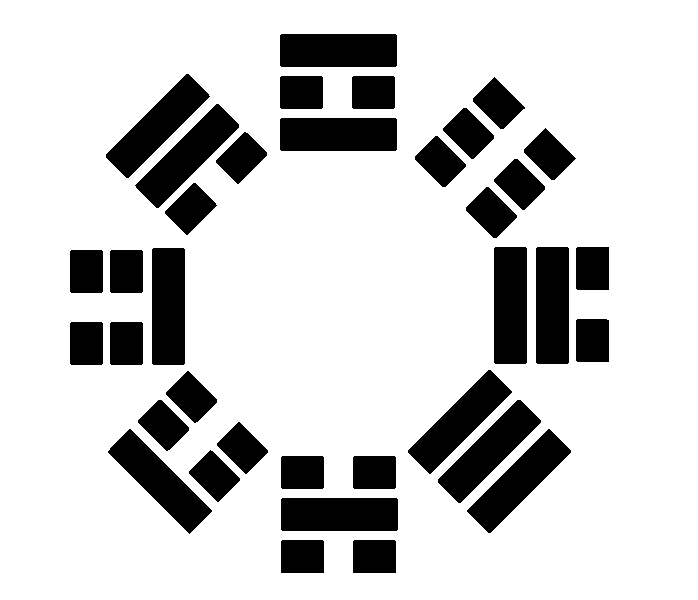
- Bagua gridObjectEight-sided map of life areas.
- Landscape formsSpaceHills, water and roads around the site.
- Door and bed placementGestureMoved to guide qi.
- Mirrors and water featuresObjectUsed in some schools to deflect or collect qi.
- PlantPlantA living plant is often added to bring qi.
- Tool
- Object
- Space
- Gesture
- Plant
Each part has an equal wedge. The ring shows what goes into the rite, not how much. Colour is the part's role.
The steps, drawn
Each drawing shows the kind of act in that step. Details differ from place to place, family to family and practitioner to practitioner.
Step 1: Gather The master surveys the hills, water and roads around the site. Step 2: Read The luopan is used to take the compass bearings of the door. Step 3: Circle The plan is drawn on the bagua grid. Step 4: Cast Doors, beds and desks are moved to match the reading. Step 5: Close The house is blessed and the new year's adjustments are set.
The practice
A feng shui master reads the land by the landscape forms, the school of forms, or by a compass called the luopan, with its rings of directions, the school of the compass. Common advice includes keeping a door from facing straight down a long corridor, placing the bed away from a line with the door, and keeping water and mirrors out of certain places. The bagua, an eight-sided grid, is used to link parts of a room with life areas such as wealth and relationships.
Business and criticism
Feng shui is consulted for large buildings in Hong Kong and elsewhere, and a consultant market has grown around it in the West. Critics call it pseudoscience, and in Maoist China it was banned as feudal superstition. Believers point to comfortable light and airflow as its practical side, and scholars study it as a Chinese way of reading land and ancestry.
What it is for
- Choose a good site
- Arrange a home or a business for good fortune
Who does it
Related entries

More on EveryJaadu
No entries here yet. New pages are added every day.
Sources and further reading
Original text and drawings by the EveryJaadu desk, written with AI assistance and checked against the sources above. Closed or sacred detail is left out. If we have something wrong, tell us.
Photo credits on this page
The small pictures above come from Wikimedia Commons under free licences. Some are cropped to fit.
- Bagua: TarcísioTS at Portuguese Wikipedia, Public domain, source
- Feng shui: Unknown author, Public domain, source