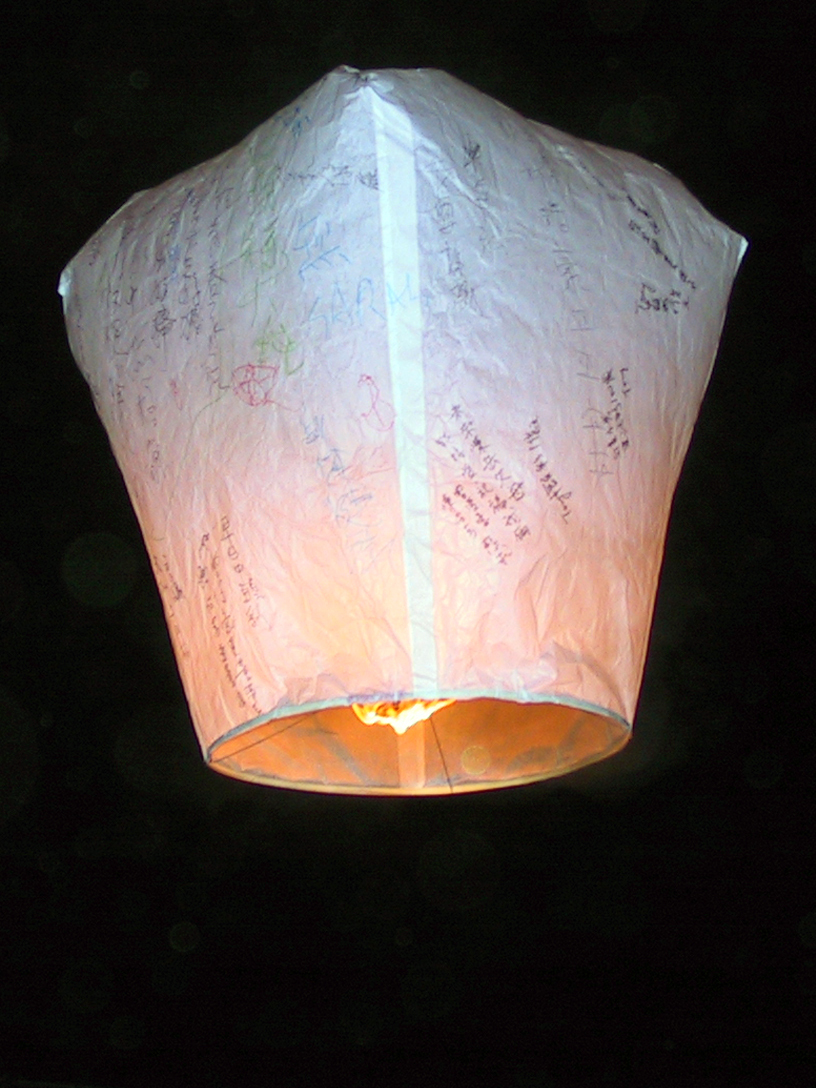
Sky lantern
In its own language: 天燈
from Chinese tiandeng, meaning sky lantern
A paper hot air balloon lifted by flame to carry wishes and blessings
A sky lantern is a lightweight paper envelope heated by a small flame, causing it to float into the night sky. Practised across Asia and other continents, the ritual release is believed to convey prayers, dispel negative fortune, and foster harmony.
- Traditional Chinese accounts attribute the invention to strategist Zhuge Liang in the third century.
- Mongolian forces introduced hot air balloons to Europe during the thirteenth-century Battle of Legnica.
- Buddhists release lanterns during Probarona Purnima to symbolize wisdom overcoming ignorance.
- Launching sky lanterns has been classified as an environmental crime in Brazil since 1998.
What it is
A sky lantern is a floating paper vessel open at the base, where a small fire heats the enclosed air and lifts it aloft. The object stays airborne until its heat source burns out, after which it drifts back down. Long constructed across various continents, these lanterns feature in communal festivities, seasonal games, and sacred observances. Across Asian and American traditions, launching a lantern is believed to carry personal wishes to heaven, offer homage to spiritual teachers, turn away harmful energy, and invite prosperity into the community.
Where it comes from
China developed the earliest documented hot air vessels. Historical traditions attribute the creation of the lantern to the third-century military commander Zhuge Liang, known by the honorific Kongming. Surrounded by hostile forces, he is said to have written a plea for assistance on a floating lantern to summon relief. Other accounts suggest the shape merely resembled his traditional hat. During the Mongol invasion of Poland, Mongolian troops employed Chinese lanterns during the Battle of Legnica, marking the earliest known use of hot air ballooning in Europe.
How it is done
To launch a lantern, participants ignite a fuel cell or candle secured to a rigid collar beneath the lower opening. The flame warms the air trapped within the shell, lowering its density until the object ascends. Devotees often write prayers, personal petitions, or names directly onto the paper walls before flight. Larger constructions require several people to hold the delicate material upright and open, ensuring the envelope fills completely with warm air without scorching the sides before release.
Tools and materials
Builders craft the outer shell from lightweight materials, including oiled pith paper, Japanese washi glassine sheets, or colourful translucent tissue paper. Bamboo strips or slender metal hoops support the structure and maintain the shape of the lower opening. The heat source consists of a small candle, a waxy flammable cell, or a packet of paraffin or rosin wrapped in cloth.
Sky lantern, drawn and placed
- Living
- Revived
- Fading
- Historical
- Legendary
- Performed
- Timing
- during full moons, new year celebrations, and seasonal festivals
What it is for
Releasing a lantern serves both festive and spiritual purposes. In Buddhist communities, the rising lights represent devotional offerings to the Buddha, prayers for global peace, and the triumph of wisdom over darkness. In Thai traditions, sending a lantern aloft is believed to carry away anxieties and bad luck while earning religious merit. In other celebrations, the ritual is held to turn away negative influences, promote forgiveness, and seek blessings for the upcoming year.
Peoples and places
Different regions have adapted the tradition to their own customs. In northern Thailand, the Lanna people release floating lanterns known as khom loi. In Bangladesh and Northeast India, Buddhist communities fly fanus lanterns in the Chittagong region and surrounding hills. In Portugal and Brazil, people construct multi-coloured geometric balloons called balões for midwinter celebrations, while residents of Semboku in Japan launch large paper balloons called kamifūsen.
At a glance: who, where and when
Who does it
Peoples
Belief worlds


What people believe
The flight of the lantern carries deep symbolic meaning across different faiths. In Taiwan, written petitions released into the sky are believed to deliver messages directly to God. Thai observers hold that the departing flame carries away life troubles and personal misfortunes. In Chinese thought, the rounded form of the lantern and its gathering with others in the night sky express family wholeness, reunion, and reconciliation during the first full moon.
When it is done
Lantern releases coincide with significant lunar and festive occasions. Chinese communities fly them during the Lantern Festival and the Mid-Autumn Festival, while Taiwan holds massive releases on the fifteenth day of the new year. Buddhists launch them on the full moon of Probarona Purnima to mark the end of the rains retreat. In Thailand, launches occur during Yi Peng, whereas Brazil celebrates them during the late June winter holidays.
How scholars and sceptics see it
The historian of science Joseph Needham documented the early technological history of these devices. His research indicated that Chinese experimenters constructed small hot air balloons for military signalling as early as the third century BC. In military history, early commanders utilized them for nocturnal sieges, surveillance, and sending secret communications before the practice shifted toward popular festivals.
Cautions and what is closed
Airborne lanterns pose significant fire hazards if tilted by gusts or snagged on obstacles, which can cause the shell to ignite or fall while burning. In Germany, lantern fires destroyed houses and caused deaths in Siegen. A stray balloon also ignited a convention centre roof in Brazil. Unburned metal frames remain on the ground for extended periods, presenting choking risks to grazing livestock, while drifting lanterns frequently disrupt air travel.
Compare and confuse
The device is known under various regional names, such as sky candles, fire balloons, khom loi in Thailand, and balão in Brazil. Because of their silent flight and glowing appearance at night, sky lanterns have occasionally been offered as an explanation for reported unidentified flying object sightings.
Law and persecution
Due to severe fire hazards and risks to livestock, several governments have outlawed sky lanterns. Vietnam banned the manufacture, commercial sale, and release of lanterns nationwide in 2009. In Brazil, launching a lantern has been treated as an environmental crime since 1998, carrying potential prison sentences of up to three years.
Today
Sky lantern festivals now attract thousands of visitors, prompting organizers to manage crowd safety and environmental impact. At Pingxi in Taiwan, immense demand led organizers to extend releases over two separate days, sending up coordinated waves of over a thousand lanterns each night. Commercial producers have also experimented with biodegradable, fireproof materials to mitigate ecological damage.
Days linked to Sky lantern
Questions people ask about Sky lantern
What is a sky lantern?
A sky lantern is a small hot air balloon made of lightweight paper with an open bottom, where a suspended flame heats the air inside and causes it to rise into the sky.
Where do sky lanterns originate?
They originated in China, where historians date early signal balloons to the third century BC. Popular tradition attributes their creation to the third-century strategist Zhuge Liang, who used one to call for military aid.
Why are sky lanterns released during festivals?
Communities release them to celebrate holidays, gain Buddhist merit, send personal wishes to heaven, and represent family unity. Many believe the floating flame carries away troubles and turns away negative energy.
Why are sky lanterns banned in some countries?
They present severe fire risks to buildings and crops if blown off course. Discarded frames can harm grazing livestock, and floating lanterns have also disrupted commercial aviation, leading nations like Vietnam and Brazil to prohibit them.
Good reading and sources
- Smethwick fire: Chinese lantern 'caused largest blaze'BBC, Article
- Krefeld zoo fire: German police suspect three womenBBC, Article
- Sky lantern on WikipediaEncyclopedia
- More photos on Wikimedia CommonsPhotos and video
- Wikidata recordOpen data
The facts on this page come from the Wikipedia article "Sky lantern", written by its contributors and used under the CC BY-SA 4.0 licence, and from its Wikidata record (CC0). EveryJaadu rewrote the text in its own words, with AI assistance, and compares every page with the article to make sure no passage is copied. It may be reused under the same CC BY-SA 4.0 licence with a link back.
It may contain mistakes. Names and customs differ from one community to the next, and some knowledge is closed to outsiders and left out here. This page describes belief and practice. It does not say that any of it works, it is not a how-to, and it is not medical advice. If something is wrong, tell us. Last refreshed 2026-10-05.
More from China
All the entries from China 🇨🇳 China and 5 moreJoss paper金紙
Paper burned as money and goods for ancestors, gods and the deadCharm · Speaking with spirits and the dead · Luck and prosperity Living
🇨🇳 China and 5 moreJoss paper金紙
Paper burned as money and goods for ancestors, gods and the deadCharm · Speaking with spirits and the dead · Luck and prosperity Living
 🇨🇳 China and 1 moreAncestor veneration in China中國傳統宗法性宗教
Rites for dead kin who are thought to watch over the familyTradition · Protection · Speaking with spirits and the dead Living
🇨🇳 China and 1 moreAncestor veneration in China中國傳統宗法性宗教
Rites for dead kin who are thought to watch over the familyTradition · Protection · Speaking with spirits and the dead Living
 🇨🇳 China and 1 moreFulu符籙
Taoist talismans with cryptic symbols used for healing and protectionCharm · Healing · Protection Living
🇨🇳 China and 3 moreQi氣 / 气
A vital force in Chinese philosophy and medicine, believed to flow through all living things.Substance · Healing · Power and authority Living
🇨🇳 China and 1 moreFulu符籙
Taoist talismans with cryptic symbols used for healing and protectionCharm · Healing · Protection Living
🇨🇳 China and 3 moreQi氣 / 气
A vital force in Chinese philosophy and medicine, believed to flow through all living things.Substance · Healing · Power and authority Living
Related elsewhere
All rite 🇸🇪 Sweden and 5 moreMidsummerJāņi; Joninės; Jaanipäev; Enyovden; Litha; Juhannus
A summer solstice festival marked by bonfires, maypole dancing, and feasting across Europe.Tradition · Protection · Luck and prosperity Living
🇸🇪 Sweden and 5 moreMidsummerJāņi; Joninės; Jaanipäev; Enyovden; Litha; Juhannus
A summer solstice festival marked by bonfires, maypole dancing, and feasting across Europe.Tradition · Protection · Luck and prosperity Living
 🇪🇬 Egypt and 2 moreLibation
The ritual pouring of liquid as an offering to spirits or the deadRite · Speaking with spirits and the dead · Protection Living
🇳🇿 New ZealandKarakia
Māori recitations used for spiritual guidance, protection, and formal greetingsTradition · Protection · Speaking with spirits and the dead Living
🇪🇬 Egypt and 2 moreLibation
The ritual pouring of liquid as an offering to spirits or the deadRite · Speaking with spirits and the dead · Protection Living
🇳🇿 New ZealandKarakia
Māori recitations used for spiritual guidance, protection, and formal greetingsTradition · Protection · Speaking with spirits and the dead Living
 🇬🇧 United Kingdom and 1 moreWell dressing
A rural English custom of decorating water sources with natural designsTradition · Protection · Speaking with spirits and the dead Living
🇬🇧 United Kingdom and 1 moreWell dressing
A rural English custom of decorating water sources with natural designsTradition · Protection · Speaking with spirits and the dead Living