Wonder and entertainment
Illusion, sleight of hand and the pleasure of being fooled.
Wonder and entertainment is the aim of the stage magician: to astonish an audience who knows it is being fooled. Conjuring, illusion, mentalism and street magic belong here, from the cups and balls of ancient Rome to Robert-Houdin, Houdini, Harry Kellar, P. C. Sorcar of India, Siegfried and Roy, and David Copperfield. This page covers the art, its history and its ethics, and does not reveal how any trick is done.
The art of the honest lie
A magician promises a trick and delivers astonishment. The pleasure comes from the gap between what is seen and what is known. Performers speak of misdirection, timing, patter and showmanship. Magicians also keep an informal rule not to expose methods, so that audiences can keep the pleasure and the craft keeps its livelihood. This is the most open part of the subject, in which no one is asked to believe.
Where it is performed
Magic has always had a street and a stage. In India, P. C. Sorcar Sr. (1913 to 1971) toured the world and became a national name. In China and Japan, conjuring was part of variety theatre and a distinct craft. In the Arab world and the Ottoman empire, performers worked in coffee houses and fairs. In the West, the music hall, the television special and the Las Vegas show carried the art into mass entertainment.
Who is welcome
For much of its history, the profession was dominated by men, with women as assistants, though performers such as Adelaide Herrmann broke the pattern. Racial stereotypes shaped acts: Western performers played Chinese or Indian magicians in costume, and Chung Ling Soo's disguise was a famous case. Today, magicians from many countries and women performers are widely visible. Magicians from Egypt, Lebanon, Iran and Nigeria now work on global stages and in festivals, and a few have become well known beyond their borders.
Entertainers against fraud
Houdini and James Randi spent years exposing mediums and faith healers who claimed real powers, arguing that honest conjurers protect the public. Scholars of the mind use magic to study attention, memory and belief. The boundary matters: claiming genuine supernatural power for a trick and charging for it is fraud, not entertainment. As the code puts it, the trick can be admired and enjoyed without the secret being known, and children and adults alike keep that pleasure.
Wonder and entertainment on EveryJaadu
The entries written up so far, best known first.
 🇨🇦 CanadaSpoon bending
A magic trick and paranormal claim involving the deformation of metal cutleryBelief · Wonder and entertainment · Power and authority Historical
 🇺🇸 United StatesBed of nails
A wooden platform studded with nails used in magic acts and physics demonstrationsIllusion · Wonder and entertainment Performed
 🇮🇹 Italy and 2 moreTarocco Bolognese
A 62-card Italian tarot deck from Bologna used for games and cartomancyText · Wonder and entertainment · Seeing and foretelling Living
 🇮🇳 IndiaIndrajalaइन्द्रजाल
A Sanskrit term for illusion and conjuring, linking stage magic to Hindu philosophy.Belief · Wonder and entertainment · Cursing and harm Historical
🇦🇺 AustraliaPortal (magic trick)
A stage illusion where the magician and a volunteer vanish to appear in a distant location.Illusion · Wonder and entertainment Historical
🇺🇸 United StatesHot foil trick
A stage illusion where foil heats and burns in a volunteer's handIllusion · Wonder and entertainment Historical
 🇪🇬 Egypt and 1 moreGuillotine (magic trick)
A stage illusion where a blade passes through a neck or finger without harmIllusion · Wonder and entertainment Living
🇺🇸 United StatesDavid Copperfield's laser illusion
A stage trick where a magician appears to be sliced by a beam of light and reassembled.Illusion · Wonder and entertainment Historical
🇺🇸 United StatesChicago-style magic
Tableside close-up magic with banter and small props, born in Chicago's barsIllusion · Wonder and entertainment Performed
 🇮🇳 IndiaSnow Lionགངས་སེང་གེ་
A celestial mountain guardian of Tibet embodying fearlessness, bliss, and the DharmaBeing · Protection · Power and authority Living
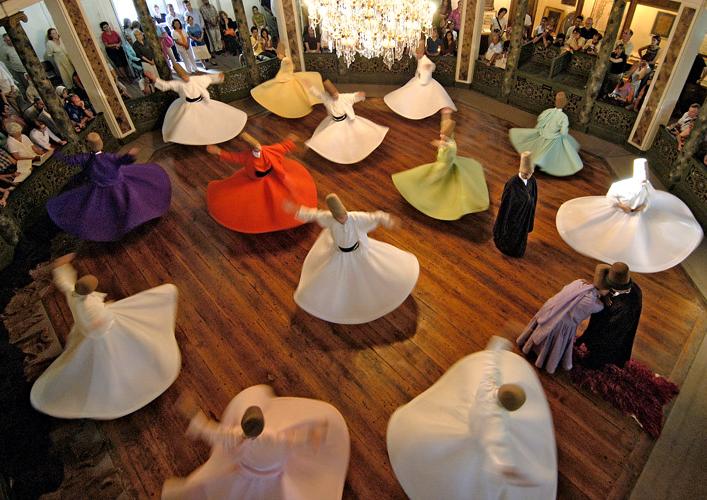 🇹🇷 Turkey and 3 moreSufi whirlingSemazen
A spinning meditation practiced by Sufi dervishes to reach spiritual connection with Allah.Tradition · Speaking with spirits and the dead · Love and attraction Living
 🇮🇳 IndiaBappiriyan Theyyam
A North Malabar ritual performance blending Hindu and Muslim mythic figuresRite · Wonder and entertainment Living
 🇳🇵 NepalLakheyलाखे (Lākhe)
A masked demon figure from Newar folklore, performed in festivals across Nepal.Figure · Protection · Wonder and entertainment Living
🇺🇸 United StatesMidwest Magic Jubilee
An annual magic convention in St. Louis featuring lectures and competitionsIllusion · Wonder and entertainment Living
🇨🇦 Canada and 5 moreSorcerer's Safari Magic Camp
A performance arts camp in Toronto that teaches magic tricks to young people.Illusion · Wonder and entertainment Living
 🇺🇸 United States and 2 moreMidnight ghost show
Traveling stage shows of illusions, fake séances and a lights-out scare finaleIllusion · Wonder and entertainment Historical
 🇬🇧 United Kingdom and 5 moreStreet performance
Public entertainment offered for voluntary tips in open spacesIllusion · Wonder and entertainment · Luck and prosperity Living
🇺🇸 United StatesLe Grand David
A Sunday stage magic show in Beverly, Massachusetts, that ran for 35 yearsIllusion · Wonder and entertainment Performed
 🇩🇪 Germany and 3 moreMephistopheles in popular culture
A fictional devil figure adapted across global media and musicFigure · Wonder and entertainment Living
 🇨🇭 Switzerland and 5 moreFédération Internationale des Sociétés Magiques
Global body uniting magic clubs and organizing world competitionsTradition · Wonder and entertainment Living
🇮🇷 IranAroos-Goolehعروس گوله
A Gilani spring performance pitting a bride against a ghoul to welcome the new yearIllusion · Wonder and entertainment · Luck and prosperity Revived
🇩🇪 GermanyMagic Circle of the German Democratic RepublicMagischer Zirkel der Deutschen Demokratischen Republik
A national association for stage magicians in East Germany from 1956 to 1990.Illusion · Wonder and entertainment Historical
🇺🇸 United StatesChavez School of Magic
A historic American institution for stage magic training founded in 1941.Illusion · Wonder and entertainment Historical
🇦🇺 Australia and 1 moreBand of Magicians
A touring stage magic show featuring multiple magicians performing together on one stage.Illusion · Wonder and entertainment Living
 🇺🇸 United StatesHail Satan
A Satanic exclamation used as ritual greeting, rebel cry, and pop-culture punchlineBelief · Power and authority · Cursing and harm Living
🇦🇹 AustriaMagic Club of ViennaMagischer Klub Wien
Austrian association for stage magicians founded in 1908Illusion · Wonder and entertainment Living
 🇫🇷 France and 2 moreTarasqueTarasca
A mythical beast from Provence tamed by Saint Martha and paraded in festivalsBeing · Wonder and entertainment Living
🇮🇹 ItalyBologna bottle
A glass vessel that withstands hammer blows but shatters from an internal scratchCharm · Wonder and entertainment Historical
 🇫🇷 France and 1 moreChapeaugraphy
A novelty act using a single ring of felt to form different hatsIllusion · Wonder and entertainment Revived
🇯🇵 Japan and 1 moreOrigami (magic trick)
A stage illusion where a person vanishes into and reappears from a folding paper boxIllusion · Wonder and entertainment Performed
 🇺🇸 United States and 5 moreMagic
A performance art using natural means to create the appearance of impossible featsIllusion · Wonder and entertainment Living
 🇮🇳 IndiaIndian basket trick
A stage illusion where an assistant vanishes inside a pierced wicker containerIllusion · Wonder and entertainment Historical
 🇩🇪 Germany and 2 moreChink-a-chink
A close-up coin trick where objects appear to jump between locations until gathered togetherIllusion · Wonder and entertainment Living
 🇺🇸 United StatesSi Stebbins stack
A mathematical card order that lets a magician find any chosen card by its neighbors.Illusion · Wonder and entertainment Historical
 🇫🇷 FranceThéâtre Robert-Houdin
A Paris venue for stage magic founded by Jean-Eugène Robert-Houdin and later directed by Georges MélièsIllusion · Wonder and entertainment Historical
🇺🇸 United StatesPolka-dot paint
A stage magic trick and a real paint product that creates dotted patternsSubstance · Wonder and entertainment Historical
 🇳🇱 Netherlands and 5 moreLiving statue
A street performer who poses motionless as a painted statue or mannequin.Illusion · Wonder and entertainment Living
 🇺🇸 United States and 4 moreZombie walk
A public gathering where people dress as zombies to walk through city streets for entertainment or charityIllusion · Wonder and entertainment · Luck and prosperity Living
 🇭🇹 HaitiHaitian CarnivalKanaval
A major Caribbean festival of music, dance, and satire leading to Mardi Gras in HaitiTradition · Wonder and entertainment · Luck and prosperity Living
🇦🇺 AustraliaThe Illusionists
A touring stage magic show with a rotating cast of performersIllusion · Wonder and entertainment Living
🇨🇦 CanadaBalzac Billy
A groundhog-costumed mascot that forecasts the weather on Groundhog Day in Alberta.Illusion · Wonder and entertainment Living
Photo credits on this page
The small pictures above come from Wikimedia Commons under free licences. Some are cropped to fit.
- Magic: Hieronymus Bosch and workshop / Workshop of Hieronymus Bosch / After H, Public domain, source
- Indian basket trick: Samri Baldwin, Public domain, source
- Chink-a-chink: Niklaus Gerber, CC BY 3.0, source
- Si Stebbins stack: SyLindsley, CC BY 3.0, source
- Haitian Carnival: User:Doron, CC BY-SA 3.0, source
- Sufi whirling: myself, Public domain, source
- Spoon bending: Sgerbic, CC BY-SA 3.0, source
- Snow Lion: John Hill, CC BY-SA 4.0, source
- Fakir: Herbert Ponting, Public domain, source
- Tarasque: Olivier, CC BY-SA 4.0, source
- Chapeaugraphy: Penny Pictorial Magazine, Public domain, source
- Théâtre Robert-Houdin: anonymous, Public domain, source
- Living statue: Another one of my pictures: This photograph was taken by Medium69 (Wil, CC BY-SA 4.0, source
- Bappiriyan Theyyam: Sumalkv, CC BY-SA 4.0, source
- Guillotine (magic trick): Reginald Scott, Public domain, source
- Indrajala: Abishekrl15156, CC BY-SA 4.0, source
- Mephistopheles in popular culture: shakko, CC BY-SA 3.0, source
- Hail Satan: Paul Sableman, CC BY 2.0, source
- Midnight ghost show: Unknown author, CC BY 4.0, source
- Street performance: Dwight Burdette, CC BY 3.0, source
- Fédération Internationale des Sociétés Magiques: Jack de Nijs for Anefo, CC BY-SA 3.0 nl, source
- Zombie walk: tangi bertin, CC BY 2.0, source
- Lakhey: Less than 3, CC BY 2.0, source
- Tarocco Bolognese: Countakeshi, CC BY-SA 4.0, source