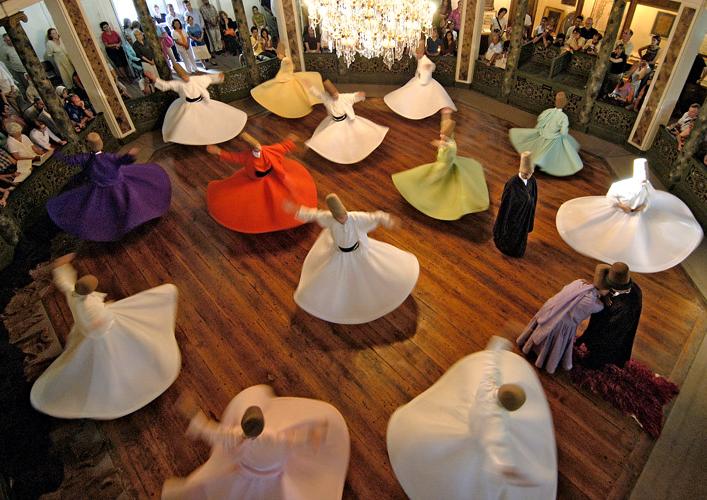
Sufi whirling
In its own language: Semazen
Semazen from Persian Sama-zan, meaning listening doer
A spinning meditation practiced by Sufi dervishes to reach spiritual connection with Allah.
Sufi whirling is a physically active meditation performed by Sufi dervishes within the sema ceremony. Originating in 13th-century Turkey among the Mevlevi order founded by Rumi, practitioners spin in repetitive circles while listening to music to abandon their ego and connect with God.
- Sufi whirling is a spinning meditation practiced by dervishes to connect with Allah.
- The Mevlevi order was founded by Rumi in the 13th century in Turkey.
- Dancers wear a white skirt and felt cap, spinning on the left foot.
- UNESCO recognized the Mevlevi Sema Ceremony as Intangible Heritage in 2005.
- Egyptian tanoura uses a multicolored skirt for visual effects and balance.
What it is
Sufi whirling is a form of physically active meditation practiced by Sufi dervishes. It takes place during the sema ceremony, where participants spin in repetitive circles while listening to devotional music. Practitioners believe this movement helps them abandon their ego and personal desires to achieve a deeper connection with Allah. The spinning is viewed as a symbolic imitation of the planets orbiting the sun.
Where it comes from
The Mevlevi order that popularized whirling was founded by the mystic poet Rumi in the 13th century. The broader custom of sama began in Baghdad around the ninth century. Over time, the practice evolved alongside dhikr rituals, adapting to different cultures and facing varying levels of acceptance within the Islamic world.
How it is done
A dervish begins by removing a black cloak to symbolize spiritual rebirth. Wearing a wide white skirt and a felt cap, they stand with arms crossed before opening them: the right hand reaches toward the sky to receive divine grace, while the left hand turns toward the earth to convey blessings to people below. They rotate on the ball of the left foot, using the right foot to step in full circles, maintaining balance through training.
Tools and materials
Participants wear a sleeveless white frock called a tennure, a long-sleeved jacket known as a destegul, a belt, and a turban. A felt cap called a sikke sits atop the head. In Pakistan, the accompanying music features a naghara drum and a shehnai wind instrument. The colorful skirts used in Egyptian variations rely on centrifugal force for visual effect.
Sufi whirling, drawn and placed
- Living
- Revived
- Fading
- Historical
- Legendary
- Performed
- Lineage
- Sufism, Mevlevi order
- Timing
- Sufi festivals, annual tourist weeks
What it is for
The ritual aims to nourish the soul and help the dancer reach a state of ecstatic trance. By spinning, the dervish testifies to God's unity and embraces humanity with love. Practitioners seek to hear the subtle sounds of the hidden world or cosmos, viewing love as a bridge to Divine love.
Who does it
Dervishes, also called semazens, perform the ritual under the guidance of a sheikh who stands in the honored corner of the space. Historically, participation was restricted to men, though some modern communities now admit women. Members often come from lower social classes, and a strict supervisor may touch a dancer to curb excessive movement if needed.
Peoples and places
The practice is most associated with the Mevlevi order in Turkey and the Rifa'i-Marufi order. In Egypt, it appears as tanoura, a dance often performed by non-Sufis for entertainment. In Pakistan, a version called Dhamaal occurs at shrines like Lal Shahbaz Qalandar, where priests and pilgrims alike may join the spinning.
At a glance: who, where and when
Belief worlds
Occasions


What people believe
Sufis follow a silsila, a chain of spiritual lineage tracing back to the Prophet Muhammad and Allah. The clothing holds deep meaning: the hat represents the tombstone of the ego, and the white skirt acts as its shroud. The ritual emphasizes that humans are created with love to love, and the spinning serves as a physical expression of this devotion and submission to God.
When it is done
Whirling is performed during dhikr ceremonies and at Sufi festivals. In Turkey, the Mevlevi order received government permission to perform these rituals for tourists during a two-week period each year. The practice adapts to local calendars and the rhythms of specific shrine celebrations.
How scholars and sceptics see it
Researchers have studied the physiological aspects of whirling, noting that performers train their inner ears to counteract motion-induced vertigo. Guinness World Records track feats of endurance, such as the highest number of rotations in an hour. Anthropologists observe how the practice shifted from religious devotion to tourist entertainment and folk dance in various regions.
Cautions and what is closed
The practice has faced political suppression, including a 1925 Turkish decree that dissolved Sufi fraternities. Some Orthodox theologians discount the Dervish practice, and there is ongoing controversy within Islam regarding whether sama constitutes spiritual listening or mere dance. Strict rules exist to distinguish sacred ritual from secular entertainment.
Compare and confuse
The Egyptian tanoura focuses on the visual impact of a multicolored skirt and is often performed as a concert dance outside religious contexts. The Pakistani Dhamaal involves skipping steps into a trance accompanied by drums and bells, honoring specific saints rather than following the formal Mevlevi structure.
Law and persecution
In 1925, the Turkish government issued a decree dissolving all Sufi orders. The Mevlevi order survived in small villages until 1954, when authorities granted special permission for annual ritual performances aimed at tourists. Despite government control, the order continues to exist in Turkey today.
Today
Dervish communities once played central roles in social and religious life across Islamic lands. Today, the practice survives through village traditions, tourist performances, and Western interest in stress relief. Techniques are sometimes adopted by belly dancers for balance, and the tradition maintains a presence in shrines and festivals across the Middle East and South Asia.
Questions people ask about Sufi whirling
What is Sufi whirling?
It is a physically active meditation where dervishes spin in circles to abandon their ego and connect with God.
Where did it originate?
The Mevlevi order started in 13th-century Turkey by Rumi, while the custom of sama began in Baghdad in the ninth century.
How do dervishes spin?
They rotate on the ball of the left foot, right arm reaching up to receive grace and left hand down to bless the earth.
Is it still practiced?
Yes, by the Mevlevi order in Turkey, in Egyptian tanoura, and as Dhamaal in Pakistan, though sometimes adapted for tourism.
Good reading and sources
- Sufi whirling on WikipediaEncyclopedia
- More photos on Wikimedia CommonsPhotos and video
- Wikidata recordOpen data
The facts on this page come from the Wikipedia article "Sufi whirling", written by its contributors and used under the CC BY-SA 4.0 licence, and from its Wikidata record (CC0). EveryJaadu rewrote the text in its own words, with AI assistance, and compares every page with the article to make sure no passage is copied. It may be reused under the same CC BY-SA 4.0 licence with a link back.
It may contain mistakes. Names and customs differ from one community to the next, and some knowledge is closed to outsiders and left out here. This page describes belief and practice. It does not say that any of it works, it is not a how-to, and it is not medical advice. If something is wrong, tell us. Last refreshed 2026-10-10.
More from Turkey
All the entries from Turkey 🇮🇷 Iran and 4 moreChaharshanbe Suriچهارشنبهسوری
An Iranian fire festival marking the transition from winter to springTradition · Luck and prosperity · Speaking with spirits and the dead Living
🇮🇷 Iran and 4 moreChaharshanbe Suriچهارشنبهسوری
An Iranian fire festival marking the transition from winter to springTradition · Luck and prosperity · Speaking with spirits and the dead Living
 🇹🇷 TurkeyKhirqaخرقه
An initiatory cloak in Sufism that passes spiritual lineage and blessings from teacher to student.Tradition · Speaking with spirits and the dead · Power and authority Living
🇹🇷 TurkeyKhirqaخرقه
An initiatory cloak in Sufism that passes spiritual lineage and blessings from teacher to student.Tradition · Speaking with spirits and the dead · Power and authority Living
 🇹🇷 Turkey and 2 moreHadraحضرة
A collective Sufi ritual of remembrance and chanting to experience Divine PresenceRite · Speaking with spirits and the dead · Power and authority Living
🇹🇷 Turkey and 3 moreSamaسماع
A Sufi ritual of listening, music, and whirling to reach spiritual ecstasyRite · Speaking with spirits and the dead · Change and initiation Living
🇹🇷 Turkey and 2 moreHadraحضرة
A collective Sufi ritual of remembrance and chanting to experience Divine PresenceRite · Speaking with spirits and the dead · Power and authority Living
🇹🇷 Turkey and 3 moreSamaسماع
A Sufi ritual of listening, music, and whirling to reach spiritual ecstasyRite · Speaking with spirits and the dead · Change and initiation Living
Related elsewhere
All tradition 🇬🇷 GreeceKykeonκυκεών
An Ancient Greek ritual drink linked to the Eleusinian Mysteries and peasant lifeSubstance · Speaking with spirits and the dead · Wonder and entertainment Historical
🇬🇷 GreeceKykeonκυκεών
An Ancient Greek ritual drink linked to the Eleusinian Mysteries and peasant lifeSubstance · Speaking with spirits and the dead · Wonder and entertainment Historical
 🇮🇳 India and 1 moreMantraमन्त्रम्
A sacred sound or phrase repeated to focus the mind and invoke spiritual powerText · Speaking with spirits and the dead · Power and authority Living
🇮🇳 India and 1 moreMantraमन्त्रम्
A sacred sound or phrase repeated to focus the mind and invoke spiritual powerText · Speaking with spirits and the dead · Power and authority Living
 🇩🇪 Germany and 7 moreWalpurgis NightWalpurgisnacht
A spring vigil marking the eve of Saint Walpurga's feast day with bonfires and student festivalsRite · Protection · Speaking with spirits and the dead Living
🇩🇪 Germany and 7 moreWalpurgis NightWalpurgisnacht
A spring vigil marking the eve of Saint Walpurga's feast day with bonfires and student festivalsRite · Protection · Speaking with spirits and the dead Living