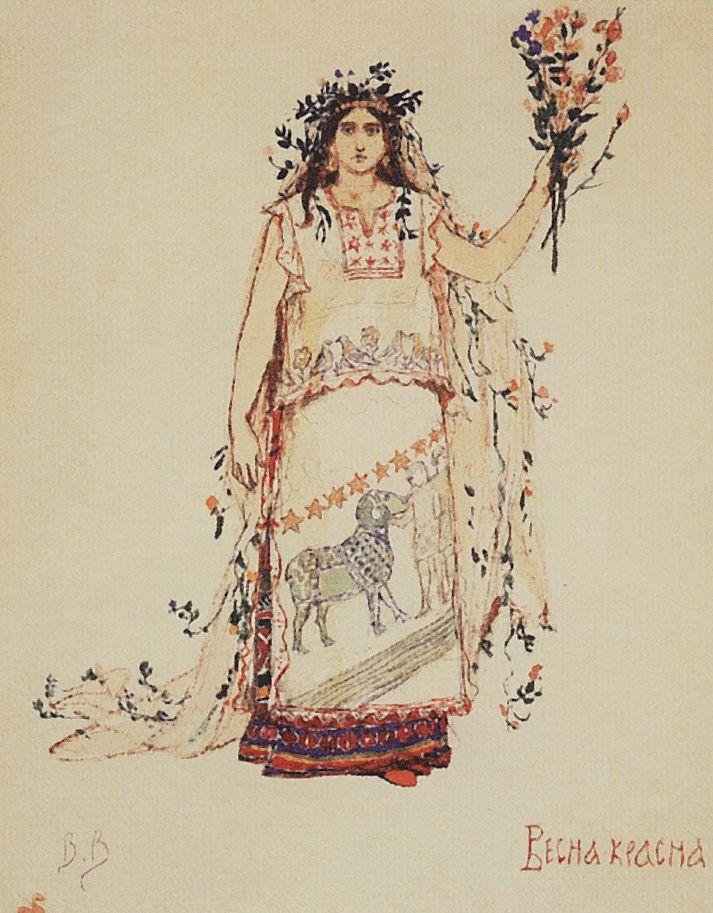
Vesna
In its own language: Весна
from Proto-Slavic *vesna, meaning 'spring'
A Slavic personification of spring and youth, known in myth and language
Vesna is a figure from later Slavic mythology linked to the arrival of spring and young life. She appears in South Slavic tales as a mountain dweller and in East Slavic customs as a clay effigy carried in seasonal rites.
- Vesna means spring in several Slavic languages
- Russian peasants carried a clay lark on March 1
- Slovene myths place vesnas in mountain palaces
- She may have been an alternate form of Mokosh
- Featured on a Slovenian postage stamp in 2005
What it is
Vesna represents the season of spring and the energy of youth within Slavic belief systems. The name functions as both a character in folklore and a common word for the season itself across several modern languages. In South Slavic regions, she is remembered as a female spirit connected to rural cycles. East Slavic traditions recall her through seasonal performances rather than direct worship. The figure bridges the gap between natural change and human ritual, marking the end of winter and the return of growth.
Where it comes from
Scholars suggest Vesna may have originated as an earth goddess active during the spring months. Some theories link her to Mokosh, a older deity associated with fertility and the land. The name derives from the Proto-Slavic root for spring, shared by Russian, Polish, Ukrainian, and Belarusian tongues. This linguistic connection points to a widespread ancient awareness of the seasonal shift. Over time, the divine aspect faded into literary and folkloric characters, particularly among South Slavic communities.
How it is done
Rituals honoring Vesna involved creating physical representations of the season. Russian peasants in the nineteenth century carried a clay lark mounted on a pivot through fields. The figure was decorated with fresh flowers while participants sang songs about the vernal season. In Slovene legend, vesnas traveled down from mountain palaces in wooden carts during February. These journeys symbolized the descent of spring energy into the valleys below. Only specific individuals could hear the spirits sing during these travels.
Tools and materials
The primary tool for celebration was a clay model of a bird, specifically a lark. This effigy was placed on a rotating pivot to mimic flight or movement. Fresh flowers adorned the clay figure to represent blooming nature. In mythological accounts, wooden carts served as the transport for mountain spirits moving into the valleys. Flowers also played a role in identifying heralds of spring, such as snowdrops and crocuses, which were called vesniki.
Vesna, drawn and placed
- Living
- Revived
- Fading
- Historical
- Legendary
- Performed
- Lineage
- Slavic mythology
- Timing
- February and March
What it is for
The practices aimed to welcome the returning warmth and encourage crop growth. Carrying the lark figure through fields was believed to align human activity with natural renewal. The mountain spirits were thought to discuss the fate of crops and inhabitants, influencing agricultural outcomes. Celebrating Vesna marked a critical transition point in the annual cycle. It served to acknowledge the power of spring over the dormant winter months.
Who does it
Rural households and peasants conducted the seasonal rites. In Slovenia, the figures were mythical women living in isolation atop mountains. These beings were distinct from ordinary humans, accessible only to those who could hear their songs. Modern usage of the name appears in personal names and poetic language. The role of practitioner has shifted from active ritual performance to cultural remembrance and literary reference.
Peoples and places
The tradition spans multiple Slavic groups. South Slavs in Slovenia, Croatia, Serbia, and North Macedonia preserved stories of mountain dwellers. East Slavs, particularly Russians, maintained the custom of the clay lark. The name survives in Slovene, Croatian, Czech, and Slovak as the word for spring. Serbo-Croatian variants use related terms for early-blooming flowers. Each group adapted the core concept of spring personification to local contexts.
At a glance: who, where and when
Who does it
Belief worlds
What people believe
Vesna embodies the force of seasonal change and youthful vitality. In Slovene lore, magical circles protected mountain palaces, keeping spirits confined until February. Those who approached these sites risked harm if discovered. The belief system viewed spring not just as weather, but as a conscious presence affecting human fate. The lark effigy acted as a focal point for this seasonal energy, connecting the community to the wider natural world.
When it is done
Key activities occurred in February and March. February marked the time when mountain spirits descended to the valleys. March first saw Russian peasants carrying the clay lark into the fields. In Slovenia, February is occasionally referred to as vesnar, linking the month directly to the season. The timing coincides with the melting of snow and the emergence of early flowers like primulas and crocuses.
How scholars and sceptics see it
Researchers view Vesna as a personification of spring rather than a widely worshipped deity today. G. F. Abbott documented the Russian lark custom in the early twentieth century, noting its roots in older practices. Linguists trace the name to Proto-Slavic origins, highlighting its spread across Eastern Europe. The figure is often analyzed in the context of South Slavic mythology and its evolution from pagan concepts to literary characters.
Cautions and what is closed
Mythological accounts warn that approaching mountain palaces without permission led to unpleasant fates. Sneaking up on vesnas was considered dangerous. No specific health risks are associated with the modern cultural usage of the name. The rituals themselves involve harmless crafts like making clay figures. There are no reported harms from contemporary celebrations or references.
Compare and confuse
Vesna is sometimes linked to Mokosh, suggesting a possible merger of spring and earth goddess concepts. The term vesnik denotes a herald of events, extending the idea of spring messages to general omens. Similar spring personifications exist across Indo-European cultures, though Vesna remains distinctively Slavic in its linguistic and ritual forms. The clay lark differs from other seasonal effigies by its specific avian shape and rotational mechanism.
Questions people ask about Vesna
What does Vesna mean?
Vesna comes from the Proto-Slavic word for spring. It is used as the poetic word for the season in Slovene, Croatian, Czech, and Slovak. It also appears in personal names across the region.
Who is Vesna in mythology?
She is a female character representing youth and springtime. In Slovene tales, she lives in mountain palaces. In Russian folklore, she is honored through a clay lark figure carried in fields during March.
Where is Vesna celebrated?
Stories appear in Slovenia, Croatia, Serbia, and North Macedonia. Rituals with a clay lark were documented among Russian peasants. The name survives linguistically in Belarus, Poland, and Ukraine.
What tools are used for Vesna?
Practitioners used a clay lark mounted on a pivot. It was decorated with flowers. Myths mention wooden carts used by mountain spirits to travel to valleys in February.
Good reading and sources
- Vesna (mythology) on WikipediaEncyclopedia
- More photos on Wikimedia CommonsPhotos and video
- Wikidata recordOpen data
The facts on this page come from the Wikipedia article "Vesna (mythology)", written by its contributors and used under the CC BY-SA 4.0 licence, and from its Wikidata record (CC0). EveryJaadu rewrote the text in its own words, with AI assistance, and compares every page with the article to make sure no passage is copied. It may be reused under the same CC BY-SA 4.0 licence with a link back.
It may contain mistakes. Names and customs differ from one community to the next, and some knowledge is closed to outsiders and left out here. This page describes belief and practice. It does not say that any of it works, it is not a how-to, and it is not medical advice. If something is wrong, tell us. Last refreshed 2026-10-06.
More from Slovenia
All the entries from Slovenia 🇩🇪 Germany and 7 moreWalpurgis NightWalpurgisnacht
A spring vigil marking the eve of Saint Walpurga's feast day with bonfires and student festivalsRite · Protection · Speaking with spirits and the dead Living
🇩🇪 Germany and 7 moreWalpurgis NightWalpurgisnacht
A spring vigil marking the eve of Saint Walpurga's feast day with bonfires and student festivalsRite · Protection · Speaking with spirits and the dead Living
 🇷🇺 Russia and 7 moreSlavic Native FaithРодноверие
A modern polytheistic movement drawing on Slavic folklore, romanticism, and global spiritual traditions.Tradition · Speaking with spirits and the dead · Power and authority Living
🇷🇺 Russia and 7 moreSlavic Native FaithРодноверие
A modern polytheistic movement drawing on Slavic folklore, romanticism, and global spiritual traditions.Tradition · Speaking with spirits and the dead · Power and authority Living
 🇩🇪 Germany and 5 moreKrampus
A horned Alpine figure who punishes misbehaving children on KrampusnachtFigure · Cursing and harm Living
🇩🇪 Germany and 5 moreKrampus
A horned Alpine figure who punishes misbehaving children on KrampusnachtFigure · Cursing and harm Living
 🇸🇮 SloveniaGiantess of Crngrobajdovska deklica
A Slovene giantess who helped build a church and left a rib as an omenFigure · Wonder and entertainment Legendary
🇸🇮 SloveniaGiantess of Crngrobajdovska deklica
A Slovene giantess who helped build a church and left a rib as an omenFigure · Wonder and entertainment Legendary
Related elsewhere
All figure 🇮🇳 India and 5 moreAstrology
A divinatory practice that reads human fate through the positions of celestial bodies.Belief · Seeing and foretelling · Luck and prosperity Living
🇮🇳 India and 5 moreAstrology
A divinatory practice that reads human fate through the positions of celestial bodies.Belief · Seeing and foretelling · Luck and prosperity Living
 🇪🇬 EgyptCurse
A spoken wish for misfortune to befall a person or placeBelief · Cursing and harm · Luck and prosperity Historical
🇪🇬 EgyptCurse
A spoken wish for misfortune to befall a person or placeBelief · Cursing and harm · Luck and prosperity Historical
 🇪🇬 Egypt and 3 moreAmulet
A portable object worn or carried to ward off harm and invite fortuneCharm · Protection · Luck and prosperity Living
🇪🇬 Egypt and 3 moreAmulet
A portable object worn or carried to ward off harm and invite fortuneCharm · Protection · Luck and prosperity Living
 🇨🇳 China and 3 moreChinese dragon龍
A legendary water deity and imperial symbol in East Asian cultureBeing · Protection · Luck and prosperity Historical
🇨🇳 China and 3 moreChinese dragon龍
A legendary water deity and imperial symbol in East Asian cultureBeing · Protection · Luck and prosperity Historical