
Slavic Native Faith
In its own language: Родноверие
from Proto-Slavic rod, meaning indigenous or ancestral, paired with vera for faith
A modern polytheistic movement drawing on Slavic folklore, romanticism, and global spiritual traditions.
The Slavic Native Faith, often called Rodnovery, is a contemporary polytheistic movement rooted in Central and Eastern Europe. Practitioners reconstruct ancient Slavic spirituality while blending elements from Hinduism, Buddhism, and European esotericism. Followers view their path as a continuation of pre-Christian traditions preserved through folk customs and romantic-era scholarship.
- Adherents honor a supreme cosmic deity alongside nature spirits and ancestors
- The Book of Veles serves as a key theological text despite scholarly disputes
- Ceremonies combine libations, dance, and communal meals in group settings
- Academic research traces origins to nineteenth century romanticism and Soviet era studies
- Some branches blend Slavic folklore with Hindu and Buddhist philosophical concepts
What it is
The Slavic Native Faith operates as a polytheistic tradition classified by researchers as a new religious movement. Adherents look toward the historical spiritual systems of Central and Eastern European communities. The path welcomes outside influences and contains many different currents. Members gather in local groups to conduct ceremonies. These meetings usually involve calling upon deities, pouring liquid offerings, making sacrifices, performing rhythmic dances, and sharing food. The theology blends henotheism and polytheism. Followers honor a supreme cosmic deity alongside multiple gods, ancestral figures, and nature spirits found in Slavic culture.
Where it comes from
Intellectual roots stretch back to eighteenth and nineteenth century romanticism, which celebrated pre-Christian Slavic customs. Organized practice began in Poland and Ukraine during the nineteen thirties and forties. Soviet authorities under Joseph Stalin funded studies of ancient Slavic spirituality. After the second world war, displaced communities created new variations in Western nations. The movement expanded quickly during the nineteen nineties and early two thousands following the dissolution of the Soviet Union. Academic attention has grown steadily in recent years.
How it is done
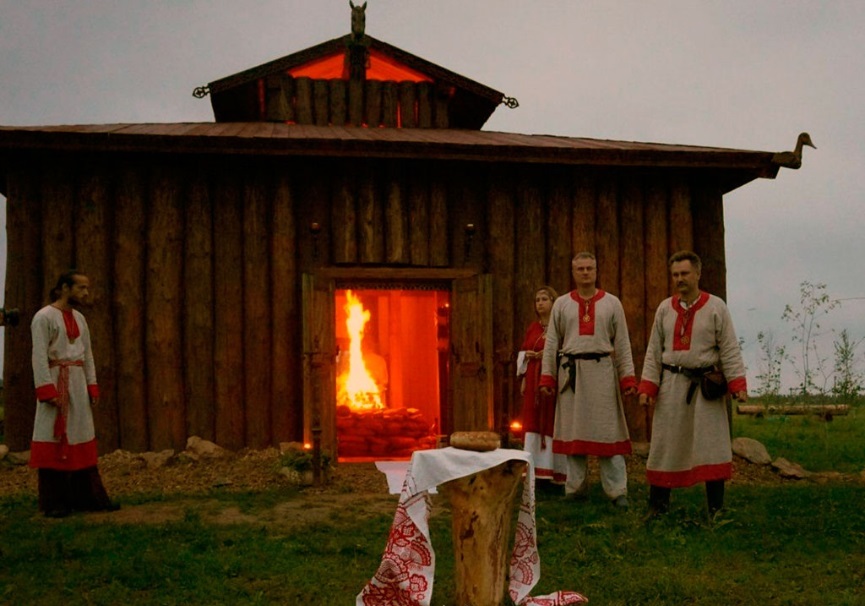
Communities convene outdoors or in dedicated halls to perform rites. Leaders guide participants through invocations directed at specific deities. Libations flow onto the ground or into fire pits. Offerings of food and crafted items rest on altars. Dancers move in coordinated patterns around sacred spaces. Groups conclude gatherings with shared meals that reinforce social bonds. The structure prioritizes collective participation over individual instruction.
Tools and materials
Practitioners rely on natural materials and seasonal produce for rituals. Fire serves as a central element in many temples and outdoor gatherings. Written texts provide theological reference points. The Book of Veles appears frequently in discussions, though scholars identify it as a later composition. Folk artifacts and carved symbols mark ceremonial areas. Each item represents connections to ancestral lineages and cosmic order.
Slavic Native Faith, drawn and placed
- Living
- Revived
- Fading
- Historical
- Legendary
- Performed
- Lineage
- Modern Slavic paganism and ethnic religion
- Timing
- seasonal festivals and Perun Day
What it is for
Followers seek to strengthen ethnic identity and reconnect with pre-Christian heritage. The path aims to foster tight community bonds among participants. Many members oppose perceived foreign ideological dominance, labeling monotheistic systems as restrictive. The tradition emphasizes collective welfare above personal freedom. Participants believe the movement will play a significant role in shaping future cultural landscapes.
Who does it
Urban intellectuals and rural residents both participate in organized groups. Charismatic leaders founded early branches and continue to influence direction. Training varies widely across different organizations. Some groups operate patriarchal structures with conservative views on gender roles. Priests lead ceremonies while lay members assist with preparations. Scholars document the movement without participating in rituals.
Peoples and places
The tradition centers on Slavic populations across Eastern and Central Europe. Russian, Ukrainian, and Polish communities maintain distinct local practices. Diaspora groups in North America and Western Europe adapt rituals to new environments. Regional variations emerge based on available folklore and historical records. Each branch develops unique theological emphases while sharing core vocabulary.
At a glance: who, where and when
Peoples
Occasions


What people believe
A supreme creator deity, often named Rod or Svarog, stands at the center of cosmology. This figure births secondary gods who shape the earth and sky. Nature spirits and honored ancestors share worship spaces with these deities. The concept of dvoeverie links modern practice to medieval folk survival alongside Christianization. Followers argue that pre-Christian customs persisted quietly within everyday life. Some groups incorporate foreign theological models, including trinity frameworks and creator hierarchies.
When it is done
Seasonal cycles and agricultural markers guide ritual timing. Specific holy days align with astronomical events and weather shifts. Perun Day receives dedicated celebration in several regions. Life transitions and community gatherings often coincide with natural rhythms. Festivals occur throughout the year to honor different deities and ancestral figures.
How scholars and sceptics see it
Researchers classify the movement as a new religious movement and an umbrella term for diverse practices. Some analysts describe it as an invented tradition crafted by urban intellectuals using fragmented historical records. Others note the synthesis of folklore, Christian remnants, and foreign spiritual concepts. Sociologists observe that Soviet scientific atheism weakened universal religious infrastructure, creating space for revival. Historians trace intellectual foundations to romantic era scholarship and anti-western sentiment.
Cautions and what is closed
Certain factions promote nationalist and exclusionary ideologies that conflict with broader ethical standards. Scholars warn against treating reconstructed theology as verified ancient history. The movement faces legal scrutiny in regions where extremist rhetoric overlaps with religious expression. Practitioners sometimes dispute academic findings regarding textual authenticity. Closed knowledge remains restricted to initiated members in select organizations.
Compare and confuse
The tradition shares structural similarities with Baltic and Germanic revival movements. It differs from Western paganism through stronger emphasis on Slavic ethnicity and anti-monotheistic framing. Some branches adopt terminology borrowed from Hinduism and Buddhist philosophy. The label ethnic religion distinguishes it from universalist paths. Researchers note parallels with other post-colonial spiritual revivals worldwide.
Law and persecution
Legal recognition varies by national jurisdiction. Some states register the movement as a legitimate religious organization. Others monitor it for political extremism or hate speech violations. Historical suppression occurred under communist regimes that favored state atheism. Post-Soviet legislation enabled formal registration and public ceremonies. Contemporary debates focus on balancing religious freedom with civic responsibility.
Today
Digital networks facilitate communication among dispersed communities. Academic institutions publish regular studies on theological development and social impact. Commercial adaptations appear alongside traditionalist circles seeking historical accuracy. Diaspora groups continue to adapt rituals for Western contexts while maintaining core frameworks. The movement attracts new members through online forums and cultural festivals.
Questions people ask about Slavic Native Faith
What does the name mean?
The term combines Proto-Slavic roots for indigenous or ancestral lineage with a word for faith. Followers use it to describe a path centered on native heritage and spiritual continuity.
Where did the movement begin?
Organized practice emerged in Poland and Ukraine during the nineteen thirties and forties. Intellectual foundations developed earlier through romantic era celebrations of pre-Christian customs.
How do followers view ancient Slavic religion?
Many see their practice as a continuation of pre-Christian traditions preserved through folk customs. They point to medieval double belief as evidence that older practices survived alongside Christianization.
Is the tradition uniform across regions?
No. Different branches develop unique theological emphases based on local folklore and historical records. Some emphasize ethnic purity while others welcome foreign spiritual concepts.
Good reading and sources
- Slavic Native Faith on WikipediaEncyclopedia
- More photos on Wikimedia CommonsPhotos and video
- Wikidata recordOpen data
The facts on this page come from the Wikipedia article "Slavic Native Faith", written by its contributors and used under the CC BY-SA 4.0 licence, and from its Wikidata record (CC0). EveryJaadu rewrote the text in its own words, with AI assistance, and compares every page with the article to make sure no passage is copied. It may be reused under the same CC BY-SA 4.0 licence with a link back.
It may contain mistakes. Names and customs differ from one community to the next, and some knowledge is closed to outsiders and left out here. This page describes belief and practice. It does not say that any of it works, it is not a how-to, and it is not medical advice. If something is wrong, tell us. Last refreshed 2026-10-06.
More from Russia
All the entries from Russia 🇷🇺 Russia and 2 moreCaul
A birth membrane kept as a talisman for luck and protection from drowningCharm · Protection · Luck and prosperity Historical
🇷🇺 RussiaSlavic folklore
The traditional beliefs and stories of the Slavic peoplesTradition Living
🇷🇺 Russia and 2 moreCaul
A birth membrane kept as a talisman for luck and protection from drowningCharm · Protection · Luck and prosperity Historical
🇷🇺 RussiaSlavic folklore
The traditional beliefs and stories of the Slavic peoplesTradition Living
 🇷🇺 RussiaBlack magic
Magic traditionally defined by malevolent intent and selfish purposesBelief · Cursing and harm Historical
🇷🇺 RussiaBlack magic
Magic traditionally defined by malevolent intent and selfish purposesBelief · Cursing and harm Historical
 🇷🇺 Russia and 4 moreLady MiddayPoludnitsa
A Slavic noon spirit who watches over fields and punishes those who work during the hottest hours.Being · Cursing and harm · Protection Historical
🇷🇺 Russia and 4 moreLady MiddayPoludnitsa
A Slavic noon spirit who watches over fields and punishes those who work during the hottest hours.Being · Cursing and harm · Protection Historical
Related elsewhere
All tradition 🇸🇳 Senegal and 5 moreMaraboutmurābiṭ
A Muslim religious leader and teacher in West Africa, often linked to Sufi brotherhoods.Tradition · Protection · Speaking with spirits and the dead Living
🇵🇾 Paraguay and 3 moreGuarani mythology
The oral traditions of the Tupi-Guarani peoples regarding gods, spirits and creationTradition · Speaking with spirits and the dead · Power and authority Living
🇸🇳 Senegal and 5 moreMaraboutmurābiṭ
A Muslim religious leader and teacher in West Africa, often linked to Sufi brotherhoods.Tradition · Protection · Speaking with spirits and the dead Living
🇵🇾 Paraguay and 3 moreGuarani mythology
The oral traditions of the Tupi-Guarani peoples regarding gods, spirits and creationTradition · Speaking with spirits and the dead · Power and authority Living
 🇮🇳 India and 2 moreHomaहोम
A fire ritual found across Asian religions where offerings are burned as a votive exchange with the divine.Rite · Protection · Speaking with spirits and the dead Living
🇮🇳 India and 2 moreHomaहोम
A fire ritual found across Asian religions where offerings are burned as a votive exchange with the divine.Rite · Protection · Speaking with spirits and the dead Living
 🇺🇸 United States and 1 moreMedicine wheel
Circular stone formations built by Indigenous peoples of North America for ceremony and astronomy.Tradition · Speaking with spirits and the dead · Power and authority Living
🇺🇸 United States and 1 moreMedicine wheel
Circular stone formations built by Indigenous peoples of North America for ceremony and astronomy.Tradition · Speaking with spirits and the dead · Power and authority Living