Villain hitting
In its own language: 打小人
A Cantonese rite that strikes paper effigies with a shoe to ward off enemies
Villain hitting is folk sorcery as kept by Cantonese communities, found in Hong Kong and also in Guangdong, in mainland China. A paper figure standing for an enemy is struck, most often with a shoe, in the belief that the act curses, drives off or neutralises that person.
- Villain hitting is folk sorcery of Cantonese communities in Hong Kong and Guangdong.
- A paper figure standing for an enemy is beaten, most often with a shoe.
- Jingzhe, the Awakening of Insects solar term, is held to be the most auspicious date.
- On Jingzhe a yellow paper tiger stands for Baihu and is fed pork soaked in pig's blood.
- Hong Kong's Home Affairs Bureau gave it preliminary intangible cultural heritage status.
What it is
Villain hitting is a form of folk sorcery among Cantonese communities. A client asks for it when a rival, a colleague or a widely disliked public figure is thought to be harming their interests or fortunes. The practitioner makes a paper figure standing for that person, sometimes adding a name, a photograph or an item of clothing, and strikes it, most often with a shoe. The act is believed to curse, drive away or otherwise neutralise the enemy. Offerings are made to deities and spirits, a paper tiger is fed, and two wooden blocks are cast to check whether the rite has gone through.
Where it comes from
The practice is usually traced to farming customs in Guangdong. In the Chinese calendar the year divides into twenty-four solar terms, and one of them, the spring Awakening of Insects, marks animals stirring again after winter. Farmers once fed the feared White Tiger by smearing pig's blood on paper tigers, an offering that stood in for food. In time the tiger, an outside danger, gave way to the villain as the figure to be expelled and symbolically punished, and that socially disruptive person became the main target.
How it is done
A rite begins with a request from a client. Paper figures in human shape are made, with details of the intended person attached when one is named. The figure is beaten, usually with a shoe, while incense and candles are offered to deities. Eight stages are commonly described: offerings to the gods, a report, the striking, a feeding of the paper tiger, a reconciliation, prayers for help from benefactors, the burning of paper wealth, and a casting of two crescent-shaped wooden blocks. Those blocks are read to see whether the work is complete.
Tools and materials
The rite works mainly with paper. There are effigies shaped like people, sometimes marked with the target's name, birth date, photograph or clothing. A fulu, a written charm, carries the client's own name and date of birth. A red sheet names the Gui Ren, the benefactors who may lend help, and paper goods stand for wealth given to the spirits. A shoe or incense sticks are used for the striking. On Jingzhe a yellow paper tiger represents Baihu and is fed pork soaked in pig's blood. Two crescent-shaped wooden blocks are cast at the close.
Villain hitting, drawn and placed
- Living
- Revived
- Fading
- Historical
- Legendary
- Performed
- Lineage
- Cantonese folk sorcery
- Timing
- at Jingzhe, the spring solar term, and whenever a client asks
What it is for
People come to villain hitting over a rival, a workplace adversary or a public figure they dislike, and the aim is to curse, drive off or otherwise neutralise that person. On Jingzhe it is also sought as protection in advance, a way of heading off trouble in relationships and daily affairs before it begins. Benefactors, the Gui Ren, are invited to lend their help, so the rite looks two ways at once: holding harm away and drawing support in. Its language is harm and protection, and those who use it treat the outcome as a matter of belief.
Who does it
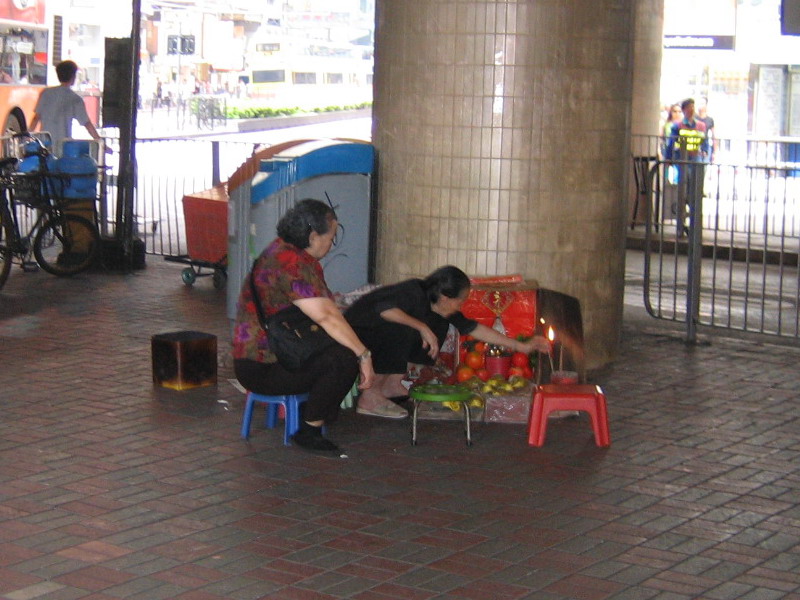
Villain hitting is often described as a modest, quasi-informal occupation, and those who take it up are mostly elderly women. They work at shrines beside roads or under flyovers, where clients come with a request. Alongside them stand the commercial do-it-yourself kits, which let a person carry out the rite without hiring anyone. So the work can be done by a paid specialist at a roadside shrine or by the client alone.
Peoples and places
Cantonese communities are the ones who keep the practice. It is found in Hong Kong, where it is well known, and in Guangdong, in mainland China. Hong Kong is where most of the described activity happens: the shrines, the practitioners, and the flyover site that draws people on Jingzhe. The Home Affairs Bureau has given it a preliminary place on the territory's list of intangible cultural heritage.
At a glance: who, where and when
Peoples
Belief worlds
Occasions


What people believe
Behind the rite lies traditional Chinese cosmology, which works with pairs of opposing forces. Human relations are read the same way: villains, the petty people, stand against the Gui Ren, the benefactors who help. That pairing is often understood through yin and yang. The solar term Jingzhe belongs to this picture as well. In folklore, spring thunder wakes creatures that slept through winter, and the White Tiger and human villains are held to grow active with them, which is why the date is thought to give protection before trouble arrives.
When it is done
The Chinese calendar splits the year into twenty-four solar terms, and the one called Jingzhe, spring's Awakening of Insects, is widely held to be the most auspicious moment for villain hitting. Folklore says thunder then rouses animals from winter sleep, and that harmful forces, among them the White Tiger and human villains, stir as well. Rites are also carried out at other times, whenever a client brings a request.
Compare and confuse
The practice carries more than one name. In Cantonese it is da siu yan, written 打小人. English texts also call it demon exorcising or petty person beating, while villain hitting is the name most used. It is usually grouped with Lingnan culture and with Chinese ideas about the spiritual world.
Today
The rite is still practised. Hong Kong's Home Affairs Bureau has given it a preliminary listing as intangible cultural heritage, and TIME magazine picked it out in its 2009 Best of Asia feature. At the Canal Road Flyover in Hong Kong, and at other shrines under flyovers and beside roads, elderly women take requests, especially around Jingzhe. Commercial kits let people perform it themselves at home, a sign of how far the practice has moved beyond the paid specialist.
Questions people ask about Villain hitting
What is villain hitting?
It is a folk sorcery of Cantonese communities. A practitioner strikes a paper figure that stands for an enemy, most often with a shoe, in the belief that the act curses, drives away or neutralises that person.
Where does the practice come from?
Its origins are traced to farming customs in Guangdong. Farmers once smeared pig's blood on paper tigers to feed the feared White Tiger. In time the socially disruptive villain took the tiger's place as the target of symbolic punishment.
When is it carried out?
Jingzhe, the spring solar term known as the Awakening of Insects, is widely held to be the most auspicious date. Thunder is said to wake hibernating creatures then, and malevolent forces, the White Tiger among them, are believed to grow active.
Who performs it?
Most often elderly women, who take it up as a modest, quasi-informal occupation at shrines beside roads or under flyovers. Clients come to them with a request. Commercial kits also let a person carry out the rite alone.
Is it officially recognised?
Hong Kong's Home Affairs Bureau has placed it provisionally on the territory's list of intangible cultural heritage, and TIME magazine featured it in its 2009 Best of Asia selection.
Good reading and sources
- Villain hitting on WikipediaEncyclopedia
- More photos on Wikimedia CommonsPhotos and video
- Wikidata recordOpen data
The facts on this page come from the Wikipedia article "Villain hitting", written by its contributors and used under the CC BY-SA 4.0 licence, and from its Wikidata record (CC0). EveryJaadu rewrote the text in its own words, with AI assistance, and compares every page with the article to make sure no passage is copied. It may be reused under the same CC BY-SA 4.0 licence with a link back.
It may contain mistakes. Names and customs differ from one community to the next, and some knowledge is closed to outsiders and left out here. This page describes belief and practice. It does not say that any of it works, it is not a how-to, and it is not medical advice. If something is wrong, tell us. Last refreshed 2026-10-16.
More from China
All the entries from China 🇨🇳 China and 5 moreGhost FestivalZhongyuan Festival; Yulanpen Festival
A festival to feed wandering spirits and guide them home during the seventh lunar month.Tradition · Speaking with spirits and the dead · Protection Living
🇨🇳 China and 5 moreGhost FestivalZhongyuan Festival; Yulanpen Festival
A festival to feed wandering spirits and guide them home during the seventh lunar month.Tradition · Speaking with spirits and the dead · Protection Living
 🇨🇳 China and 5 moreJoss paper金紙
Paper burned as money and goods for ancestors, gods and the deadCharm · Speaking with spirits and the dead · Luck and prosperity Living
🇨🇳 China and 5 moreJoss paper金紙
Paper burned as money and goods for ancestors, gods and the deadCharm · Speaking with spirits and the dead · Luck and prosperity Living
 🇨🇳 ChinaChinese alchemy煉丹術
A Taoist pursuit of longevity through elixirs and internal cultivationTradition · Healing · Speaking with spirits and the dead Historical
🇨🇳 ChinaChinese alchemy煉丹術
A Taoist pursuit of longevity through elixirs and internal cultivationTradition · Healing · Speaking with spirits and the dead Historical
 🇨🇳 China and 1 moreAncestor veneration in China中國傳統宗法性宗教
Rites for dead kin who are thought to watch over the familyTradition · Protection · Speaking with spirits and the dead Living
🇨🇳 China and 1 moreAncestor veneration in China中國傳統宗法性宗教
Rites for dead kin who are thought to watch over the familyTradition · Protection · Speaking with spirits and the dead Living
Related elsewhere
All tradition 🇪🇬 EgyptCurse
A spoken wish for harm, often backed by ritual or divine authorityBelief · Cursing and harm · Protection Historical
🇪🇬 EgyptCurse
A spoken wish for harm, often backed by ritual or divine authorityBelief · Cursing and harm · Protection Historical
 🇹🇷 Turkey and 5 moreEvil eye
A curse caused by an envious look and the charms used to block itBelief · Protection · Cursing and harm Living
🇹🇷 Turkey and 5 moreEvil eye
A curse caused by an envious look and the charms used to block itBelief · Protection · Cursing and harm Living
 🇫🇷 FranceLady of the LakeDame du Lac
A water spirit who raises knights and captures wizards in Arthurian talesFigure · Protection · Cursing and harm Legendary
🇫🇷 FranceLady of the LakeDame du Lac
A water spirit who raises knights and captures wizards in Arthurian talesFigure · Protection · Cursing and harm Legendary
 🇮🇪 IrelandPúca
A shape-shifting spirit of Celtic folklore that brings fortune or mischiefBeing · Luck and prosperity · Cursing and harm Legendary
🇮🇪 IrelandPúca
A shape-shifting spirit of Celtic folklore that brings fortune or mischiefBeing · Luck and prosperity · Cursing and harm Legendary