
Chinese alchemy
In its own language: 煉丹術
from liandan, meaning method for refining cinnabar
A Taoist pursuit of longevity through elixirs and internal cultivation
Chinese alchemy is a historical system within Taoism focused on achieving immortality and spiritual harmony. Practitioners used external chemical processes or internal meditative techniques to refine the body and mind.
- Focuses on longevity and spiritual purification within Taoism
- Uses waidan (external) and neidan (internal) methods
- Cinnabar and mercury are central to external alchemy
- Rooted in yin-yang and five agents cosmology
- Often led to poisoning from toxic metal ingestion
What it is
Chinese alchemy represents a historical approach to spiritual and physical refinement rooted in Taoism. The practice centers on the belief that aligning with cosmic forces can extend life and purify the spirit. Two main paths exist: waidan, which involves creating chemical elixirs from minerals like cinnabar and gold; and neidan, which uses meditation and breathing to cultivate internal energy. Both methods aim to achieve immortality or a higher state of being by harmonizing the body with the five agents of change.
Where it comes from
Scholars disagree on when Chinese alchemy began. Some suggest it existed before Confucius, while others note that gold was unknown in China until the fifth century BCE. Traditions often credit Laozi and Zhang Daoling with founding the practice after they sought to create an Elixir of Life. Historical records mention Emperor Qin Shi Huang’s interest in alchemical substances and edicts against counterfeit gold production during the Han dynasty, indicating early active experimentation.
How it is done
Practitioners followed two distinct paths. Waidan involved building laboratories, kindling special fires, and preparing elixirs from metals and herbs. This required strict rules of seclusion and purification. Neidan focused on internal processes, using breathing exercises, visualization, and bodily postures to manipulate the three treasures of the body: jing, qi, and shen. These techniques aimed to preserve life essence and improve energy flow without external chemicals.
Tools and materials
Key materials included cinnabar, mercury, gold, lead, and arsenic. Cinnabar was prized for its red color, symbolizing sun, fire, and vitality. Its ability to be roasted into liquid mercury and back again represented the balance of yin and yang. Other ingredients involved natural herbs and animal products like rhinoceros horn, believed to enhance fertility. The preparation process often required specific dietary regimens and ceremonial protections.
Chinese alchemy, drawn and placed
- Living
- Revived
- Fading
- Historical
- Legendary
- Performed
- Lineage
- Taoism
- Timing
- during periods of seclusion and purification
What it is for
The primary goal was achieving immortality or extreme longevity through ingested elixirs or internal cultivation. Practitioners believed that consuming refined substances transferred their enduring qualities to the body. Beyond physical health, the practice sought wisdom and spiritual alignment with the Tao. It was also intended to protect the self and maintain harmony with cosmic cycles, ensuring both mental clarity and physical resilience.
Who does it
Alchemists were typically Taoist monks or scholars who underwent rigorous training. They followed strict codes of conduct, including periods of seclusion and purification rituals. The practice required deep knowledge of mineralogy, herbal medicine, and cosmological theory. While some texts suggest gender-specific roles, the tradition generally emphasized individual discipline and mastery over natural elements rather than social status.
Peoples and places
The tradition is primarily associated with Taoist communities in China. It differs from Western alchemy in its consistent focus on medicinal and spiritual goals rather than transmuting base metals into wealth. Chinese practitioners accepted mineral remedies alongside herbal ones, avoiding the conflicts seen in Europe between chemical and herbal factions. The practice remained relatively unified in its core doctrines despite variations in specific elixir recipes.
At a glance: who, where and when


What people believe
Chinese alchemy operates within a worldview defined by yin-yang dynamics and the five agents: water, fire, earth, metal, and wood. These elements are seen as interchangeable and cyclical. Metals were categorized by gender, with mercury and sulphur linked to lunar and solar powers respectively. The universe was viewed as a web of interconnected forces, where manipulating one part could influence the whole, allowing humans to participate in cosmic transformation.
When it is done
Practices were often conducted during periods of personal seclusion or ritual purity rather than fixed annual events. The timing of experiments might have aligned with seasonal changes or astrological signs, but no specific holy days are recorded in the provided text.
How scholars and sceptics see it
Historians and sinologists study Chinese alchemy to understand its role in Taoist philosophy and early science. Research highlights its contributions to medicine and chemistry, though debates continue regarding its origins and exact timeline. Scholars note that unlike Western alchemy, which faded after losing practical appeal, Chinese alchemy persisted longer due to its integration with traditional medicine and spiritual life.
Cautions and what is closed
Ingesting alchemical elixirs posed significant health risks due to toxic substances like mercury, lead, and arsenic. Many practitioners suffered poisoning or death from these preparations. The practice also faced legal scrutiny, with emperors issuing edicts against counterfeit gold production. Despite these dangers, the pursuit of immortality drove continued experimentation, often blurring the line between healing and harm.
Compare and confuse
Chinese alchemy shares similarities with Western alchemy in seeking immortality and transmutation. However, it diverges in its theological basis, relying on yin-yang and five agents rather than European elemental theories. While Western alchemists often struggled with conflicts between medicinal and metallurgical goals, Chinese practitioners maintained a more unified focus on health and spiritual elevation, integrating alchemy deeply into Taoist doctrine.
Questions people ask about Chinese alchemy
What is Chinese alchemy?
It is a historical Taoist practice aimed at achieving immortality and spiritual harmony. It involves either external chemical processes or internal meditative techniques to refine the body and mind.
Where did it originate?
It originated in China, deeply connected to Taoist philosophy. Traditions often credit figures like Laozi and Zhang Daoling with establishing its foundational principles.
What are the main methods?
The two main methods are waidan, which creates chemical elixirs from minerals, and neidan, which uses meditation and breathing to cultivate internal energy and balance.
What substances were used?
Common substances included cinnabar, mercury, gold, lead, and arsenic. These were believed to transfer their enduring qualities to the practitioner, promoting longevity.
Good reading and sources
The facts on this page come from the Wikipedia article "Chinese alchemy", written by its contributors and used under the CC BY-SA 4.0 licence, and from its Wikidata record (CC0). EveryJaadu rewrote the text in its own words, with AI assistance, and compares every page with the article to make sure no passage is copied. It may be reused under the same CC BY-SA 4.0 licence with a link back.
It may contain mistakes. Names and customs differ from one community to the next, and some knowledge is closed to outsiders and left out here. This page describes belief and practice. It does not say that any of it works, it is not a how-to, and it is not medical advice. If something is wrong, tell us. Last refreshed 2026-10-05.
More from China
All the entries from China 🇨🇳 China and 1 moreAncestor veneration in China中國傳統宗法性宗教
Rites for dead kin who are thought to watch over the familyTradition · Protection · Speaking with spirits and the dead Living
🇨🇳 China and 1 moreAncestor veneration in China中國傳統宗法性宗教
Rites for dead kin who are thought to watch over the familyTradition · Protection · Speaking with spirits and the dead Living
 🇲🇳 Mongolia and 1 moreTsagaan SarЦагаан сар
A Mongol lunisolar new year marked by white clothes and dairy feastsTradition · Luck and prosperity · Speaking with spirits and the dead Living
🇲🇳 Mongolia and 1 moreTsagaan SarЦагаан сар
A Mongol lunisolar new year marked by white clothes and dairy feastsTradition · Luck and prosperity · Speaking with spirits and the dead Living
 🇨🇳 China and 5 moreGhost FestivalZhongyuan Festival; Yulanpen Festival
A festival to feed wandering spirits and guide them home during the seventh lunar month.Tradition · Speaking with spirits and the dead · Protection Living
🇨🇳 China and 5 moreGhost FestivalZhongyuan Festival; Yulanpen Festival
A festival to feed wandering spirits and guide them home during the seventh lunar month.Tradition · Speaking with spirits and the dead · Protection Living
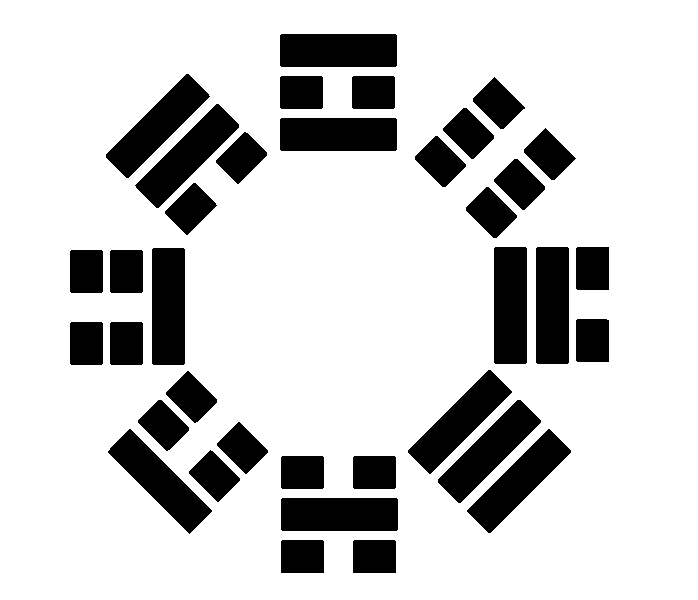 🇨🇳 China and 1 moreBagua八卦
A set of eight trigram symbols from China used in divination, cosmology, and feng shui.Tradition · Seeing and foretelling · Protection Living
🇨🇳 China and 1 moreBagua八卦
A set of eight trigram symbols from China used in divination, cosmology, and feng shui.Tradition · Seeing and foretelling · Protection Living
Related elsewhere
All tradition 🇰🇪 Kenya and 1 moreMaasai religion
The spiritual beliefs of the semi-nomadic Maasai people of East AfricaTradition · Protection · Healing Living
🇰🇪 Kenya and 1 moreMaasai religion
The spiritual beliefs of the semi-nomadic Maasai people of East AfricaTradition · Protection · Healing Living
 🇮🇶 Iraq and 5 moreGrimoire
A textbook containing instructions for spells, rituals, and the creation of magical objects.Text · Protection · Healing Historical
🇮🇶 Iraq and 5 moreGrimoire
A textbook containing instructions for spells, rituals, and the creation of magical objects.Text · Protection · Healing Historical
 🇸🇳 Senegal and 1 moreSerer religionA ƭat Roog
The traditional faith of the Serer people, centred on the supreme deity Roog and ancestral veneration.Tradition · Protection · Speaking with spirits and the dead Living
🇸🇳 Senegal and 1 moreSerer religionA ƭat Roog
The traditional faith of the Serer people, centred on the supreme deity Roog and ancestral veneration.Tradition · Protection · Speaking with spirits and the dead Living
 🇪🇪 Estonia and 5 moreSoul dualism
A belief that a person contains two or more distinct kinds of soulsBelief · Healing · Speaking with spirits and the dead Historical
🇪🇪 Estonia and 5 moreSoul dualism
A belief that a person contains two or more distinct kinds of soulsBelief · Healing · Speaking with spirits and the dead Historical