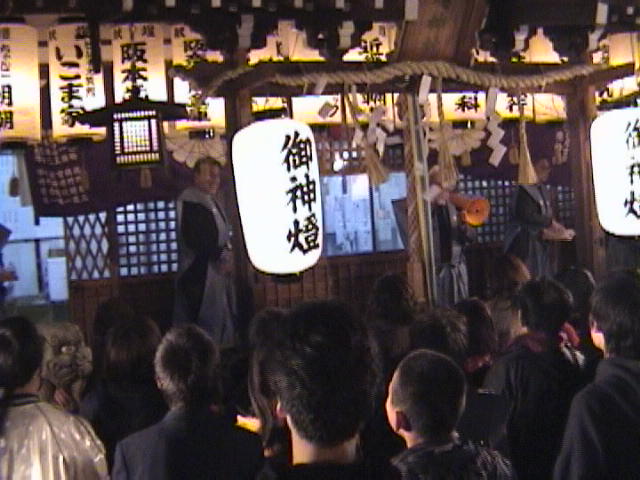
Setsubun
In its own language: 節分
from the Japanese word for 'seasonal division'
A Japanese seasonal rite to drive away bad luck and welcome spring with roasted beans
Setsubun marks the day before spring begins in Japan's traditional calendar. Families throw roasted soybeans to clear out evil spirits and eat lucky sushi rolls to invite prosperity for the coming year.
- Families throw roasted soybeans to drive away evil spirits
- The date falls between February 2 and 4 each year
- People eat uncut sushi rolls facing the lucky direction
- Holly branches with sardine heads guard home entrances
- The ritual originated from an ancient Chinese court ceremony
What it is
Setsubun is a seasonal marker in Japan that falls just before the start of spring. The name translates directly to seasonal division. It serves as a spiritual boundary between winter and the warmer months. People perform specific rituals to cleanse their homes of lingering misfortune. The event acts as a protective barrier against negative forces. It is widely observed across the country as a cultural and religious practice. Families gather to ensure good health and fortune for the new season.
Where it comes from
The roots of this celebration trace back to an ancient Chinese custom called tsuina. This ritual arrived in Japan during the eighth century. Originally, it was a court ceremony held at the end of the lunar year. Nobles used clay figures and peach wood to ward off disease. Over time, the practice shifted to the beginning of spring. By the Muromachi period, commoners began throwing beans from their homes. A legend about a monk blinding demons with beans helped shape the modern ritual.
How it is done
The central act involves scattering roasted soybeans. Participants shout phrases like 'Devils out! Fortune in!' while tossing the beans. Some families throw them at a person wearing a demon mask. Others cast them out of the front door. After the cleansing, people eat one bean for each year of their life plus one extra. In some regions, families hang holly branches with roasted sardine heads on their gates. The strong smell and sharp thorns are believed to repel unwanted spirits.
Tools and materials
Roasted soybeans serve as the primary tool for purification. They are often called fortune beans. Holly leaves provide a physical barrier due to their spiky nature. Roasted sardine heads add a potent scent that deters evil. In some households, people wear masks representing oni or demons. These props help visualize the expulsion of bad luck. The combination of food and foliage creates a multi-sensory defense system.
Setsubun, drawn and placed
- Living
- Revived
- Fading
- Historical
- Legendary
- Performed
- Lineage
- Shinto and folk tradition
- Timing
- between February 2 and 4
What it is for
The main goal is to remove bad luck accumulated over the past year. People seek protection from illness and misfortune. Eating specific foods invites prosperity and happiness. The uncut sushi roll known as ehōmaki is consumed in silence. Diners face the lucky direction of the year while eating. This act symbolizes swallowing good fortune whole. The rituals aim to reset the household's spiritual state for spring.
Who does it
Most households participate in the bean-throwing ritual. Often, the male head of the family leads the ceremony. Sometimes, a man born in the current zodiac year takes charge. In temples and shrines, priests and invited guests distribute beans. Celebrities and sumo wrestlers sometimes join large public events. Geisha apprentices may perform dances and toss beans in Kyoto. Families with the surname Watanabe traditionally skip the ritual.
Peoples and places
The practice is deeply embedded in Japanese culture. It is observed nationwide from urban centers to rural villages. Regional variations exist in the foods eaten and chants used. In the Tohoku area, peanuts might replace soybeans. Kansai residents focus heavily on the lucky sushi roll. Aizuwakamatsu has its own unique chant for driving away demons. The celebration unites diverse communities under a shared seasonal theme.
At a glance: who, where and when
Who does it
Peoples
Belief worlds
Occasions


What people believe
The spirit world is thought to be closer to humans during this transition. Wandering spirits can bring harm if not properly addressed. Beans are seen as powerful seeds that carry purifying energy. Demons and oni are real threats that must be physically driven away. The loud shouting and noise confuse and frighten these entities. Good fortune is viewed as something tangible that can be captured and eaten.
When it is done
The date varies slightly each year but usually falls around February third. It marks the final day of winter in the old calendar. The following day is Risshun, the first day of spring. The timing aligns with the solar term of spring's arrival. Families prepare in advance by buying roasted beans and preparing decorations. The event serves as a bridge between the old and new agricultural cycles.
Rites that involve Setsubun
Days linked to Setsubun
Questions people ask about Setsubun
What does Setsubun mean?
The name means seasonal division. It marks the day before spring begins in the traditional Japanese calendar. The event separates winter from the new growing season.
Why do people throw beans?
Beans are thrown to purify the home. The act drives away evil spirits and bad luck from the previous year. Shouting helps scare the demons away from the household.
What is the lucky sushi roll?
It is called ehōmaki. People eat the uncut roll in silence while facing the year's lucky direction. This practice is believed to bring prosperity and happiness.
When is Setsubun celebrated?
It occurs between February 2 and 4. The exact date depends on the solar terms. It always falls on the day before the official start of spring.
Good reading and sources
- Setsubun on WikipediaEncyclopedia
- More photos on Wikimedia CommonsPhotos and video
- Wikidata recordOpen data
The facts on this page come from the Wikipedia article "Setsubun", written by its contributors and used under the CC BY-SA 4.0 licence, and from its Wikidata record (CC0). EveryJaadu rewrote the text in its own words, with AI assistance, and compares every page with the article to make sure no passage is copied. It may be reused under the same CC BY-SA 4.0 licence with a link back.
It may contain mistakes. Names and customs differ from one community to the next, and some knowledge is closed to outsiders and left out here. This page describes belief and practice. It does not say that any of it works, it is not a how-to, and it is not medical advice. If something is wrong, tell us. Last refreshed 2026-10-05.
More from Japan
All the entries from Japan 🇯🇵 Japan and 1 moreMisogi禊
A Shinto rite of full-body purification using cold waterRite · Cleansing and purification · Speaking with spirits and the dead Living
🇯🇵 Japan and 1 moreMisogi禊
A Shinto rite of full-body purification using cold waterRite · Cleansing and purification · Speaking with spirits and the dead Living
 🇨🇳 China and 5 moreGhost FestivalZhongyuan Festival; Yulanpen Festival
A festival to feed wandering spirits and guide them home during the seventh lunar month.Tradition · Speaking with spirits and the dead · Protection Living
🇨🇳 China and 5 moreGhost FestivalZhongyuan Festival; Yulanpen Festival
A festival to feed wandering spirits and guide them home during the seventh lunar month.Tradition · Speaking with spirits and the dead · Protection Living
 🇯🇵 JapanOnmyōdō陰陽道
A Japanese system of divination and calendar science rooted in yin-yang philosophyTradition · Seeing and foretelling · Protection Revived
🇯🇵 JapanOnmyōdō陰陽道
A Japanese system of divination and calendar science rooted in yin-yang philosophyTradition · Seeing and foretelling · Protection Revived
 🇯🇵 JapanShinto shrine神社 (jinja)
A structure housing kami deities within the Shinto tradition of JapanTradition · Protection · Speaking with spirits and the dead Living
🇯🇵 JapanShinto shrine神社 (jinja)
A structure housing kami deities within the Shinto tradition of JapanTradition · Protection · Speaking with spirits and the dead Living
Related elsewhere
All rite 🇧🇪 Belgium and 2 moreHorseshoe
A metal shoe for a horse's hoof and a talisman of good fortuneCharm · Protection · Luck and prosperity Living
🇧🇪 Belgium and 2 moreHorseshoe
A metal shoe for a horse's hoof and a talisman of good fortuneCharm · Protection · Luck and prosperity Living
 🇪🇬 Egypt and 3 moreAmulet
A portable object worn or carried to ward off harm and invite fortuneCharm · Protection · Luck and prosperity Living
🇪🇬 Egypt and 3 moreAmulet
A portable object worn or carried to ward off harm and invite fortuneCharm · Protection · Luck and prosperity Living
 🇬🇧 United Kingdom and 1 moreWell dressing
A rural English custom of decorating water sources with natural designsTradition · Protection · Speaking with spirits and the dead Living
🇬🇧 United Kingdom and 1 moreWell dressing
A rural English custom of decorating water sources with natural designsTradition · Protection · Speaking with spirits and the dead Living
 🇮🇳 India and 5 moreKolamகோலம்
A daily geometric floor drawing made with rice flour at the home entrance in South IndiaTradition · Protection · Luck and prosperity Living
🇮🇳 India and 5 moreKolamகோலம்
A daily geometric floor drawing made with rice flour at the home entrance in South IndiaTradition · Protection · Luck and prosperity Living