Seasonal rites
Setsubun bean-throwing
On the eve of spring, roasted beans are thrown at a masked ogre while the household calls for good luck.
Presented by ClearTrust Customs described as customs, free to read.
Setsubun is the day before the start of spring in the old Japanese calendar, on or about 3 February. At home, shrines and temples, people throw roasted soybeans, fukumame, at an oni, a demon, usually a person in a mask, and call oni wa soto, fuku wa uchi: demons out, luck in. It is an old rite of clearing misfortune from the house at the turn of the season.
This is an outline of a custom, said as belief and practice. It is not instruction, it does not say that the rite works, and it is not medical advice.
What goes into it
- Roasted soybeansPlantFukumame, thrown from a box or bowl.
- Oni maskObjectWorn by the demon.
- Holly and sardine headObjectHung at the door in some regions.
- Call and responseWordOni wa soto, fuku wa uchi.
- Door of the houseSpaceOpened and shut again.
- Eating the beansGestureOne bean for each year of age.
- Plant
- Object
- Word
- Space
- Gesture
Each part has an equal wedge. The ring shows what goes into the rite, not how much. Colour is the part's role.
The steps, drawn
Each drawing shows the kind of act in that step. Details differ from place to place, family to family and practitioner to practitioner.
Step 1: Gather Roast soybeans and set them in a box. Step 2: Speak Call oni wa soto, fuku wa uchi, demons out, luck in. Step 3: Cast Throw the beans out of the open door or at the oni. Step 4: Close Shut the door at once. Step 5: Rest Eat the beans, one for each year of your age.
What is done
At a house, the head of the family or the member born in that year of the zodiac throws the beans out of the door or at the mask, then shuts the door. Afterwards each person eats beans equal to their age, and sometimes one more for the coming year. Sprigs of holly with a sardine head are hung at the door in some regions, and in the Kansai area people eat a long uncut sushi roll, ehomaki, facing the year's lucky direction.
Shrines and today
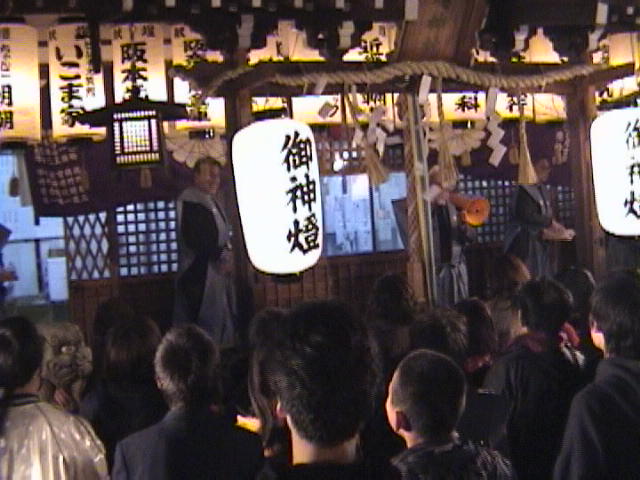
At large shrines the throwing is a public event, with local people and sometimes celebrities throwing beans and sweets from a stage. The custom is linked to the older court ritual of driving out demons at the end of the year and to Chinese roots. Scholars describe it as a seasonal rite of renewal, and families often say that it is mostly an occasion for children.
What it is for
- Drive misfortune from the house
- Welcome the spring
Who does it
Related entries

Also part of it, and being written: Japanese new year (The wider season.).
More on EveryJaadu
No entries here yet. New pages are added every day.
Sources and further reading
Original text and drawings by the EveryJaadu desk, written with AI assistance and checked against the sources above. Closed or sacred detail is left out. If we have something wrong, tell us.
Photo credits on this page
The small pictures above come from Wikimedia Commons under free licences. Some are cropped to fit.
- Oni: Katsushika Hokusai 葛飾北斎 (1760-1849), Public domain, source
- Setsubun: Unknown author, CC BY-SA 3.0, source