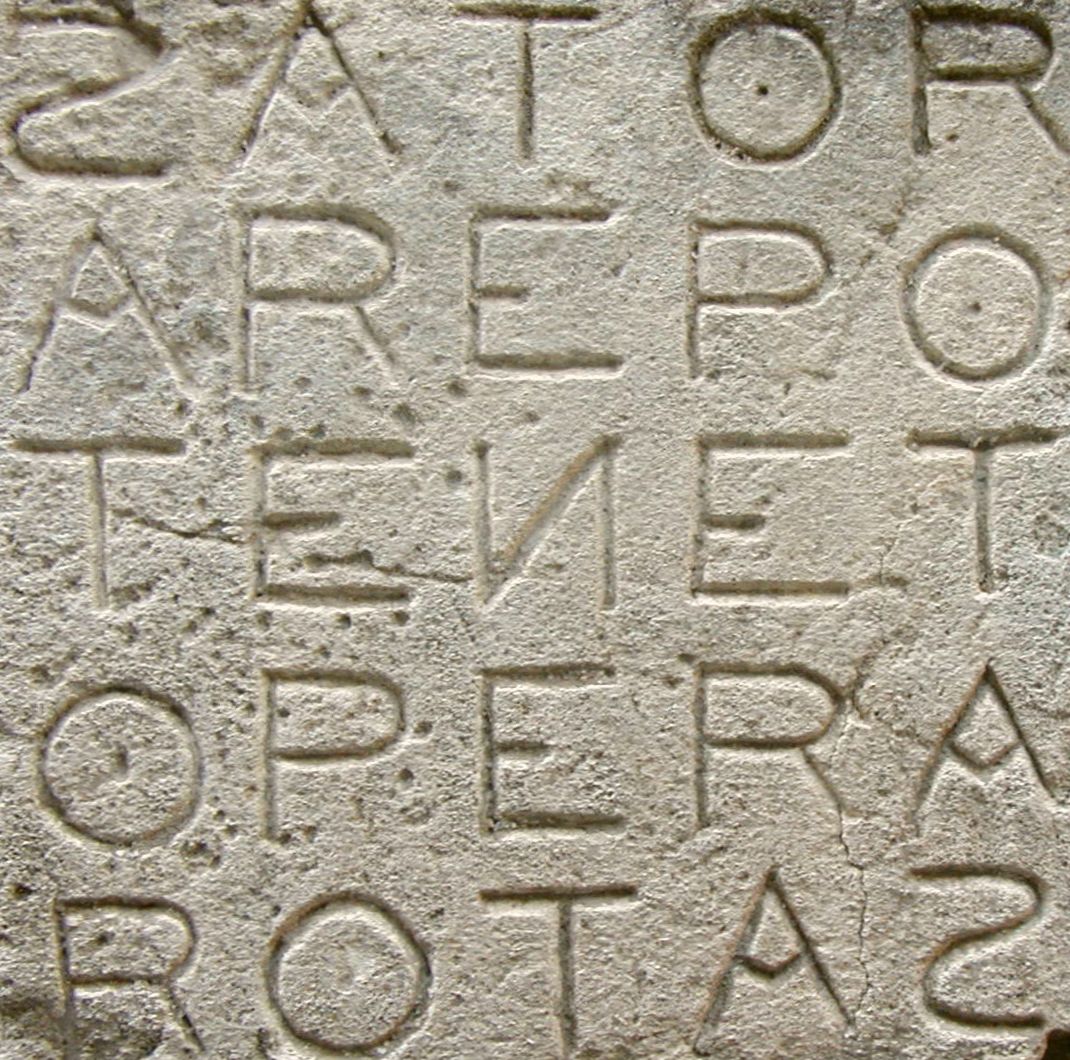
Sator Square
Named after its most common opening word, Sator
A five-word Latin palindrome found in Roman ruins and medieval churches
The Sator Square is a two-dimensional grid of five Latin words arranged to form a perfect palindrome. Earliest examples date to the first century AD in Pompeii. It was used as a magical charm for protection and healing across Europe and North Africa.
- Earliest example found in Pompeii before AD 62
- Contains five Latin words forming a perfect palindrome
- Used in medieval medicine to treat rabies and dog bites
- Believed in Germany to extinguish fires
- Scholars debate whether it originated as a Jewish or Roman puzzle
What it is
The Sator Square is a grid of twenty-five letters forming five Latin words. These words read identically forward and backward, horizontally and vertically. This structure creates a double acrostic that functions as a complete palindrome. The arrangement has been viewed as a magical seal or charm for centuries. Scholars describe it as one of the most famous lettered squares in Western history. Its exact meaning remains debated among researchers today.
Where it comes from
The earliest known examples come from Roman sites like Pompeii, dating before the earthquake of AD 62. These early versions began with the word ROTAS rather than SATOR. By the sixth century, Christian symbols appeared alongside the text. Medieval inscriptions are found across Europe, Asia Minor, and North Africa. Some academics suggest a Jewish origin for the ROTAS form. Others argue it started as a simple Roman word game. The transition to a religious symbol happened gradually over time.
How it is done
The square is typically carved into stone walls or written in manuscripts. It appears in medieval medical books like the Trotula. People believed writing it could cure dog bites and rabies. It was also used to help women during childbirth. In Germany, it was thought to stop fires from spreading. The text itself serves as the active element. No specific ritual actions are required beyond its placement.
Tools and materials
The tool is the text itself, composed of eight unique Latin letters. The words are SATOR, AREPO, TENET, OPERA, and ROTAS. Arepo is a rare word with uncertain origins. The grid uses consonants and vowels to balance the palindrome. Some versions include visible lines separating the words. Others leave the letters floating in space. The physical medium varies from plaster to parchment.
Sator Square, drawn and placed
- Living
- Revived
- Fading
- Historical
- Legendary
- Performed
- Lineage
- Latin word puzzle
- Timing
- Found on walls and medical texts throughout history
What it is for
People used the square for protection against harm. It was believed to ward off fire and disease. Medical practitioners cited it for treating insanity. Parents invoked it for safe delivery of children. The charm offered comfort through its structured symmetry. Believers saw power in the balanced arrangement of letters. It served as a spiritual shield in daily life.
Who does it
Households displayed the square on their walls. Physicians referenced it in their medical textbooks. Scholars have studied its linguistic structure for decades. No specific priestly class is tied to its use. It functioned as a folk remedy and domestic charm. Anyone could write or carve it for protective purposes.
Peoples and places
The square spread from ancient Rome to medieval Europe. It appears in French biblical manuscripts from the ninth century. German traditions linked it to fire prevention. Syrian military offices held early examples. Egyptian Coptic settlements preserved older forms. The text crossed cultural and religious boundaries easily.
At a glance: who, where and when
Peoples
Belief worlds


What people believe
The square sits at the intersection of magic and religion. Words were believed to hold inherent power when combined correctly. Christians adapted it for their own theological purposes. Some see hidden Jewish symbolism in the layout. The palindrome structure suggests cosmic order and balance. It bridges the gap between language and spiritual force.
When it is done
The square does not have a specific festival calendar. It appears in texts related to birth and illness. Medical manuals included it for crisis situations. It was used whenever protection was needed. There are no set dates for its recitation or display.
How scholars and sceptics see it
Academics have published extensive research on the square. No consensus exists on its original meaning. The Paternoster theory once suggested Christian authorship. Archaeological finds in Pompeii challenged this view. Some researchers propose a Jewish origin for the ROTAS form. Linguistic analysis focuses heavily on the word Arepo. Historical context shifts interpretations over time.
Cautions and what is closed
The square is a historical artifact and folk belief. Modern readers should view it as cultural heritage. It has no proven scientific efficacy for healing. Misinterpretations of its anagrams can lead to confusion. Researchers caution against overreading hidden meanings. The charm reflects past anxieties about disease and fire.
Compare and confuse
It is often confused with other magical squares. The Templar Magic Square is another name for it. Word puzzles like the Roma-Amor share structural similarities. Different cultures may adapt the same palindrome concept. The Sator Square stands out for its perfect symmetry.
Rites that involve Sator Square
Questions people ask about Sator Square
What is the Sator Square?
It is a five-by-five grid of Latin words that reads the same forwards and backwards. The words are Sator, Arepo, Tenet, Opera, and Rotas. It functions as a double acrostic and palindrome.
Where did the Sator Square originate?
The oldest known examples come from Roman sites in Italy, specifically Pompeii. They date to the first century AD. The text later spread to Europe, Syria, and Egypt.
What was the square used for?
Historically, it was used as a protective charm. People believed it could cure rabies, aid childbirth, and stop fires. It appeared in medical texts and on household walls.
Who created the Sator Square?
Scholars do not agree on its creator. Some believe Romans made it as a word game. Others suggest early Christians or Jews adapted it for religious purposes. The word Arepo remains unexplained.
Good reading and sources
- Sator Square on WikipediaEncyclopedia
- More photos on Wikimedia CommonsPhotos and video
- Wikidata recordOpen data
The facts on this page come from the Wikipedia article "Sator Square", written by its contributors and used under the CC BY-SA 4.0 licence, and from its Wikidata record (CC0). EveryJaadu rewrote the text in its own words, with AI assistance, and compares every page with the article to make sure no passage is copied. It may be reused under the same CC BY-SA 4.0 licence with a link back.
It may contain mistakes. Names and customs differ from one community to the next, and some knowledge is closed to outsiders and left out here. This page describes belief and practice. It does not say that any of it works, it is not a how-to, and it is not medical advice. If something is wrong, tell us. Last refreshed 2026-10-05.
More from Italy
All the entries from Italy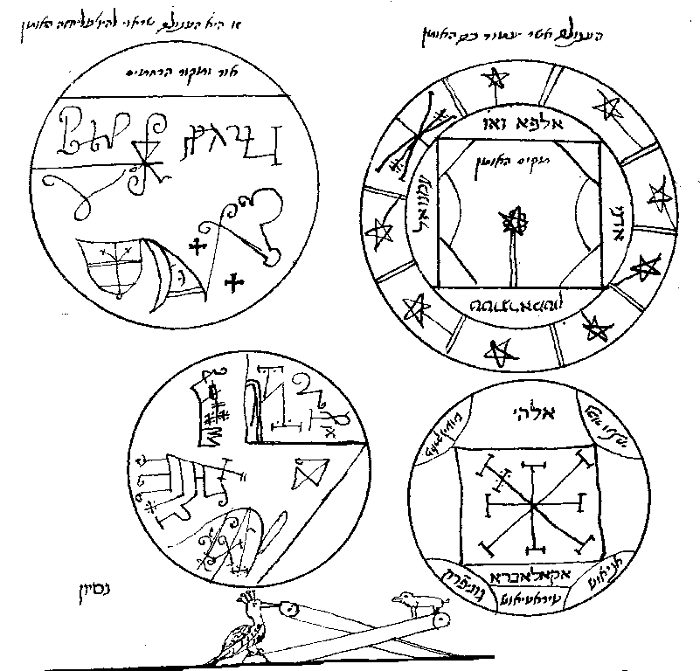 🇮🇹 Italy and 2 moreKey of SolomonClavicula Salomonis
A Renaissance grimoire attributed to King Solomon, detailing ritual preparations and invocations.Text · Cursing and harm · Love and attraction Historical
🇮🇹 Italy and 2 moreKey of SolomonClavicula Salomonis
A Renaissance grimoire attributed to King Solomon, detailing ritual preparations and invocations.Text · Cursing and harm · Love and attraction Historical
 🇮🇹 Italy and 5 moreRelic
An object or body part kept to honor a holy person and mark their connection to the divineCharm · Protection · Healing Living
🇮🇹 Italy and 5 moreRelic
An object or body part kept to honor a holy person and mark their connection to the divineCharm · Protection · Healing Living
 🇫🇷 France and 1 moreNostradamus
A French astrologer and physician known for a book of poetic propheciesText · Seeing and foretelling · Power and authority Historical
🇫🇷 France and 1 moreNostradamus
A French astrologer and physician known for a book of poetic propheciesText · Seeing and foretelling · Power and authority Historical
 🇮🇹 Italy and 5 morePrecious coral
A marine skeleton harvested for jewelry and worn as a protective charm in several culturesSubstance · Protection · Healing Living
🇮🇹 Italy and 5 morePrecious coral
A marine skeleton harvested for jewelry and worn as a protective charm in several culturesSubstance · Protection · Healing Living
Related elsewhere
All charm 🇨🇳 China and 5 moreGuanyin觀音 (Guānyīn)
The Bodhisattva of compassion, worshipped across East Asia as a listener to human sufferingBeing · Protection · Healing Living
🇨🇳 China and 5 moreGuanyin觀音 (Guānyīn)
The Bodhisattva of compassion, worshipped across East Asia as a listener to human sufferingBeing · Protection · Healing Living
 🇹🇭 Thailand and 3 moreThai Buddha amuletsพระเครื่อง (phrakhrueang)
Sacred Buddhist images and relics worn for protection, merit, and fortune in Thailand.Charm · Protection · Luck and prosperity Living
🇹🇭 Thailand and 3 moreThai Buddha amuletsพระเครื่อง (phrakhrueang)
Sacred Buddhist images and relics worn for protection, merit, and fortune in Thailand.Charm · Protection · Luck and prosperity Living
 🇺🇸 United StatesFolk healer
An unlicensed community member who provides healing care using local plants and traditional knowledge.Tradition · Healing · Protection Historical
🇺🇸 United StatesFolk healer
An unlicensed community member who provides healing care using local plants and traditional knowledge.Tradition · Healing · Protection Historical
 🇪🇬 Egypt and 1 moreEye of Horuswḏꜣt
A stylized eye symbol in ancient Egypt representing healing and cosmic orderCharm · Protection · Healing Historical
🇪🇬 Egypt and 1 moreEye of Horuswḏꜣt
A stylized eye symbol in ancient Egypt representing healing and cosmic orderCharm · Protection · Healing Historical