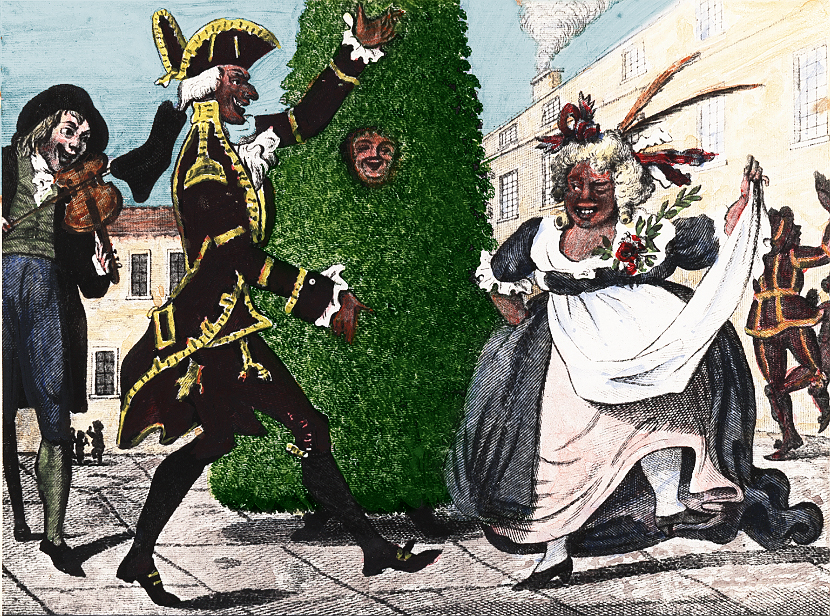
Jack in the Green is an English folk custom featuring a person concealed within a foliage-covered frame. The tradition emerged in the eighteenth century and became closely linked with chimney sweeps by the nineteenth century.
- A person wears a leaf-covered wicker frame in May Day processions
- The custom emerged in England during the eighteenth century
- Chimney sweeps became strongly associated with the figure in the nineteenth century
- Roy Judge's 1979 study disproved theories of ancient pagan origins
- Modern revivals occur in towns like Whitstable and Hastings
What it is
Jack in the Green is a traditional English folk performance centered on a human figure covered in greenery. A participant wears a pyramidal or conical structure made of wicker or wood, which is densely decorated with leaves, branches, and flowers. The wearer stands inside this frame, often with only their feet visible at the base, while looking out through a small opening. This figure leads or joins processions that celebrate the arrival of summer. The practice is recognized as a living folk custom, though its modern form relies on historical records rather than unbroken lineage.
Where it comes from
The custom developed in England during the eighteenth century from earlier May Day practices. In the seventeenth century, milkmaids carried decorated pails or silver plates topped with objects. By the late eighteenth century, these decorations evolved into larger headpieces worn by various workers. The earliest known account dates to a London procession in 1770. Initially associated with multiple trades, the figure became strongly linked to chimney sweeps by the nineteenth century.
Tools and materials
The primary tool is a lightweight frame constructed from wood or wicker. This structure is entirely covered with fresh vegetation, including green branches, leaves, and flowers. The materials create a natural, bush-like appearance. Some modern versions use metal objects or pewter garlands, reflecting historical variations used by different occupational groups.
Jack in the Green, drawn and placed
- Living
- Revived
- Fading
- Historical
- Legendary
- Performed
- Lineage
- English May Day customs
- Timing
- May Day
What it is for
The performance serves to celebrate the coming of summer and the month of May. It functions as a public spectacle that brings communities together through shared ritual and entertainment. While some scholars have interpreted it as a fertility rite, practitioners generally view it as a seasonal festival honoring nature and local history.
Who does it
Historically, the role was filled by members of specific trades, particularly chimney sweeps and milkmaids. Modern revivals involve local volunteers, Morris dancers, and community groups who construct and wear the figures. The practice does not require formal initiation, relying instead on community participation and the preservation of local traditions.
Peoples and places
The custom is distinctly English, originating in London and spreading to towns in the south-east such as Kent. It has been adopted by various occupational groups throughout its history. Today, it survives in specific towns like Whitstable and Hastings, where organized festivals keep the tradition active. It also appears in diaspora communities in North America.
At a glance: who, where and when
Who does it
Peoples
Belief worlds
Occasions


What people believe
Scholars have debated the meaning of the figure. Lady Raglan suggested it represented pre-Christian fertility spirits, linking it to medieval church carvings known as Green Men. However, historians like Roy Judge rejected this theory, arguing that the evidence points to a secular, eighteenth-century origin rooted in trade customs rather than ancient pagan worship.
When it is done
The event takes place annually on May Day. Revival groups schedule parades in early May to coincide with the traditional date. The timing marks the transition into summer, aligning with other seasonal celebrations across Europe.
How scholars and sceptics see it
Folklorists initially accepted theories of ancient pagan origins promoted by Lady Raglan. This view dominated mid-twentieth-century studies. Roy Judge's research in 1979 shifted the consensus toward a documented eighteenth-century development.
Cautions and what is closed
The original processions were sometimes noisy and disorderly, leading to disapproval in the twentieth century. Modern revivals are organized events focused on cultural heritage. There are no significant health risks associated with wearing the foliage, though the frames can be heavy.
Compare and confuse
Jack in the Green is related to other May Day figures like the May Queen and the Green Man. While the Green Man is a static architectural motif, Jack in the Green is a mobile performer. Both share associations with nature and spring, but they differ in form and function.
Law and persecution
The custom faced decline due to social disapproval of rowdy behavior in the early twentieth century. It was not banned but faded from public life until revived by enthusiasts. Today, it is protected as part of England's intangible cultural heritage.
Today
Revival groups maintain the tradition in towns like Rochester, Hastings, and Ilfracombe. New figures are created based on historical illustrations. The practice has also entered Pagan parades and broader folk festivals, adapting to contemporary community needs while preserving its visual identity.
Days linked to Jack in the Green
Questions people ask about Jack in the Green
What is Jack in the Green?
It is an English folk custom where a person wears a tall, leafy framework during May Day processions. The figure represents a celebration of summer and local trade history.
Where did the tradition come from?
It originated in England in the eighteenth century, evolving from earlier May Day practices involving milkmaids and other workers carrying decorated items.
Who performs the Jack in the Green today?
Local community groups, Morris dancers, and revival societies perform the custom in various English towns and occasionally in North American festivals.
Good reading and sources
- Jack in the Green on WikipediaEncyclopedia
- More photos on Wikimedia CommonsPhotos and video
- Wikidata recordOpen data
The facts on this page come from the Wikipedia article "Jack in the Green", written by its contributors and used under the CC BY-SA 4.0 licence, and from its Wikidata record (CC0). EveryJaadu rewrote the text in its own words, with AI assistance, and compares every page with the article to make sure no passage is copied. It may be reused under the same CC BY-SA 4.0 licence with a link back.
It may contain mistakes. Names and customs differ from one community to the next, and some knowledge is closed to outsiders and left out here. This page describes belief and practice. It does not say that any of it works, it is not a how-to, and it is not medical advice. If something is wrong, tell us. Last refreshed 2026-10-05.
More from the United Kingdom
All the entries from the United Kingdom 🇩🇪 Germany and 2 morePhantasmagoria
A horror theatre using magic lanterns to project frightening images in the darkIllusion · Wonder and entertainment Historical
🇩🇪 Germany and 2 morePhantasmagoria
A horror theatre using magic lanterns to project frightening images in the darkIllusion · Wonder and entertainment Historical
 🇬🇧 United Kingdom and 1 moreSawing a woman in half
A stage illusion where an assistant appears to be cut into pieces inside a box or on a tableIllusion · Wonder and entertainment Living
🇬🇧 United Kingdom and 1 moreSawing a woman in half
A stage illusion where an assistant appears to be cut into pieces inside a box or on a tableIllusion · Wonder and entertainment Living
 🇬🇧 United KingdomEgyptian Hall
A London exhibition hall known for magic shows and Egyptian-style architecture, demolished in 1905.Illusion · Wonder and entertainment Historical
🇬🇧 United KingdomEgyptian Hall
A London exhibition hall known for magic shows and Egyptian-style architecture, demolished in 1905.Illusion · Wonder and entertainment Historical
Related elsewhere
All illusion 🇪🇬 Egypt and 1 moreSphinx
A mythical hybrid with a human head and lion body, serving as guardian or riddler in Egyptian and Greek traditions.Being · Protection · Wonder and entertainment Legendary
🇷🇺 Russia and 3 moreNart sagaНарты кадджытæ
A collection of epic tales from the North Caucasus about a legendary group of heroes.Text · Wonder and entertainment Historical
🇨🇱 ChileChilean mythology
The myths and legends of Chile, blending indigenous roots with colonial influences.Tradition · Wonder and entertainment Living
🇪🇬 EgyptDjedi
A fictional magician from the Westcar Papyrus who resurrects animals and foretells a king's lineage.Figure · Seeing and foretelling · Wonder and entertainment Legendary
🇪🇬 Egypt and 1 moreSphinx
A mythical hybrid with a human head and lion body, serving as guardian or riddler in Egyptian and Greek traditions.Being · Protection · Wonder and entertainment Legendary
🇷🇺 Russia and 3 moreNart sagaНарты кадджытæ
A collection of epic tales from the North Caucasus about a legendary group of heroes.Text · Wonder and entertainment Historical
🇨🇱 ChileChilean mythology
The myths and legends of Chile, blending indigenous roots with colonial influences.Tradition · Wonder and entertainment Living
🇪🇬 EgyptDjedi
A fictional magician from the Westcar Papyrus who resurrects animals and foretells a king's lineage.Figure · Seeing and foretelling · Wonder and entertainment Legendary