
Born David Wighton in London, he became a leading figure in British stage magic during the late nineteenth and early twentieth centuries. He is remembered for his humorous style and for founding The Magic Circle.
- Born David Wighton in Holloway, London in 1868
- Partnered with John Nevil Maskelyne at St George's Hall
- First president of The Magic Circle
- Exhibited the first films in the UK in 1896
- Died in 1941 and buried in Highgate Cemetery
What it is
David Devant was a prominent English magician who shaped the art of stage illusion in the late Victorian era and beyond. Born David Wighton in Holloway, London, he adopted the stage name Devant to build his career. He is widely considered one of the most important figures in British magic history. His approach combined technical skill with a light, humorous delivery that distinguished him from the serious, pseudo-scientific tone common among earlier performers. Magicians and historians regard him as a master entertainer whose influence extended well beyond his own performances.
Where it comes from
Devant began his career as part of the famous Maskelyne & Cooke company at the Egyptian Hall in London. In 1893, he started performing alongside John Nevil Maskelyne. Their professional partnership solidified around 1904 when they moved to St George's Hall. This collaboration created a venue known as the House of Magic, which became a central hub for conjurers. The team attracted top talent from across the globe, establishing London as a key centre for magical performance during this period.
Tools and materials
Devant utilized standard conjuring props such as hats, kettles, and moths to create his effects. He was also an early adopter of cinematic technology. He purchased a Theatrograph projector made by R. W. Paul and used it to exhibit films. This device allowed him to showcase moving images to audiences, bridging the gap between live magic and emerging visual media. His use of these tools helped define the modern spectacle of entertainment.
David Devant, drawn and placed
- Living
- Revived
- Fading
- Historical
- Legendary
- Performed
- Lineage
- British conjuring tradition
What it is for
The primary goal of his work was to entertain and amaze audiences through skilled deception. He aimed to delight viewers with wit and charm rather than to claim supernatural powers. Despite presenting a fake psychic act that fooled some observers, including the scientist Oliver Lodge, his intent remained theatrical. He sought to prove that magic could be both intellectually engaging and emotionally satisfying for the public.
Who does it
As a professional performer, Devant trained through years of stage experience and collaboration with peers like Maskelyne. He mentored other magicians, including Max Holden, and influenced many contemporaries. His status was elevated by invitations to perform at Royal Command Performances for King George V. He was respected enough to represent the world of wizardry at court events, marking him as a leading authority in his field.
Peoples and places
Devant was a fixture in British entertainment, particularly in London. His work defined the style of conjuring in the United Kingdom during the turn of the century. While his reputation is strongest in Britain, his influence reached international circles through his writings and the global nature of the magic community. He is celebrated by magicians worldwide for his contributions to the art form.
At a glance: who, where and when
Who does it
Peoples
What people believe
His work did not rely on religious or spiritual beliefs but on the mechanics of illusion. However, his fake clairvoyant act blurred lines for some audience members, leading them to believe in genuine psychic ability. Devant later exposed this method to demonstrate that such feats were tricks. His legacy rests on the understanding that magic is a craft of misdirection and skill, not supernatural power.
When it is done
He performed regularly throughout his career, with peak activity from the 1890s to the 1910s. Key moments included his Royal Command Performance in 1912 and his early film exhibitions in 1896. His retirement in 1920 marked the end of his active stage life due to health issues.
How scholars and sceptics see it
Magic historian Jim Steinmeyer has called him England’s greatest magician. Fellow magicians view him as a consummate exponent of entertaining magical theatre. Critics have occasionally argued that some of his routines prioritized comedy over magical impact. Nevertheless, scholars of magic history recognize his role in elevating the profession and establishing its standards.
Cautions and what is closed
No specific harms or fraud cases are recorded beyond his intentional deception in the fake clairvoyant act, which he later revealed. His work was purely entertainment. He faced no legal persecution or public backlash for his methods, which were accepted as part of the theatrical contract with the audience.
Compare and confuse
Devant is often compared to his partner John Nevil Maskelyne, with whom he shared the stage. His style differed from earlier conjurers who adopted a serious, scientific tone. He is also linked to early film pioneers like Georges Méliès and R. W. Paul, showing the intersection of magic and cinema. His name is associated with The Magic Circle, an organization he helped found.
Law and persecution
He operated within the legal entertainment framework of the time. No laws restricted his performances. He was honoured by the state with Royal Command Performances, indicating official approval and respect for his profession. His burial in Highgate Cemetery reflects his standing in society.
Today
His legacy lives on through The Magic Circle, which named its function room after him and established the David Devant Award. A blue plaque marks his former home in Hampstead. Magicians still study his writings and emulate his style. His name continues to symbolize excellence in the art of stage illusion.
Questions people ask about David Devant
Who was David Devant?
He was a famous English magician born David Wighton in London. He is known for his witty stage style and for helping to found The Magic Circle.
Where did he perform?
He performed at the Egyptian Hall and later at St George's Hall in London with his partner John Nevil Maskelyne.
What was his connection to film?
He was an early film exhibitor who showed the first films in the UK using a Theatrograph projector in 1896.
Why is he important?
He is regarded as one of the greatest British magicians for combining technical skill with humour and for mentoring future performers.
Good reading and sources
- David Devant on WikipediaEncyclopedia
- More photos on Wikimedia CommonsPhotos and video
- Wikidata recordOpen data
The facts on this page come from the Wikipedia article "David Devant", written by its contributors and used under the CC BY-SA 4.0 licence, and from its Wikidata record (CC0). EveryJaadu rewrote the text in its own words, with AI assistance, and compares every page with the article to make sure no passage is copied. It may be reused under the same CC BY-SA 4.0 licence with a link back.
It may contain mistakes. Names and customs differ from one community to the next, and some knowledge is closed to outsiders and left out here. This page describes belief and practice. It does not say that any of it works, it is not a how-to, and it is not medical advice. If something is wrong, tell us. Last refreshed 2026-10-05.
More from the United Kingdom
All the entries from the United Kingdom 🇩🇪 Germany and 2 morePhantasmagoria
A horror theatre using magic lanterns to project frightening images in the darkIllusion · Wonder and entertainment Historical
🇩🇪 Germany and 2 morePhantasmagoria
A horror theatre using magic lanterns to project frightening images in the darkIllusion · Wonder and entertainment Historical
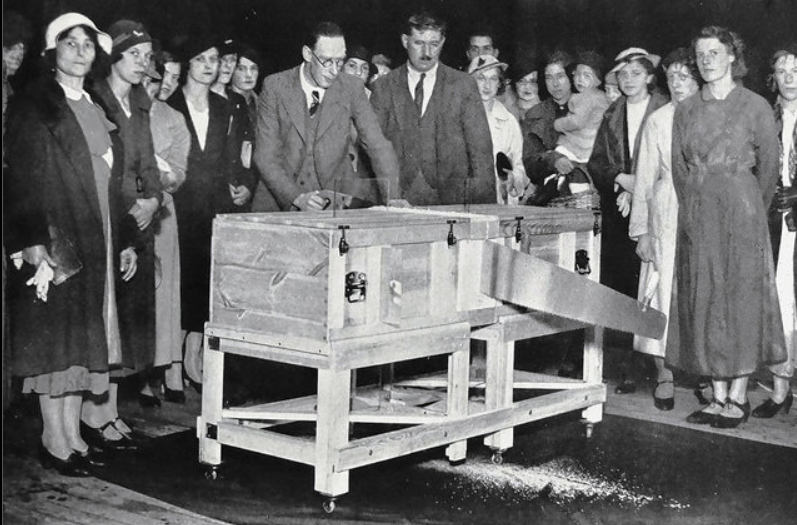 🇬🇧 United Kingdom and 1 moreSawing a woman in half
A stage illusion where an assistant appears to be cut into pieces inside a box or on a tableIllusion · Wonder and entertainment Living
🇬🇧 United Kingdom and 1 moreSawing a woman in half
A stage illusion where an assistant appears to be cut into pieces inside a box or on a tableIllusion · Wonder and entertainment Living
 🇬🇧 United KingdomEgyptian Hall
A London exhibition hall known for magic shows and Egyptian-style architecture, demolished in 1905.Illusion · Wonder and entertainment Historical
🇬🇧 United KingdomEgyptian Hall
A London exhibition hall known for magic shows and Egyptian-style architecture, demolished in 1905.Illusion · Wonder and entertainment Historical
Related elsewhere
All illusion 🇪🇬 Egypt and 1 moreSphinx
A mythical hybrid with a human head and lion body, serving as guardian or riddler in Egyptian and Greek traditions.Being · Protection · Wonder and entertainment Legendary
🇷🇺 Russia and 3 moreNart sagaНарты кадджытæ
A collection of epic tales from the North Caucasus about a legendary group of heroes.Text · Wonder and entertainment Historical
🇨🇱 ChileChilean mythology
The myths and legends of Chile, blending indigenous roots with colonial influences.Tradition · Wonder and entertainment Living
🇪🇬 Egypt and 1 moreSphinx
A mythical hybrid with a human head and lion body, serving as guardian or riddler in Egyptian and Greek traditions.Being · Protection · Wonder and entertainment Legendary
🇷🇺 Russia and 3 moreNart sagaНарты кадджытæ
A collection of epic tales from the North Caucasus about a legendary group of heroes.Text · Wonder and entertainment Historical
🇨🇱 ChileChilean mythology
The myths and legends of Chile, blending indigenous roots with colonial influences.Tradition · Wonder and entertainment Living
 🇨🇳 ChinaLan Caihe藍采和
An ambiguous Taoist immortal known for a flower basket and wandering songsBeing · Wonder and entertainment Legendary
🇨🇳 ChinaLan Caihe藍采和
An ambiguous Taoist immortal known for a flower basket and wandering songsBeing · Wonder and entertainment Legendary