
John Nevil Maskelyne was an English stage magician and inventor active in the late nineteenth and early twentieth centuries. He is best known for his long-running illusions at London's Egyptian Hall and for founding a group to investigate supernatural claims.
- Invented the coin-operated toilet lock in London
- Developed the illusion of levitation on stage
- Founded the Occult Committee in 1914
- Wrote Sharps and Flats on card cheating
- Had a 31-year tenancy at the Egyptian Hall
What it is
John Nevil Maskelyne was a prominent figure in British stage magic during the Victorian era. He performed elaborate illusions that relied on mechanical skill and misdirection rather than supernatural power. His work helped define the modern art of conjuring as entertainment. He also contributed to the field of anomalistic psychology by using his expertise to debunk fraudulent spiritualist claims.
Where it comes from
Maskelyne was born in Cheltenham, England, in 1839. He trained as a watchmaker, a trade that likely informed his later inventions and mechanical illusions. His interest in magic began after watching the Davenport brothers perform. He realized their spirit cabinet acts were tricks and decided to expose them publicly. This led to a career focused on revealing the mechanics behind alleged paranormal phenomena.
Tools and materials
He utilized custom-built stage apparatus, including a giant spirit cabinet and levitation devices. Beyond magic, he invented practical items such as a proportional typewriter and the coin-operated lock for public toilets. These inventions introduced the phrase 'spend a penny' to the English language. His tools ranged from fine watchmaking instruments to large theatrical machinery.
John Nevil Maskelyne, drawn and placed
- Living
- Revived
- Fading
- Historical
- Legendary
- Performed
- Lineage
- Victorian stage magic
What it is for
His performances aimed to entertain audiences through wonder and surprise. He also sought to educate the public about deception, particularly in the realm of spiritualism. By exposing frauds, he intended to protect people from being misled by fake mediums. His book on card cheating served a similar purpose, revealing the secrets of gambling swindles.
Who does it
Maskelyne was a professional performer who managed his own shows and partnerships. He worked closely with other magicians and inventors, forming lasting collaborations. His background in watchmaking gave him technical precision. He was a respected member of The Magic Circle and used his status to advocate for rational explanations of paranormal claims.
Peoples and places
He was primarily active in England, with a significant tenure at the Egyptian Hall in London. His work influenced other performers, including filmmaker Georges Méliès. He engaged in public debates with figures like Hiram Maxim regarding the nature of trickery. His legacy includes both his magical contributions and his role in early scientific skepticism.
At a glance: who, where and when
What people believe
Maskelyne held a skeptical view of spiritualism and theosophy. He believed that many claimed supernatural powers were actually clever tricks. He founded the Occult Committee to investigate such claims systematically. His writings offered rational explanations for religious and paranormal experiences, aligning with the emerging field of anomalistic psychology.
How scholars and sceptics see it
Psychiatrist Lionel Weatherly collaborated with Maskelyne on texts that provided rational accounts of occult practices. Their work is considered an early contribution to anomalistic psychology. Maskelyne's investigations into mediums like Eusapia Palladino were important for exposing fraudulent techniques. Historians view him as a key figure in the transition of magic from mystery to revealed entertainment.
Cautions and what is closed
Maskelyne spent much of his career warning against fraud in spiritualism. He testified in court cases against purported mediums, such as Henry Slade. His efforts helped establish legal and social standards for distinguishing between performance and deception. He faced challenges from those who defended spiritualist claims, leading to public debates.
Compare and confuse
He is often compared to Harry Houdini for his efforts to dispel supernatural beliefs. While Houdini focused on escape acts, Maskelyne specialized in mechanical illusions and exposure. Both men used their skills to challenge the validity of spiritualist phenomena. Maskelyne's work on levitation is sometimes confused with that of Jean Eugène Robert-Houdin or Harry Kellar.
Law and persecution
Maskelyne participated in legal proceedings against fraudulent mediums. His testimony helped secure convictions in cases involving spiritualist scams. He also engaged in public disputes over intellectual property and credit for illusions. His founding of the Occult Committee reflected a desire to create a structured approach to investigating paranormal claims.
Questions people ask about John Nevil Maskelyne
What is John Nevil Maskelyne known for?
He was a Victorian stage magician and inventor. He is famous for his levitation illusion, his long run at the Egyptian Hall, and for inventing the pay toilet mechanism.
Did Maskelyne believe in supernatural powers?
No, he was a skeptic. He used his magic skills to expose fraudulent spiritualists and founded the Occult Committee to investigate claims of supernatural power.
What is his connection to the phrase 'spend a penny'?
He invented a door lock for London public toilets that required inserting a penny to operate. This mechanism led to the common euphemism for using the restroom.
Who did he collaborate with?
He worked with partners like George Alfred Cooke and David Devant. They built props together and performed routines that exposed the tricks of other performers.
Good reading and sources
- John Nevil Maskelyne on WikipediaEncyclopedia
- More photos on Wikimedia CommonsPhotos and video
- Wikidata recordOpen data
The facts on this page come from the Wikipedia article "John Nevil Maskelyne", written by its contributors and used under the CC BY-SA 4.0 licence, and from its Wikidata record (CC0). EveryJaadu rewrote the text in its own words, with AI assistance, and compares every page with the article to make sure no passage is copied. It may be reused under the same CC BY-SA 4.0 licence with a link back.
It may contain mistakes. Names and customs differ from one community to the next, and some knowledge is closed to outsiders and left out here. This page describes belief and practice. It does not say that any of it works, it is not a how-to, and it is not medical advice. If something is wrong, tell us. Last refreshed 2026-10-05.
More from the United Kingdom
All the entries from the United Kingdom 🇩🇪 Germany and 2 morePhantasmagoria
A horror theatre using magic lanterns to project frightening images in the darkIllusion · Wonder and entertainment Historical
🇩🇪 Germany and 2 morePhantasmagoria
A horror theatre using magic lanterns to project frightening images in the darkIllusion · Wonder and entertainment Historical
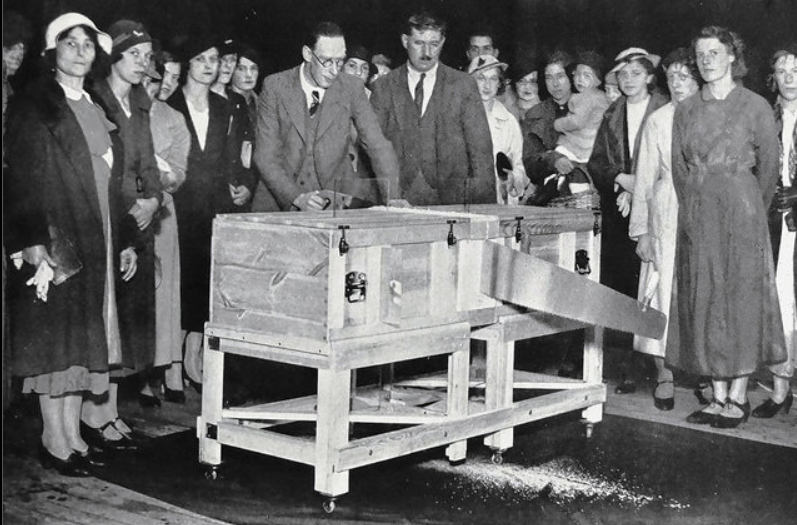 🇬🇧 United Kingdom and 1 moreSawing a woman in half
A stage illusion where an assistant appears to be cut into pieces inside a box or on a tableIllusion · Wonder and entertainment Living
🇬🇧 United Kingdom and 1 moreSawing a woman in half
A stage illusion where an assistant appears to be cut into pieces inside a box or on a tableIllusion · Wonder and entertainment Living
 🇬🇧 United KingdomEgyptian Hall
A London exhibition hall known for magic shows and Egyptian-style architecture, demolished in 1905.Illusion · Wonder and entertainment Historical
🇬🇧 United KingdomEgyptian Hall
A London exhibition hall known for magic shows and Egyptian-style architecture, demolished in 1905.Illusion · Wonder and entertainment Historical
Related elsewhere
All illusion 🇪🇬 Egypt and 1 moreSphinx
A mythical hybrid with a human head and lion body, serving as guardian or riddler in Egyptian and Greek traditions.Being · Protection · Wonder and entertainment Legendary
🇷🇺 Russia and 3 moreNart sagaНарты кадджытæ
A collection of epic tales from the North Caucasus about a legendary group of heroes.Text · Wonder and entertainment Historical
🇪🇬 EgyptDjedi
A fictional magician from the Westcar Papyrus who resurrects animals and foretells a king's lineage.Figure · Seeing and foretelling · Wonder and entertainment Legendary
🇨🇱 ChileChilean mythology
The myths and legends of Chile, blending indigenous roots with colonial influences.Tradition · Wonder and entertainment Living
🇪🇬 Egypt and 1 moreSphinx
A mythical hybrid with a human head and lion body, serving as guardian or riddler in Egyptian and Greek traditions.Being · Protection · Wonder and entertainment Legendary
🇷🇺 Russia and 3 moreNart sagaНарты кадджытæ
A collection of epic tales from the North Caucasus about a legendary group of heroes.Text · Wonder and entertainment Historical
🇪🇬 EgyptDjedi
A fictional magician from the Westcar Papyrus who resurrects animals and foretells a king's lineage.Figure · Seeing and foretelling · Wonder and entertainment Legendary
🇨🇱 ChileChilean mythology
The myths and legends of Chile, blending indigenous roots with colonial influences.Tradition · Wonder and entertainment Living