
Isaac Fawkes
An English conjurer who moved magic from the fairground to fashionable London society.
Isaac Fawkes was an eighteenth-century English magician and showman. He is known for presenting conjuring as respectable entertainment for high society rather than a fairground trick. He used sleight of hand and automata to amass wealth and fame in London.
- First appeared publicly in 1722 with his son at Southwark Fair.
- Performed for King George II before becoming widely known.
- Collaborated with automata maker Christopher Pinchbeck.
- Satirized by artist William Hogarth in 1723.
- Amassed considerable wealth through self-promotion and shows.
What it is
Isaac Fawkes was an English conjurer active in the early eighteenth century. He presented magic as a form of public entertainment rather than a display of supernatural power. His act combined manual dexterity with mechanical devices. He became one of the first magicians to perform outside the traditional fairground setting. This allowed him to attract wealthy patrons in London. He built a reputation on skill and promotion rather than mystery.
Where it comes from
The first record of Fawkes appears in 1722 when his son performed tumbling at Southwark Fair. Advertisements from that year claim he had already performed for George II. This suggests he was established in London before 1722. A newspaper piece from 1711 may also refer to him. He began as a fairground performer but quickly moved into private venues. He sought to distance himself from the stigma of black magic.
Tools and materials
His routine used standard conjuring props like cards and coins. He utilized the Egg Bag to produce showers of gold and silver. Live animals such as birds and beasts were central to his act. He collaborated with clockmaker Christopher Pinchbeck. Pinchbeck provided complex automata and dioramas. These devices created illusions of movement and music. Fawkes also incorporated Punch and Judy puppetry into his shows.
Isaac Fawkes, drawn and placed
- Living
- Revived
- Fading
- Historical
- Legendary
- Performed
What it is for
Fawkes aimed to entertain fashionable society and earn a fortune. He wanted to prove that magic was a skill, not fraud. His shows offered amusement to the public and rewards to the elite. He charged varying entrance fees based on location and audience. He promoted his wealth to demonstrate his success. His goal was commercial viability and social acceptance.
Who does it
Fawkes was a male performer and showman. He managed his own acts and promoted them heavily. He trained pupils and worked with other entertainers. His son performed contortionism alongside his father's magic. Fawkes dressed in smart suits and wigs to appeal to gentrified tastes. He avoided the stereotypical robes of earlier conjurers. He positioned himself as a natural philosopher and entertainer.
Peoples and places
Fawkes was popular in England, particularly in London. He performed at Southwark and Bartholomew fairs. He moved to venues near the Opera House in Haymarket. His work appealed to both common fairgoers and high society. William Hogarth satirized his popularity in prints. Critics viewed him as a fraudster, while others admired his business acumen. He toured to Bristol and other cities.
At a glance: who, where and when
Who does it
Peoples

What people believe
Fawkes rejected the association of conjuring with witchcraft. He presented his acts as demonstrations of dexterity. He mocked contemporaries who claimed supernatural connections. However, he occasionally used spirits for promotional effect. An advertisement mentioned auxiliary spirits shut up in a bottle. This was likely a joke to attract attention. He aligned himself with travelling scientists and natural philosophers.
How scholars and sceptics see it
Ricky Jay researched Fawkes and linked him to earlier records. Ronald Paulson analyzed Hogarth's depiction of Fawkes. Scholars note that Hogarth used artistic license in his prints. Some view Fawkes as a pioneer of modern stage magic. Others see him as a clever businessman who exploited public taste. His success is attributed to effective marketing and management.
Cautions and what is closed
Some critics, like James Caulfield, viewed Fawkes as a fraudster. They believed he deceived fools out of their money. Fawkes faced competition from other magicians and performers. He retired temporarily due to health problems with his leg. His shows were subject to satire and public scrutiny. He navigated the legal and social expectations of his time.
Questions people ask about Isaac Fawkes
Who was Isaac Fawkes?
Isaac Fawkes was an English conjurer and showman active in the early eighteenth century. He is known for moving magic performance from fairgrounds to fashionable London venues.
Where did Isaac Fawkes perform?
He performed at Southwark and Bartholomew fairs. He later established shows in London venues including the Haymarket and Upper Moorfields.
What tools did Isaac Fawkes use?
He used cards, eggs, live birds, and money for sleight of hand. He also employed automata and mechanical devices created by Christopher Pinchbeck.
Was Isaac Fawkes considered a fraud?
Some critics like James Caulfield viewed him as a fraudster. However, he presented his acts as skilled entertainment and distanced himself from claims of black magic.
Good reading and sources
The facts on this page come from the Wikipedia article "Isaac Fawkes", written by its contributors and used under the CC BY-SA 4.0 licence, and from its Wikidata record (CC0). EveryJaadu rewrote the text in its own words, with AI assistance, and compares every page with the article to make sure no passage is copied. It may be reused under the same CC BY-SA 4.0 licence with a link back.
It may contain mistakes. Names and customs differ from one community to the next, and some knowledge is closed to outsiders and left out here. This page describes belief and practice. It does not say that any of it works, it is not a how-to, and it is not medical advice. If something is wrong, tell us. Last refreshed 2026-10-05.
More from the United Kingdom
All the entries from the United Kingdom 🇩🇪 Germany and 2 morePhantasmagoria
A horror theatre using magic lanterns to project frightening images in the darkIllusion · Wonder and entertainment Historical
🇩🇪 Germany and 2 morePhantasmagoria
A horror theatre using magic lanterns to project frightening images in the darkIllusion · Wonder and entertainment Historical
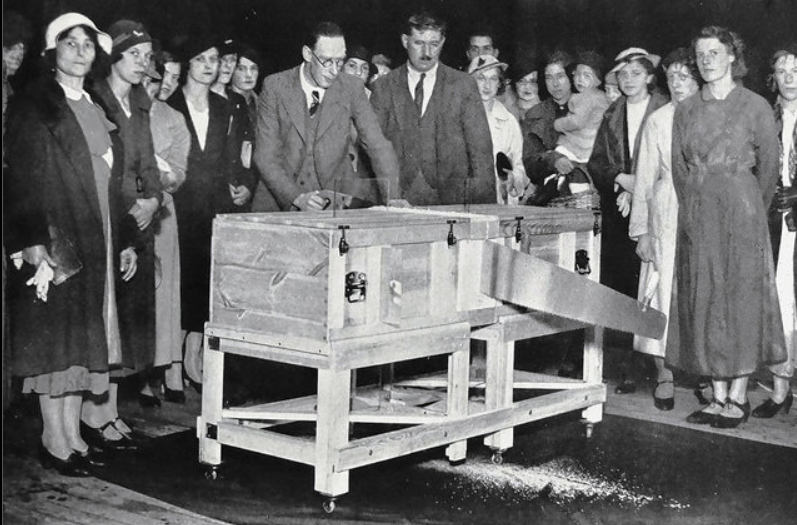 🇬🇧 United Kingdom and 1 moreSawing a woman in half
A stage illusion where an assistant appears to be cut into pieces inside a box or on a tableIllusion · Wonder and entertainment Living
🇬🇧 United Kingdom and 1 moreSawing a woman in half
A stage illusion where an assistant appears to be cut into pieces inside a box or on a tableIllusion · Wonder and entertainment Living
 🇬🇧 United KingdomEgyptian Hall
A London exhibition hall known for magic shows and Egyptian-style architecture, demolished in 1905.Illusion · Wonder and entertainment Historical
🇬🇧 United KingdomEgyptian Hall
A London exhibition hall known for magic shows and Egyptian-style architecture, demolished in 1905.Illusion · Wonder and entertainment Historical
Related elsewhere
All illusion 🇪🇬 Egypt and 1 moreSphinx
A mythical hybrid with a human head and lion body, serving as guardian or riddler in Egyptian and Greek traditions.Being · Protection · Wonder and entertainment Legendary
🇷🇺 Russia and 3 moreNart sagaНарты кадджытæ
A collection of epic tales from the North Caucasus about a legendary group of heroes.Text · Wonder and entertainment Historical
🇨🇱 ChileChilean mythology
The myths and legends of Chile, blending indigenous roots with colonial influences.Tradition · Wonder and entertainment Living
🇪🇬 Egypt and 1 moreSphinx
A mythical hybrid with a human head and lion body, serving as guardian or riddler in Egyptian and Greek traditions.Being · Protection · Wonder and entertainment Legendary
🇷🇺 Russia and 3 moreNart sagaНарты кадджытæ
A collection of epic tales from the North Caucasus about a legendary group of heroes.Text · Wonder and entertainment Historical
🇨🇱 ChileChilean mythology
The myths and legends of Chile, blending indigenous roots with colonial influences.Tradition · Wonder and entertainment Living
 🇨🇳 ChinaLan Caihe藍采和
An ambiguous Taoist immortal known for a flower basket and wandering songsBeing · Wonder and entertainment Legendary
🇨🇳 ChinaLan Caihe藍采和
An ambiguous Taoist immortal known for a flower basket and wandering songsBeing · Wonder and entertainment Legendary