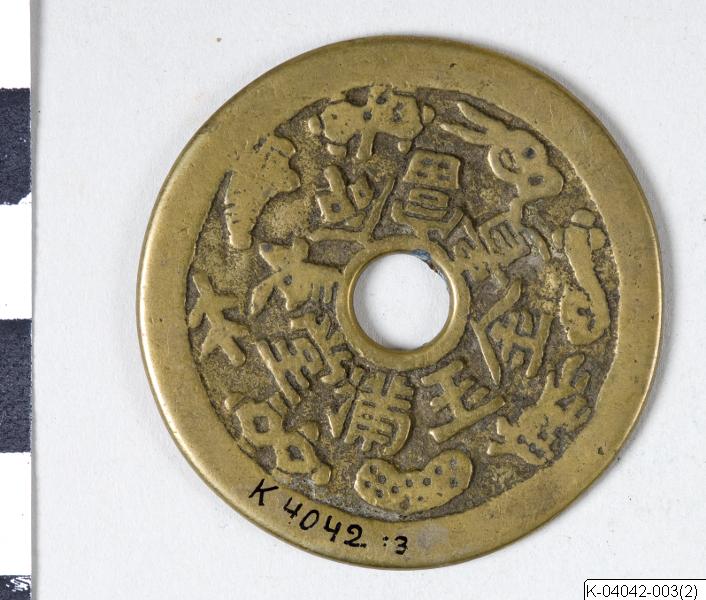
Eight Treasures
In its own language: 八寶 (Bābǎo)
from the Chinese Bābǎo, meaning eight precious items
A set of eight symbols in Chinese art and amulets representing good fortune.
The Eight Treasures are a popular group of symbols in Chinese culture, often found on charms and artwork. They represent concepts like wealth, happiness, and wishes coming true. This specific set is distinct from other Buddhist or Taoist symbol groups.
- Includes a wish-granting pearl and a stone chime.
- Double lozenges protect against maleficent influences.
- Rhinoceros horns symbolize happiness.
- Charm inscriptions may wish for gold and jade to fill the house.
- Distinct from Buddhist Ashtamangala symbols.
What it is
The Eight Treasures form a standard collection of auspicious symbols in Chinese visual culture. While longer lists exist, this specific grouping is the most recognized. These items appear frequently in traditional art and on numismatic charms, which are coin-like objects used for protection or luck. The symbols serve as visual prayers for positive outcomes in daily life.
Where it comes from
The concept derives from the broader tradition of the Hundred Treasures. Over time, a specific combination of eight items became the preferred subset for decorative and talismanic use. The exact historical moment of this selection is not detailed, but it reflects a cultural preference for these particular meanings over others.
How it is done
Artisans carve or cast these symbols onto metal discs to create charms. These discs often feature inscriptions alongside the images. For example, one charm held in Sweden bears text wishing for longevity and wealth. The arrangement of the eight items creates a complete protective field for the wearer.
Tools and materials
The set includes the wish-granting pearl, which represents fulfilled desires. Double lozenges stand for marital joy and ward off bad influences. A stone chime signifies moral integrity. Rhinoceros horns bring happiness, while double coins attract money. An ingot adds to the wealth theme. Coral and the wish-granting scepter complete the group with their own associations of good fortune.
Eight Treasures, drawn and placed
- Living
- Revived
- Fading
- Historical
- Legendary
- Performed
- Lineage
- Chinese folk symbolism
What it is for
People wear these charms to invite prosperity and safety into their homes. The symbols are believed to actively counteract negative forces. Families seek them out to ensure their children live long lives and that their households remain filled with valuable goods. The charms act as constant reminders of these hopes.
Who does it
These items are primarily used by ordinary households rather than specialized priests. Artisans in places like Zhangzhou craft seal pastes named after the treasures, linking the symbols to everyday administrative and artistic practices. The knowledge of the symbols is widespread among the general population.
Peoples and places
The tradition is central to Chinese folk culture. It appears across various media, from paintings to currency replicas. The symbols are understood broadly within Chinese communities. Similar groups of eight exist in Buddhism and Taoism, but the Eight Treasures remain distinct in their secular and folk focus.
At a glance: who, where and when
What people believe
The underlying worldview holds that symbols carry inherent power. Displaying these items is thought to manifest their qualities. The belief is that the visual presence of the pearl or the scepter invites the abstract concepts they represent into the physical world. This relies on a system of correspondences between object and outcome.
How scholars and sceptics see it
Researchers view these charms as examples of folk religion and material culture. The presence of such charms in museums like the one in Sweden highlights their role in cross-cultural exchange. Scholars note the distinction between these folk symbols and the more formal religious icons of Buddhism or Taoism.
Cautions and what is closed
There are no known dangers associated with wearing these charms. However, the use of rhinoceros horn has raised ethical and legal concerns globally due to conservation issues. Modern interpretations often substitute materials to avoid harming wildlife while maintaining the symbolic value.
Compare and confuse
The Eight Treasures are sometimes confused with the Ashtamangala, which are sacred symbols in Buddhism, Hinduism, and Jainism. They also differ from the eight signs of the Buddha's body. While there is overlap in the number eight, the specific items and their meanings vary significantly between these traditions.
Questions people ask about Eight Treasures
What are the Eight Treasures?
They are a popular set of eight symbols in Chinese culture, used in art and on charms to represent good fortune, wealth, and protection.
Where do these symbols come from?
They originate from China, derived from a larger list of Hundred Treasures, with this specific group becoming the most favored for talismanic use.
What does the wish-granting pearl represent?
It symbolizes the granting of wishes and is often depicted as a flaming pearl in traditional imagery.
How are these symbols used today?
They appear on numismatic charms worn for luck and in folk art, continuing a tradition of seeking prosperity and safety through visual symbols.
Good reading and sources
The facts on this page come from the Wikipedia article "Eight Treasures", written by its contributors and used under the CC BY-SA 4.0 licence, and from its Wikidata record (CC0). EveryJaadu rewrote the text in its own words, with AI assistance, and compares every page with the article to make sure no passage is copied. It may be reused under the same CC BY-SA 4.0 licence with a link back.
It may contain mistakes. Names and customs differ from one community to the next, and some knowledge is closed to outsiders and left out here. This page describes belief and practice. It does not say that any of it works, it is not a how-to, and it is not medical advice. If something is wrong, tell us. Last refreshed 2026-10-09.
More from China
All the entries from China 🇨🇳 China and 1 moreAncestor veneration in China中國傳統宗法性宗教
Rites for dead kin who are thought to watch over the familyTradition · Protection · Speaking with spirits and the dead Living
🇨🇳 China and 1 moreAncestor veneration in China中國傳統宗法性宗教
Rites for dead kin who are thought to watch over the familyTradition · Protection · Speaking with spirits and the dead Living
 🇨🇳 China and 5 moreJoss paper金紙
Paper burned as money and goods for ancestors, gods and the deadCharm · Speaking with spirits and the dead · Luck and prosperity Living
🇨🇳 China and 5 moreJoss paper金紙
Paper burned as money and goods for ancestors, gods and the deadCharm · Speaking with spirits and the dead · Luck and prosperity Living
 🇨🇳 China and 1 moreFulu符籙
Taoist talismans with cryptic symbols used for healing and protectionCharm · Healing · Protection Living
🇨🇳 China and 3 moreQi氣 / 气
A vital force in Chinese philosophy and medicine, believed to flow through all living things.Substance · Healing · Power and authority Living
🇨🇳 China and 1 moreFulu符籙
Taoist talismans with cryptic symbols used for healing and protectionCharm · Healing · Protection Living
🇨🇳 China and 3 moreQi氣 / 气
A vital force in Chinese philosophy and medicine, believed to flow through all living things.Substance · Healing · Power and authority Living
Related elsewhere
All charm 🇧🇪 Belgium and 2 moreHorseshoe
A metal shoe for a horse's hoof and a talisman of good fortuneCharm · Protection · Luck and prosperity Living
🇧🇪 Belgium and 2 moreHorseshoe
A metal shoe for a horse's hoof and a talisman of good fortuneCharm · Protection · Luck and prosperity Living
 🇪🇬 Egypt and 3 moreAmulet
A portable object worn or carried to ward off harm and invite fortuneCharm · Protection · Luck and prosperity Living
🇪🇬 Egypt and 3 moreAmulet
A portable object worn or carried to ward off harm and invite fortuneCharm · Protection · Luck and prosperity Living
 🇮🇳 India and 5 moreKolamகோலம்
A daily geometric floor drawing made with rice flour at the home entrance in South IndiaTradition · Protection · Luck and prosperity Living
🇮🇳 India and 5 moreKolamகோலம்
A daily geometric floor drawing made with rice flour at the home entrance in South IndiaTradition · Protection · Luck and prosperity Living
 🇫🇷 France and 5 moreYule log
A large wooden log burned in the hearth during winter festivals across Europe and North America.Tradition · Protection · Luck and prosperity Living
🇫🇷 France and 5 moreYule log
A large wooden log burned in the hearth during winter festivals across Europe and North America.Tradition · Protection · Luck and prosperity Living