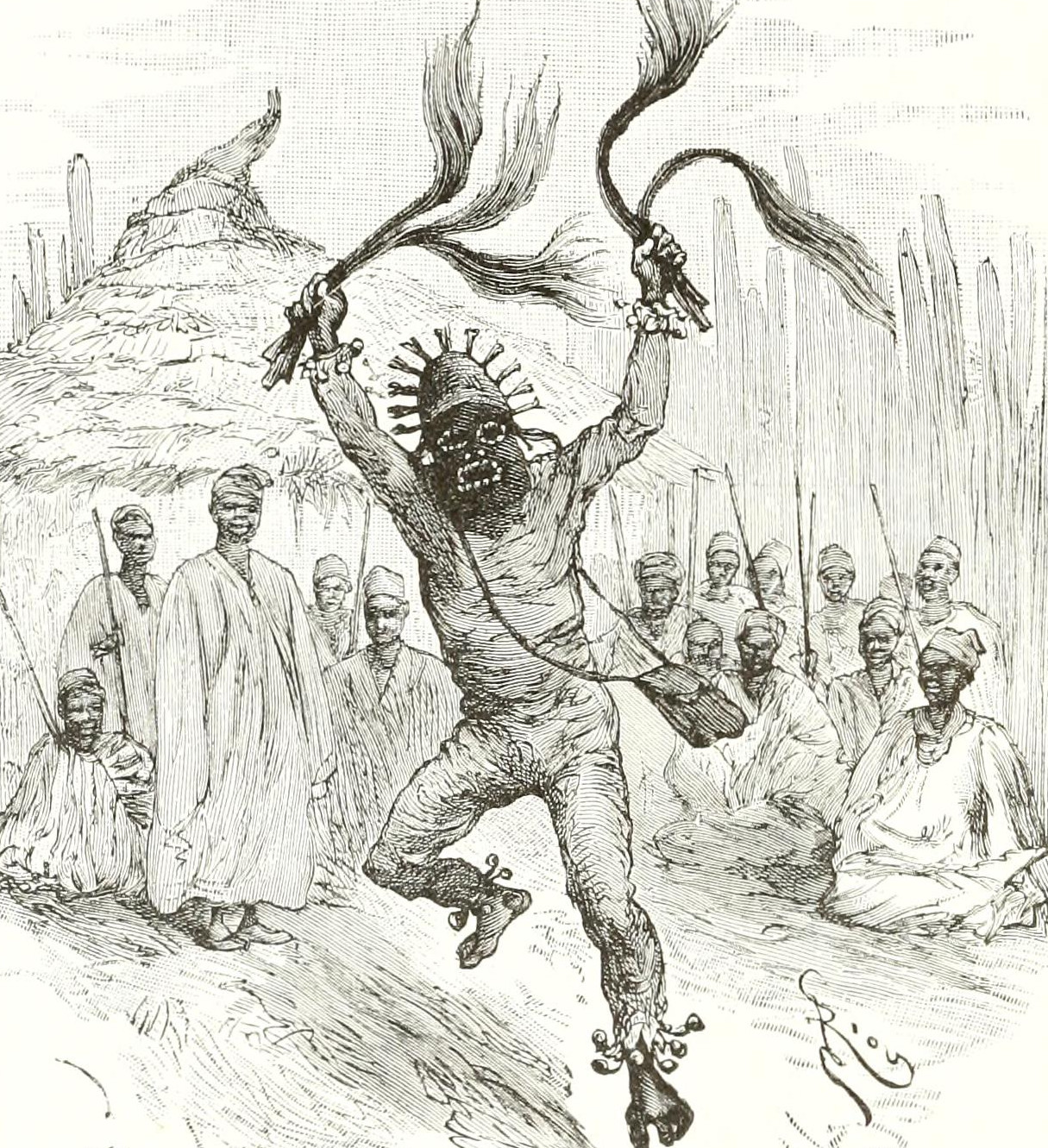
Boum'ba Maza
from Haitian Creole 'boat' and Kongo 'water'
A family of water spirits in Haitian Vodou rites
The Boum'ba Maza are a group of lwa spirits in Haitian Vodou. They represent sacred waters and the magic of libation. Practitioners invoke them for agricultural fertility and harvest blessings.
What it is
The Boum'ba Maza are a family of lwa spirits within Haitian Vodou. They serve as the Terrestrial Masters of Water. These spirits govern the ritual power of pouring liquid offerings. This act, called libation, is used to call down spiritual forces. The Maza embody the essence of holy water. They stand in contrast to other spirits who represent fire or heat. Their presence marks the sacred center of the ceremony.
Where it comes from
These spirits come from Kongolese religion. They originated as bisimbi water spirits. Enslaved Africans brought these beliefs to Saint-Domingue. By the eighteenth century, they merged into local worship. They were linked to nkisi spirit fetishes. This process created the modern Vodou understanding of the Maza. Some scholars trace their name to specific African languages. Others suggest different roots for the term mbumba.
How it is done
Practitioners pour liquid offerings to honor the Maza. This ritual action invokes the vèvè symbols on the floor. The vèvè draws the spirits into the hounfour space. The symbol often includes arrows. This feature links the practice to Kongolese traditions. Offerings typically include the first fruits of the harvest. This act connects the community to the land's bounty.
Tools and materials
The primary tool is the offering of water and food. A sacred water basin sits in the ritual space. It represents the wells found in biblical stories. The vèvè drawing uses chalk or flour. Arrows appear in the design for this family. These lines map the spiritual connection between the people and the water masters.
Boum'ba Maza, drawn and placed
- Living
- Revived
- Fading
- Historical
- Legendary
- Performed
- Lineage
- Haitian Vodou Makaya and Petwo rites
- Timing
- during rituals and at harvest time
What it is for
People seek the Maza for good fortune in farming. They ask for fertility and a rich harvest. The spirits ensure the land provides enough food. Boum'ba Maza also guides souls after death. As a psychopomp, he helps the dead find their way. This role mirrors other guide spirits in different Vodou rites.
Who does it
The houngan, a male priest, leads the ceremonies. He manages the sacred water basin. He performs the libations to invite the spirits. The priest must know the correct chants and symbols. He acts as the bridge between the community and the water masters.
Peoples and places
The Maza are central to Haitian Vodou. They appear in both Makaya and Petwo rites. Most Petwo spirits are associated with fire. The Maza bring water to balance this energy. Their roots lie in Central African traditions. This distinguishes them from West African spirits common in other groups.
At a glance: who, where and when
Who does it
Belief worlds
Occasions
What people believe
The Maza represent the life-giving force of water. They connect the physical world to the spiritual realm. Libation is not just a gesture; it is a summoning tool. The spirits are benevolent and protective. They reward respect with agricultural success. Their nature is cool and fluid, opposing the hot Petwo energy.
When it is done
Offerings are made during the harvest season. The first crops are given to the spirits. Christmas Eve services may involve fire symbols alongside water rites. The timing aligns with agricultural cycles and religious festivals.
Questions people ask about Boum'ba Maza
Where does Boum'ba Maza come from?
As our sources describe it, Boum'ba Maza belongs to Haiti. Communities differ in what they call it and how they keep it.
What kind of thing is Boum'ba Maza?
As our sources describe it, Boum'ba Maza belongs with the being entries in a guide to magic. What it is believed to do depends on who is speaking, and scholars read it differently from those who practise it.
Is Boum'ba Maza still practised?
Our sources place Boum'ba Maza among the entries that are living. Practised today by communities who hold it as their own.
Which peoples keep Boum'ba Maza?
As our sources describe it, Boum'ba Maza is kept by Haitians, Kongolese, Vili and Yombe. Others now know it too, often in changed forms.
Good reading and sources
The facts on this page come from the Wikipedia article "Boum'ba Maza", written by its contributors and used under the CC BY-SA 4.0 licence, and from its Wikidata record (CC0). EveryJaadu rewrote the text in its own words, with AI assistance, and compares every page with the article to make sure no passage is copied. It may be reused under the same CC BY-SA 4.0 licence with a link back.
It may contain mistakes. Names and customs differ from one community to the next, and some knowledge is closed to outsiders and left out here. This page describes belief and practice. It does not say that any of it works, it is not a how-to, and it is not medical advice. If something is wrong, tell us. Last refreshed 2026-10-06.
More from Haiti
All the entries from Haiti 🇭🇹 Haiti and 2 moreLwa
Spirits in Haitian Vodou that mediate between people and the creator god.Being · Protection · Healing Living
🇭🇹 Haiti and 2 moreLwa
Spirits in Haitian Vodou that mediate between people and the creator god.Being · Protection · Healing Living
 🇭🇹 Haiti and 1 moreEzili DantorÈzili Dantò
A fierce mother spirit in Haitian Vodou who protects the marginalized and demands loyalty.Being · Protection · Love and attraction Living
🇧🇯 Benin and 2 morePapa Legba
A loa who stands at the crossroads and opens the gate between people and spiritsBeing · Speaking with spirits and the dead · Power and authority Living
🇭🇹 Haiti and 1 moreEzili DantorÈzili Dantò
A fierce mother spirit in Haitian Vodou who protects the marginalized and demands loyalty.Being · Protection · Love and attraction Living
🇧🇯 Benin and 2 morePapa Legba
A loa who stands at the crossroads and opens the gate between people and spiritsBeing · Speaking with spirits and the dead · Power and authority Living
 🇭🇹 HaitiGedeGuédé
A family of spirits in Haitian Vodou who guard the dead and grant fertility.Being · Speaking with spirits and the dead · Protection Living
🇭🇹 HaitiGedeGuédé
A family of spirits in Haitian Vodou who guard the dead and grant fertility.Being · Speaking with spirits and the dead · Protection Living
Related elsewhere
All being 🇫🇷 FranceHoly GrailSaint Graal
A cup or stone from Arthurian tales that grants healing and eternal lifeFigure · Healing · Luck and prosperity Legendary
🇫🇷 FranceHoly GrailSaint Graal
A cup or stone from Arthurian tales that grants healing and eternal lifeFigure · Healing · Luck and prosperity Legendary
 🇨🇳 China and 2 moreEight Immortals八仙
Eight legendary Taoist figures of China, each with a power and a vesselFigure · Protection · Healing Living
🇨🇳 China and 2 moreEight Immortals八仙
Eight legendary Taoist figures of China, each with a power and a vesselFigure · Protection · Healing Living
 🇹🇭 Thailand and 3 moreThai Buddha amuletsพระเครื่อง (phrakhrueang)
Sacred Buddhist images and relics worn for protection, merit, and fortune in Thailand.Charm · Protection · Luck and prosperity Living
🇹🇭 Thailand and 3 moreThai Buddha amuletsพระเครื่อง (phrakhrueang)
Sacred Buddhist images and relics worn for protection, merit, and fortune in Thailand.Charm · Protection · Luck and prosperity Living
 🇨🇳 China and 5 moreGuanyin觀音 (Guānyīn)
The Bodhisattva of compassion, worshipped across East Asia as a listener to human sufferingBeing · Protection · Healing Living
🇨🇳 China and 5 moreGuanyin觀音 (Guānyīn)
The Bodhisattva of compassion, worshipped across East Asia as a listener to human sufferingBeing · Protection · Healing Living