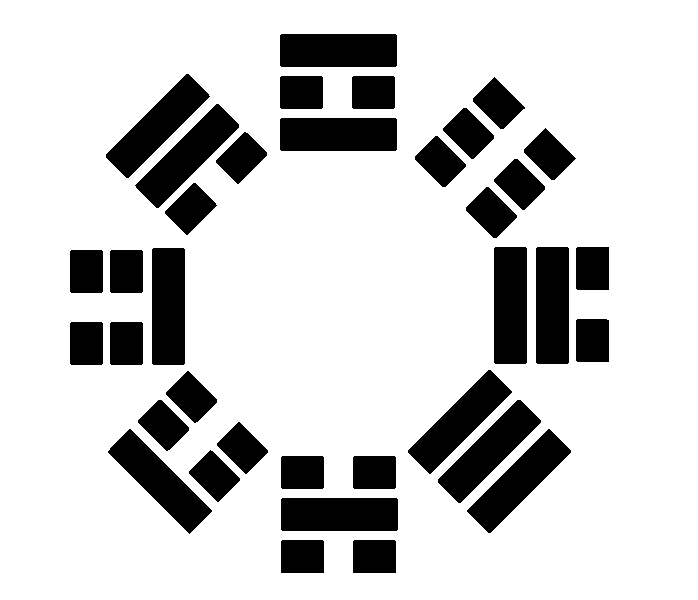
Bagua
In its own language: 八卦
from Chinese bāguà, meaning 'eight trigrams'
A set of eight trigram symbols from China used in divination, cosmology, and feng shui.
The bagua is a system of eight trigrams originating in China to illustrate reality as opposing forces. It serves as the foundation for the I Ching oracle and traditional Chinese metaphysics like feng shui and medicine.
- Eight trigrams made of broken and unbroken lines represent yin and yang.
- Two arrangements exist: Earlier Heaven (Fuxi) and Later Heaven (King Wen).
- Used in I Ching divination with yarrow stalks or coins.
- Bagua mirrors deflect negative energy in feng shui.
- Corresponds to five elements, seasons, and cardinal directions.
What it is
The bagua consists of eight trigrams, each made of three lines that are either broken or unbroken. These lines represent yin and yang, the dual forces of nature. The system illustrates how opposing energies reinforce one another to form reality. It is a core component of Chinese philosophy and cosmology. The trigrams combine to create hexagrams, which are used in the I Ching for divination. They also map onto natural elements, seasons, and directions. This framework helps practitioners understand the flow of energy in the universe and in human life.
Where it comes from
Legend attributes the discovery of the trigrams to Fuxi, the first primordial being. He is said to have drawn them to replace the old system of tying knots for record-keeping. Historical records link the system to the Shang and Zhou state religions. Two main arrangements exist: the Earlier Heaven sequence linked to Fuxi, and the Later Heaven sequence attributed to King Wen of Zhou. The Earlier Heaven version represents a balanced, static state. The Later Heaven version describes dynamic energy flow and is used in active practices like feng shui.
How it is done
Diviners use the bagua to interpret hexagrams in the I Ching. Methods include throwing yarrow stalks, tossing coins, or observing natural signs like bird flights or bone cracks. In feng shui, practitioners place the trigrams on a Luo Pan compass to analyze qi movement in a space. The Later Heaven arrangement maps specific energies to cardinal directions. Practitioners use this map to adjust living environments. The system organizes spatial relationships based on elemental interactions and seasonal cycles.
Tools and materials
The primary tools are the trigram symbols themselves, formed by solid and broken lines. Divination uses yarrow stalks, coins, or animal entrails. Feng shui masters use the Luo Pan compass to align the bagua with physical spaces. Bagua mirrors are octagonal or circular talismans with trigrams around a central mirror. These mirrors reflect or disperse negative energy, known as sha qi, away from homes. They can be flat, convex, or concave depending on the intended effect.
Bagua, drawn and placed
- Living
- Revived
- Fading
- Historical
- Legendary
- Performed
- Lineage
- I Ching studies
- Timing
- for divination and spatial analysis
What it is for
The bagua is used to foresee outcomes through the I Ching oracle. It guides decisions by showing possible paths and their likely results. In feng shui, it protects residences by deflecting harmful external energies. Traditional Chinese medicine uses the sequences to understand health patterns and familial risks. It helps identify imbalances in the body's elemental phases. The system also aids in meditation and martial arts by aligning the practitioner with natural forces.
Who does it
Scholars and historians study the bagua as part of Chinese philosophy. Diviners consult the I Ching to provide guidance. Feng shui practitioners use the compass to assess and adjust living spaces. Traditional Chinese medicine doctors apply the sequences to diagnose health issues. Training involves memorizing the trigram meanings and their correspondences. Mastery requires understanding the dynamic relationships between the elements and directions.
Peoples and places
The bagua originates in China and is central to Chinese culture. It appears in South Korean traditions as well. In China, it is used in both religious and secular contexts. Hong Kong communities frequently encounter it in daily life and architecture. Western interest has grown through the popularity of feng shui. The Western adaptation often simplifies the system into an 'aspirations' map. This version focuses more on intention than traditional spatial analysis.
At a glance: who, where and when
Who does it
Peoples
Belief worlds
Occasions


What people believe
The system is rooted in the belief that reality is composed of interacting forces. Yin and yang are the fundamental dualities that generate all phenomena. The five elements, water, wood, fire, earth, and metal, interact through promotion and subversion. These interactions determine balance or imbalance in nature and the body. Qi flows through spaces and bodies according to these principles. Harmonizing with these flows is believed to bring health and prosperity.
Cautions and what is closed
Misuse of bagua mirrors can cause conflicts between neighbors. Pointing a mirror at a neighbor's home is considered offensive and taboo. Such installations are sometimes used for personal vendettas. Conflicts over mirror placement are common in dense urban areas. There is no medical advice associated with the system; it is a traditional framework. Practitioners do not claim to cure diseases but to identify energetic patterns.
Rites that involve Bagua
Questions people ask about Bagua
What is the bagua?
The bagua is a set of eight trigrams from China. Each trigram has three lines that are broken or unbroken. These symbols represent yin and yang forces. They form the basis of the I Ching and feng shui practices.
Where does the bagua come from?
It originates in ancient China. Legend says Fuxi discovered the trigrams. King Wen of Zhou later arranged them into the Later Heaven sequence. The system is tied to Shang and Zhou state religion.
How is the bagua used in divination?
Diviners stack two trigrams to make a hexagram. They throw yarrow stalks or toss coins to select a hexagram. The I Ching text then provides an interpretation. This process helps predict outcomes and guide decisions.
What is a bagua mirror?
A bagua mirror is a feng shui talisman. It has trigrams around a central mirror. It reflects or disperses negative energy called sha qi. People hang it above doors to protect their homes from harm.
Good reading and sources
- Bagua on WikipediaEncyclopedia
- More photos on Wikimedia CommonsPhotos and video
- Wikidata recordOpen data
The facts on this page come from the Wikipedia article "Bagua", written by its contributors and used under the CC BY-SA 4.0 licence, and from its Wikidata record (CC0). EveryJaadu rewrote the text in its own words, with AI assistance, and compares every page with the article to make sure no passage is copied. It may be reused under the same CC BY-SA 4.0 licence with a link back.
It may contain mistakes. Names and customs differ from one community to the next, and some knowledge is closed to outsiders and left out here. This page describes belief and practice. It does not say that any of it works, it is not a how-to, and it is not medical advice. If something is wrong, tell us. Last refreshed 2026-10-05.
More from China
All the entries from China 🇨🇳 China and 5 moreGhost FestivalZhongyuan Festival; Yulanpen Festival
A festival to feed wandering spirits and guide them home during the seventh lunar month.Tradition · Speaking with spirits and the dead · Protection Living
🇨🇳 China and 5 moreGhost FestivalZhongyuan Festival; Yulanpen Festival
A festival to feed wandering spirits and guide them home during the seventh lunar month.Tradition · Speaking with spirits and the dead · Protection Living
 🇲🇳 Mongolia and 1 moreTsagaan SarЦагаан сар
A Mongol lunisolar new year marked by white clothes and dairy feastsTradition · Luck and prosperity · Speaking with spirits and the dead Living
🇲🇳 Mongolia and 1 moreTsagaan SarЦагаан сар
A Mongol lunisolar new year marked by white clothes and dairy feastsTradition · Luck and prosperity · Speaking with spirits and the dead Living
 🇨🇳 ChinaChinese alchemy煉丹術
A Taoist pursuit of longevity through elixirs and internal cultivationTradition · Healing · Speaking with spirits and the dead Historical
🇨🇳 ChinaChinese alchemy煉丹術
A Taoist pursuit of longevity through elixirs and internal cultivationTradition · Healing · Speaking with spirits and the dead Historical
 🇨🇳 China and 1 moreAncestor veneration in China中國傳統宗法性宗教
Rites for dead kin who are thought to watch over the familyTradition · Protection · Speaking with spirits and the dead Living
🇨🇳 China and 1 moreAncestor veneration in China中國傳統宗法性宗教
Rites for dead kin who are thought to watch over the familyTradition · Protection · Speaking with spirits and the dead Living
Related elsewhere
All tradition 🇸🇸 South Sudan and 1 moreAzande witchcraft
A Zande belief that certain people harm others by an inherited power, judged by oraclesBelief · Cursing and harm · Seeing and foretelling Living
🇸🇸 South Sudan and 1 moreAzande witchcraft
A Zande belief that certain people harm others by an inherited power, judged by oraclesBelief · Cursing and harm · Seeing and foretelling Living
 🇨🇺 Cuba and 2 moreSanteríaRegla de Ocha
An Afro-Cuban religion blending Yoruba beliefs with Catholicism and SpiritismTradition · Protection · Healing Living
🇨🇺 Cuba and 2 moreSanteríaRegla de Ocha
An Afro-Cuban religion blending Yoruba beliefs with Catholicism and SpiritismTradition · Protection · Healing Living
 🇸🇪 Sweden and 1 moreSoul flight
A trance practice where the spirit leaves the body to visit other realmsRite · Healing · Seeing and foretelling Historical
🇸🇪 Sweden and 1 moreSoul flight
A trance practice where the spirit leaves the body to visit other realmsRite · Healing · Seeing and foretelling Historical
 🇬🇧 United Kingdom and 4 moreCunning folk
European practitioners of folk medicine and helpful magic from the Middle Ages to the twentieth centuryTradition · Protection · Healing Historical
🇬🇧 United Kingdom and 4 moreCunning folk
European practitioners of folk medicine and helpful magic from the Middle Ages to the twentieth centuryTradition · Protection · Healing Historical