🇱🇦 Magic in Laos
12 entries from Laos, best known first.
Tai folk religion centers on reverence for local spirits, life force entities, and family ancestors. It emerged long before Hindu and Buddhist traditions arrived in mainland Southeast Asia. Today it exists alongside state religions, often blending into daily customs and community ceremonies.
- Cotton strings tie around wrists to anchor life forces during baci ceremonies.
- Ahom priests belong to three hereditary clans named Mo-sai, Mo-hong, and Mo-Pong.
- Village guardians receive annual offerings to protect settlement boundaries and prosperity.
- Thirty-two body locations are believed to hold protective khwan spirits.
- Lamet ritualists inherit their role through sons or brothers' children.
Overview
This belief system belongs to the Tai peoples across mainland Southeast Asia. It began as an indigenous tradition focused on nature spirits and family lines. Later waves of Hindu and Buddhist teachings arrived and merged with these older customs. In Thailand scholars describe the result as a blended faith rather than a separate path. The tradition shares roots with Confucian ancestor worship and regional animism. It treats the landscape as alive with protective and demanding presences. Communities maintain these views through shared meals, seasonal gatherings, and household altars. Neighboring cultures developed similar spirit veneration, making the practice part of a wider regional pattern.
Practices and beliefs
Followers honor three main categories of beings. Phi refers to place guardians and ancestral shades that can offer help or cause trouble. Khwan represents a vital energy believed to dwell in thirty-two spots throughout the body. Dam stands for forebears who watch over families. People leave food, flowers, incense, and candles at small shrines. Chicken and rice wine serve as common gifts for temple gods. Villagers also tie cotton threads around wrists to keep life forces anchored. Natural features like rivers, groves, and mountains receive regular attention to maintain balance.
Rites and charms
Ceremonies mark personal milestones and community needs. A baci gathering calls back wandering life energies after illness, travel, or major life shifts. Cotton cords secure the returning forces while participants receive blessings. Households perform quiet prayers led by the eldest member. Village leaders once hosted large annual feasts to feed the local guardian, sometimes using water buffalo sacrifices. These events temporarily closed settlements to strangers and reinforced shared borders. Lamet builders consult ritual specialists before raising new structures, while households observe strict behavior rules to avoid upsetting resident ancestors.
Who practises
Local shamans known as mophi guide communities through trance states and sacred tools called saksit. They address hauntings, sickness, and bad luck caused by restless shades. Ahom communities rely on hereditary priestly families divided into three branches. Lamet villages select a single ritual expert who inherits his role through male relatives. Elders often pick lucky dates for weddings and planting seasons. Household heads lead everyday prayers. These figures hold practical knowledge about spirit communication and traditional healing routines without claiming medical authority.
Regions and communities
The tradition stretches across several countries and ethnic divisions. Different Tai groups use distinct names for their life force concepts. Lowland Thai and Lao settlements emphasize village guardians that require yearly tribute. Highland and plateau communities maintain stronger ties to forest spirits and mountain deities. The Ahom lineage in Assam preserves ancient ceremony forms linked to early Yunnan origins. Each subgroup adapts core ideas to local geography and social structure while keeping the central focus on ancestral respect and environmental harmony.
The calendar
Ritual activity peaks during personal transitions and agricultural cycles. Families gather for wedding celebrations and newborn naming events where life bonds are renewed. Travelers receive wrist ties before long journeys. Farmers and merchants ask elders to select favorable days for important ventures. Villages hold annual meetings to honor their territorial protector. Religious festivals bring shamans together for public performances. Seasonal changes trigger quiet household prayers. The rhythm of spiritual work follows human milestones rather than fixed monthly dates.
Today
Practitioners continue these customs across scattered Tai communities. The faith blends smoothly with state-sponsored Buddhism in Thailand and Laos. Roughly thirty percent of Lao citizens still follow these older paths. Urban migration and tourism have not erased rural ceremonies. Scholars note the tradition survives through adaptation rather than isolation. Daily life retains its spirit-focused framework alongside modern institutions.
The facts in this overview come from the Wikipedia article "Tai folk religion", written by its contributors and used under the CC BY-SA 4.0 licence. EveryJaadu rewrote the text in its own words, with AI assistance, and compares every page with the article to make sure no passage is copied. It may be reused under the same CC BY-SA 4.0 licence with a link back.
 🇲🇾 Malaysia and 5 morePenanggalan
A floating head and trailing organs from Malay ghost mythsBeing · Cursing and harm Living
 🇨🇳 China and 5 moreChinese guardian lions石獅 (shíshī)
Stone lion pairs placed at entrances to ward off harm and welcome fortuneCharm · Protection · Luck and prosperity Living
 🇨🇳 China and 3 moreHmong folk religionKev Dab Qhuas
The ethnic religion of the Miao and Hmong peoples, centered on spirit worship and shamanic healing.Tradition · Healing · Protection Living
 🇰🇭 Cambodia and 3 moreSak Yantសាក់យ័ន្ត
Sacred geometric tattoos from Southeast Asia believed to grant protection and powerTradition · Protection · Luck and prosperity Living
 🇹🇭 Thailand and 7 moreSpirit house
A small shrine found across Southeast Asia to appease local protective spiritsTradition · Protection · Speaking with spirits and the dead Living
 🇱🇦 Laos and 3 moreTai folk religionສາສະໜາຜີ
Spirits, ancestor rites, and soul-calling ceremonies of the Tai peoplesTradition · Protection · Healing Living
 🇹🇭 Thailand and 5 moreKrasueกระสือ
A floating head with trailing organs from Southeast Asian folkloreBeing · Cursing and harm Living
 🇲🇲 Myanmar and 5 moreChintheခြင်္သေ့
A stylized lion statue that guards Buddhist temples in Myanmar and across Asia.Being · Protection Living
 🇹🇭 Thailand and 2 moreSang Thongสังข์ทอง
A Southeast Asian folktale about a prince born in a shell who gains golden skin and magical powers.Figure · Luck and prosperity · Love and attraction Historical
🇹🇭 Thailand and 1 moreKong koiผีกองกอย
A one-legged Lao and Thai jungle ghost said to drink blood from travellers' toesBeing · Cursing and harm Legendary
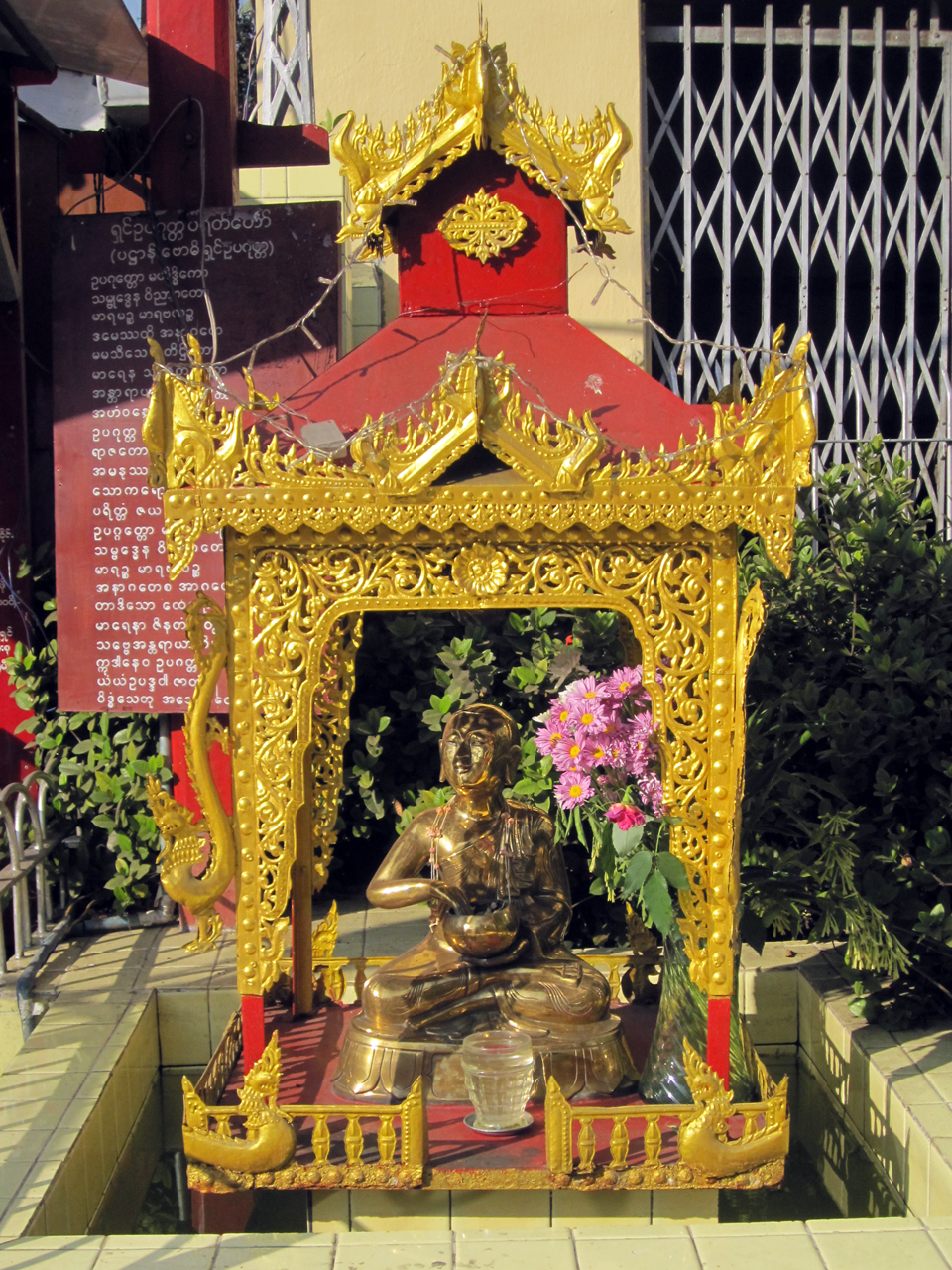 🇲🇲 Myanmar and 3 moreShin Upaguttaရှင်ဥပဂုတ်
A Burmese Buddhist arhat asked to keep storms and floods awayBeing · Protection Living
 🇮🇳 India and 2 moreAiravataऐरावत
A pristine white mythic elephant that carries the king of gods and controls the rains.Being · Power and authority · Protection Legendary
Photo credits on this page
The small pictures above come from Wikimedia Commons under free licences. Some are cropped to fit.
- Chinthe: Wagaung, CC BY-SA 3.0, source
- Airavata: Unknown, India, Rajasthan, Amber, South Asia, Public domain, source
- Hmong folk religion: Thomas Riccio, CC BY 4.0, source
- Krasue: Xavier Romero-Frias, CC BY-SA 3.0, source
- Spirit house: Chainwit., CC BY-SA 4.0, source
- Penanggalan: Hi I really try my best here, CC BY-SA 4.0, source
- Sak Yant: Mikhailovich, CC BY 3.0, source
- Shin Upagutta: Hintha, CC BY-SA 3.0, source
- Sang Thong: Narisara Nuwattiwong, Public domain, source
- Chinese guardian lions: Pvt pauline, CC BY-SA 3.0, source
The weekly digest
Every Monday: seven entries you may not know, what is on the calendar this week, and one rite drawn step by step.