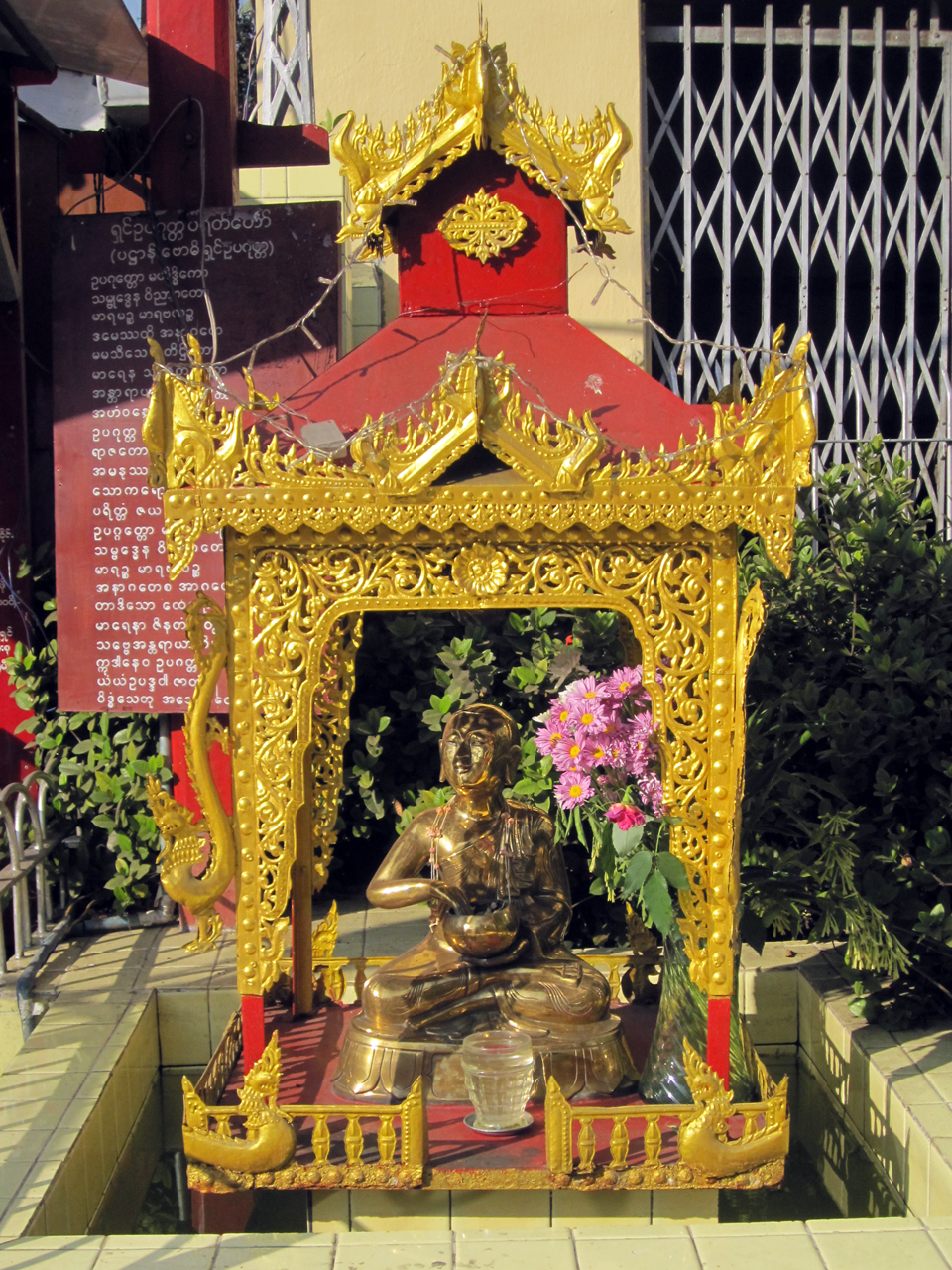
Shin Upagutta
In its own language: ရှင်ဥပဂုတ်
A Burmese Buddhist arhat asked to keep storms and floods away
Shin Upagutta is an arhat in Burmese Buddhist devotion, asked to guard people from storms, floods and other danger. He is also honoured in Cambodia, northern Thailand and Laos as Upakhut, and is shown as a robed monk holding an alms bowl.
- An arhat honoured in Myanmar, and called Upakhut in Cambodia, northern Thailand and Laos.
- His image is a cross-legged monk in robes, one hand over an alms bowl called a thabeik.
- Devotees ask him to ward off storms, floods and other danger.
- A major festival is held at Shwegyin in the Burmese month of Thadingyut.
- The Ye Hmyaw Pwe in Yangon's Chinatown includes ashes dispersed in the Yangon River.
What it is
Shin Upagutta belongs to Burmese Buddhist devotion as an arhat, a figure who has reached the goal of the Buddhist path. People in Myanmar turn to him for safety, particularly from storms and floods. Images show him seated with legs crossed in monk's robes, one hand angled over a thabeik, the alms bowl carried by monks. He is linked with naga, the water serpents of Buddhist story. Outside Myanmar he appears in Cambodia, northern Thailand and Laos under the name Upakhut. This is a devotion centred on protection and remembrance.
Where it comes from
Accounts of his identity differ. One tradition identifies him with Moggaliputta-Tissa, the monk said to have led the Third Buddhist council. Another points to Upagupta, an arhat of Mahayana tradition. A third view treats him as a Mahayana creation. He has no place in the Pali Canon and is named in the Burmese chronicle Maha Yazawin. His story also places him in earlier Buddha eras. In the time of Kassapa Buddha he was the monk Eindagotta, who urged fellow monks to return to lay life. The Buddha foretold he would become an arhat 218 years after Gautama Buddha's death.
How it is done
Devotion takes the form of honouring his image and calling on him. A Pali incantation is used, in Burmese belief, to invite his presence. That presence is thought to hold back storms and floods. At the Ye Hmyaw Pwe in Yangon's Chinatown, the observance includes a procession in Chinese style and the ceremonial scattering of ashes into the Yangon River. The festival at Shwegyin, close to Bago, falls in Thadingyut. Public observance is centred on these two festivals.
Tools and materials
His image carries the signs of a monk: robes, a seated cross-legged posture and a thabeik, the alms bowl into which the hand is tilted. The naga, or water serpent, is part of his iconography. A Pali incantation belongs to the devotional practice that calls him. The Ye Hmyaw Pwe adds ashes, carried in procession and dispersed in the Yangon River. These are the visible marks of a devotion focused on safety from water and weather.
Shin Upagutta, drawn and placed
- Living
- Revived
- Fading
- Historical
- Legendary
- Performed
- Lineage
- Buddhist arhat devotion
- Timing
- at Thadingyut and in October
What it is for
The main appeal is protection. Worshippers ask Shin Upagutta to avert danger, and floods and storms are named among the harms he is believed to check. The Irrawaddy Delta, a region exposed to water, is where devotion is especially common. The two festivals give communities a public occasion to honour him: one at Shwegyin in Thadingyut, one in Yangon's Chinatown in October. The ritual disposal of ashes at the Yangon event gives the observance a local, Chinese-influenced form.
Who does it
Ordinary Buddhists in Myanmar form the main following, and Burmese communities hold the festivals. The figure himself is a monk in the stories, and his image is that of a member of the monastic community. In Cambodia, northern Thailand and Laos he is known as Upakhut and honoured within local Buddhist life. Devotion is expressed through image, invocation and festival.
Peoples and places
Myanmar is the centre of his veneration, with particular strength in the Irrawaddy Delta. Burmese Buddhists call him Shin Upagutta and keep his festivals at Shwegyin and in Yangon. In Cambodia, northern Thailand and Laos the same figure is called Upakhut, with the Thai spelling Uppakhut in Roman letters. Across these countries the shared thread is Buddhist honour paid to an arhat asked for safety.
At a glance: who, where and when

What people believe
Behind the devotion is a Buddhist world of Buddhas, arhats and rebirth. Shin Upagutta is held to have lived through earlier Buddha eras and to have become an arhat in the time after Gautama Buddha. Some Burmese believe he is still alive in a palace of brass that drifts on the sea. He can be called by incantation, and his unseen presence is thought to keep storms and floods away. Naga, the water serpents, belong to this watery setting.
When it is done
Two public dates stand out. The larger festival is held at Shwegyin, near Bago, in the Burmese month of Thadingyut. The Ye Hmyaw Pwe takes place in Yangon's Chinatown in October, with a Chinese-style procession and ashes dispersed in the Yangon River. Both place his protection in a calendar of communal gathering.
How scholars and sceptics see it
His identity has several explanations. He is absent from the Pali Canon and appears in the Burmese chronicle Maha Yazawin. He may be Moggaliputta-Tissa, the monk linked to the Third Buddhist council. He may be the Mahayana arhat Upagupta. He may also be a figure formed within Mahayana Buddhism. These identifications draw on different Buddhist traditions.
Compare and confuse
Shin Upagutta is also written Shin Upagot, Shin Upagote and Shin U Pagoke. In Cambodia, northern Thailand and Laos he is Upakhut, spelled Uppakhut in Thai Romanisation. His identity is compared with Moggaliputta-Tissa and with the Mahayana arhat Upagupta. The naga, or water serpent, is a related motif in his imagery.
Today
Devotion continues in Myanmar, with Shwegyin and Yangon hosting his festivals. The Irrawaddy Delta is named as a place where he is commonly honoured. The Ye Hmyaw Pwe in Yangon's Chinatown brings a Chinese-style procession and the scattering of ashes into the river. In Cambodia, northern Thailand and Laos, Upakhut remains a familiar name within Buddhist life. The figure crosses national and ethnic lines while keeping a Burmese centre.
Questions people ask about Shin Upagutta
Who is Shin Upagutta?
Shin Upagutta is an arhat in Burmese Buddhist devotion. People ask him for safety from storms, floods and danger. His image is a monk with an alms bowl, and he is linked with naga, water serpents.
Where does his story come from?
His identity is debated. He may be Moggaliputta-Tissa, the monk of the Third Buddhist council, or the Mahayana arhat Upagupta, or a Mahayana creation. He is absent from the Pali Canon and appears in the Burmese chronicle Maha Yazawin.
Where is he honoured?
Myanmar is the centre, especially the Irrawaddy Delta. He is also honoured in Cambodia, northern Thailand and Laos as Upakhut. Festivals are held at Shwegyin in Thadingyut and in Yangon's Chinatown in October.
What is he believed to do?
He is believed to keep worshippers from danger, including floods and storms. Some Burmese hold that he still lives in a brass palace on the sea and can be called by a Pali incantation, with his unseen presence preventing bad weather.
What does his image look like?
He sits with legs crossed in monk's robes. One hand is tilted into a thabeik, the alms bowl. Naga, or water serpents, are associated with him.
Good reading and sources
- Shin Upagutta on WikipediaEncyclopedia
- More photos on Wikimedia CommonsPhotos and video
- Wikidata recordOpen data
The facts on this page come from the Wikipedia article "Shin Upagutta", written by its contributors and used under the CC BY-SA 4.0 licence, and from its Wikidata record (CC0). EveryJaadu rewrote the text in its own words, with AI assistance, and compares every page with the article to make sure no passage is copied. It may be reused under the same CC BY-SA 4.0 licence with a link back.
It may contain mistakes. Names and customs differ from one community to the next, and some knowledge is closed to outsiders and left out here. This page describes belief and practice. It does not say that any of it works, it is not a how-to, and it is not medical advice. If something is wrong, tell us. Last refreshed 2026-10-20.
More from Myanmar
All the entries from Myanmar 🇲🇲 MyanmarBurmese folk religionNat Worship
Animistic worship of nature spirits and ancestors in Myanmar, often practiced alongside Buddhism.Tradition · Protection · Luck and prosperity Living
 🇲🇲 MyanmarNatနတ်
Spirits venerated in Myanmar alongside Buddhism, including deified humans and nature guardians.Tradition · Protection · Speaking with spirits and the dead Living
 🇲🇲 Myanmar and 5 moreChintheခြင်္သေ့
A stylized lion statue that guards Buddhist temples in Myanmar and across Asia.Being · Protection Living
 🇲🇲 MyanmarMythical creatures in Burmese folklore
A collection of spirits, beasts and hybrids from Myanmar's stories and playsBeing · Wonder and entertainment Living
Related elsewhere
All being 🇪🇬 Egypt and 1 moreSphinx
A composite creature of human head and lion body found in Egyptian and Greek mythBeing · Protection Legendary
 🇪🇬 EgyptCurse
A spoken wish for harm, often backed by ritual or divine authorityBelief · Cursing and harm · Protection Historical
 🇨🇳 China and 5 moreHorseshoe
A curved plate fixed to a horse's hoof for protection, also kept as a charm for fortune.Charm · Protection · Luck and prosperity Living
 🇪🇬 Egypt and 5 moreAmulet
A portable object worn or carried to ward off harm and invite fortuneCharm · Protection · Luck and prosperity Living