Mari Lwyd
In its own language: Y Fari Lwyd
from Welsh Y Fari Lwyd, meaning Grey Mare or Holy Mary
A Welsh winter custom featuring a horse skull carried through villages for song and hospitality.
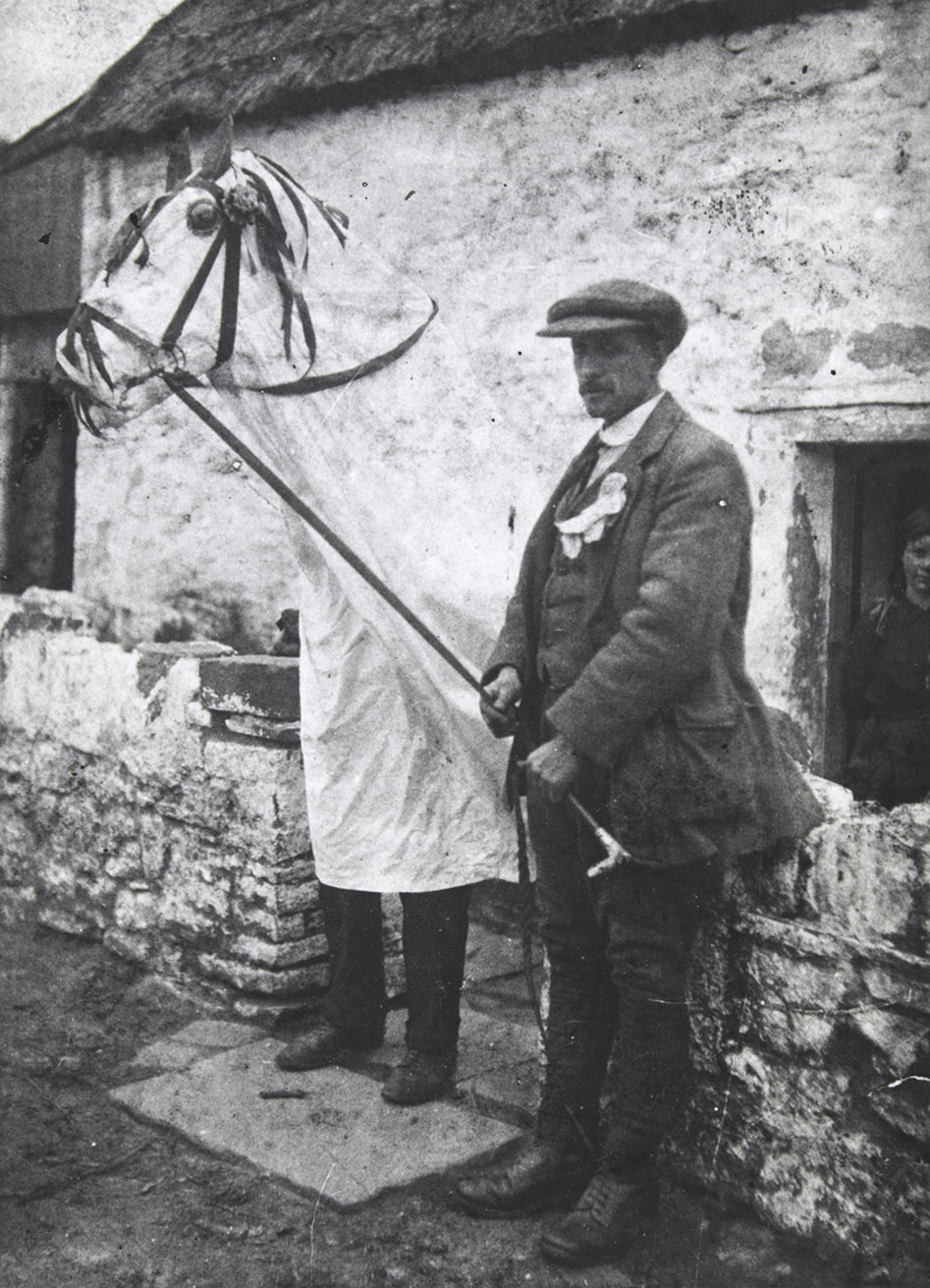
The Mari Lwyd is a wassailing folk custom from South Wales involving a hobby horse made from a decorated horse skull. Groups of men carry the figure to local houses, where they engage in a musical debate with householders to gain entry for food and drink during the Christmas season.
- A horse skull mounted on a pole and covered with a white sheet
- Performed in South Wales during Christmas and New Year
- Involves a musical debate called pwnco with householders
- Etymology debated: Grey Mare vs Holy Mary
- Revived in the mid-twentieth century after declining
What it is
The Mari Lwyd is a traditional wassailing custom originating in South Wales. It centers on a hobby horse constructed from a real horse's skull mounted on a pole and draped with a white sheet. An individual hides beneath the sheet to carry the device, while others in the group dress as stock characters like Punch and Judy. The practice involves a team visiting local homes to perform songs and engage in a verbal exchange with the residents.
Where it comes from
Scholars have debated the origins of the Mari Lwyd for centuries. Some early folklorists suggested it was a pre-Christian religious rite that survived Christianization, though modern support for this view has declined due to a lack of evidence. Other theories link it to sixteenth-century elite fashion for hobby horses or to mystery plays. The etymology of the name itself is disputed, with interpretations ranging from 'Grey Mare' to 'Holy Mary' or even 'Grey Death'.
How it is done
The performance begins at dusk when the party approaches a house and sings a request for entry. The householders respond with excuses, leading to a musical debate known as pwnco. This back-and-forth continues until the householders run out of ideas, at which point they must allow the team inside. Once admitted, the group provides entertainment by running around, neighing, and playing music while the householders offer ale and food.
Tools and materials
The primary tool is the Mari Lwyd head, typically a horse's skull decorated with ribbons and attached to a pole. A white sheet covers the carrier and the pole. Some versions featured wooden or paper heads, glass eyes, or jaws that could open and close via strings. The accompanying performers often carried props such as staffs, whips, brooms, and fire irons to enhance their character roles.
Mari Lwyd, drawn and placed
- Living
- Revived
- Fading
- Historical
- Legendary
- Performed
- Lineage
- Celtic tradition
- Timing
- winter festivals around Christmas and New Year
What it is for
The custom serves as a form of seasonal celebration and social bonding. It is believed to bring good luck and community spirit during the winter holidays. The interaction between the visitors and the hosts reinforces local ties through shared song and hospitality. The practice is not intended for healing or divination but rather for festive entertainment and maintaining cultural traditions.
Who does it
The tradition is performed by groups of men who travel together to visit houses. The group typically includes a leader carrying a staff, a musician, and individuals dressed in specific costumes. Historically, the preparation of the horse head was a communal activity involving many locals. The performers are usually members of the community participating in a shared cultural event.
Peoples and places
The Mari Lwyd is primarily associated with South Wales, particularly areas like Glamorgan and Gower. Variations of the custom exist in other parts of Britain, including Kent and northern England, often under different names like the Hoodening or Old Horse. Similar hooded horse traditions are found in Ireland and the Isle of Man, suggesting a broader regional connection to these types of folk performances.
At a glance: who, where and when
Who does it
Peoples
Belief worlds


What people believe
There is no specific spiritual belief system attached to the Mari Lwyd in its modern form. Earlier interpretations suggested it represented a 'death horse' or a survival of ancient pagan rites, but these views are now considered speculative. The custom is generally understood as a secular folk tradition focused on entertainment and social interaction rather than religious worship or magical efficacy.
When it is done
The Mari Lwyd is performed during the winter season, specifically around Christmas and New Year. Performances typically begin at dusk and may last late into the night. In some villages, the custom is carried out over several consecutive nights. One unique account from Gower mentions the horse head being buried throughout the year and only dug up for use during the Christmas period.
How scholars and sceptics see it
Folklorists have long analyzed the Mari Lwyd, with figures like Iorwerth Peate and E. C. Cawte offering differing interpretations of its name and origins. While early scholars often linked it to pre-Christian rituals, contemporary research emphasizes its development within popular culture and its connection to other British hobby horse traditions. Academic consensus now leans towards a more recent origin influenced by social elites rather than ancient survival.
Cautions and what is closed
The Mari Lwyd does not involve harmful practices or dangerous rituals. It is a safe, community-oriented custom focused on song and hospitality. There are no reports of fraud or legal issues associated with the tradition. The practice is respected as a cultural heritage item and is performed without any risk to participants or observers.
Compare and confuse
The Mari Lwyd is similar to other British hobby horse customs such as the Hoodening of Kent and the Broad of the Cotswolds. These traditions share features like animal skulls or effigies and seasonal performances. However, each custom has distinct regional characteristics and names. The Irish Láir Bhán and Manx Laare Vane also resemble the Mari Lwyd in concept but differ in specific details and cultural context.
Law and persecution
The Mari Lwyd is not subject to specific legal restrictions. It is recognized as a part of Welsh cultural heritage and is permitted to be performed publicly. The tradition has faced occasional opposition from local clergy in the past, but it is currently accepted and celebrated as a legitimate folk custom without legal interference.
Questions people ask about Mari Lwyd
What is the Mari Lwyd?
It is a Welsh wassailing custom featuring a hobby horse made from a horse skull. Groups carry it through villages to sing and seek entry to homes for food and drink during the winter holidays.
Where does the Mari Lwyd come from?
The tradition originates in South Wales, particularly in areas like Glamorgan and Gower. It is part of a broader family of British hobby horse customs found across the region.
What does the name mean?
The name Y Fari Lwyd is debated. It likely means 'Grey Mare' referring to the skull, or 'Holy Mary' referencing the Virgin Mary. Some older sources suggest 'Grey Death' or 'Merry Lude'.
How is the custom performed?
A group visits a house and sings a request for entry. The residents respond with excuses, leading to a musical battle. If the residents lose the debate, they must let the group in and provide refreshments.
Good reading and sources
- Mari Lwyd on WikipediaEncyclopedia
- More photos on Wikimedia CommonsPhotos and video
- Wikidata recordOpen data
The facts on this page come from the Wikipedia article "Mari Lwyd", written by its contributors and used under the CC BY-SA 4.0 licence, and from its Wikidata record (CC0). EveryJaadu rewrote the text in its own words, with AI assistance, and compares every page with the article to make sure no passage is copied. It may be reused under the same CC BY-SA 4.0 licence with a link back.
It may contain mistakes. Names and customs differ from one community to the next, and some knowledge is closed to outsiders and left out here. This page describes belief and practice. It does not say that any of it works, it is not a how-to, and it is not medical advice. If something is wrong, tell us. Last refreshed 2026-10-05.
More from the United Kingdom
All the entries from the United Kingdom 🇮🇪 Ireland and 5 moreTrick-or-treating
A Halloween custom where costumed visitors ask for treats from homesTradition · Luck and prosperity · Wonder and entertainment Living
🇮🇪 Ireland and 5 moreTrick-or-treating
A Halloween custom where costumed visitors ask for treats from homesTradition · Luck and prosperity · Wonder and entertainment Living
 🇩🇪 Germany and 5 moreMaypoleMaibaum
A tall wooden pole raised for European spring festivals, accompanied by dance and celebration.Tradition · Luck and prosperity · Love and attraction Living
🇩🇪 Germany and 5 moreMaypoleMaibaum
A tall wooden pole raised for European spring festivals, accompanied by dance and celebration.Tradition · Luck and prosperity · Love and attraction Living
 🇪🇸 Spain and 5 moreSt John's Eve
A Christian vigil marked by bonfires and plant gathering on the summer solstice eveRite · Protection · Speaking with spirits and the dead Living
🇪🇸 Spain and 5 moreSt John's Eve
A Christian vigil marked by bonfires and plant gathering on the summer solstice eveRite · Protection · Speaking with spirits and the dead Living
 🇬🇧 United Kingdom and 4 moreMummers' play
A folk drama featuring a fight and a resurrection, performed by amateur troupes in the British Isles.Rite · Luck and prosperity · Speaking with spirits and the dead Revived
🇬🇧 United Kingdom and 4 moreMummers' play
A folk drama featuring a fight and a resurrection, performed by amateur troupes in the British Isles.Rite · Luck and prosperity · Speaking with spirits and the dead Revived
Related elsewhere
All rite 🇪🇬 EgyptSham Ennessimشم النسيم
An Egyptian spring holiday marked by picnics, colored eggs, and salted fishTradition · Luck and prosperity · Wonder and entertainment Living
🇪🇬 EgyptSham Ennessimشم النسيم
An Egyptian spring holiday marked by picnics, colored eggs, and salted fishTradition · Luck and prosperity · Wonder and entertainment Living
 🇮🇳 India and 5 moreSnake charming
A street performance using a gourd flute to make snakes swayIllusion · Wonder and entertainment · Luck and prosperity Fading
🇮🇳 India and 5 moreSnake charming
A street performance using a gourd flute to make snakes swayIllusion · Wonder and entertainment · Luck and prosperity Fading
 🇯🇵 Japan and 2 moreTanabataたなばた (七夕)
A Japanese celebration of star-crossed lovers and written wishesTradition · Luck and prosperity · Wonder and entertainment Living
🇯🇵 Japan and 2 moreTanabataたなばた (七夕)
A Japanese celebration of star-crossed lovers and written wishesTradition · Luck and prosperity · Wonder and entertainment Living
 🇯🇵 JapanKitsunebi狐火
Atmospheric ghost lights in Japanese folklore, often linked to foxes and natural phenomena.Belief · Wonder and entertainment · Luck and prosperity Historical
🇯🇵 JapanKitsunebi狐火
Atmospheric ghost lights in Japanese folklore, often linked to foxes and natural phenomena.Belief · Wonder and entertainment · Luck and prosperity Historical