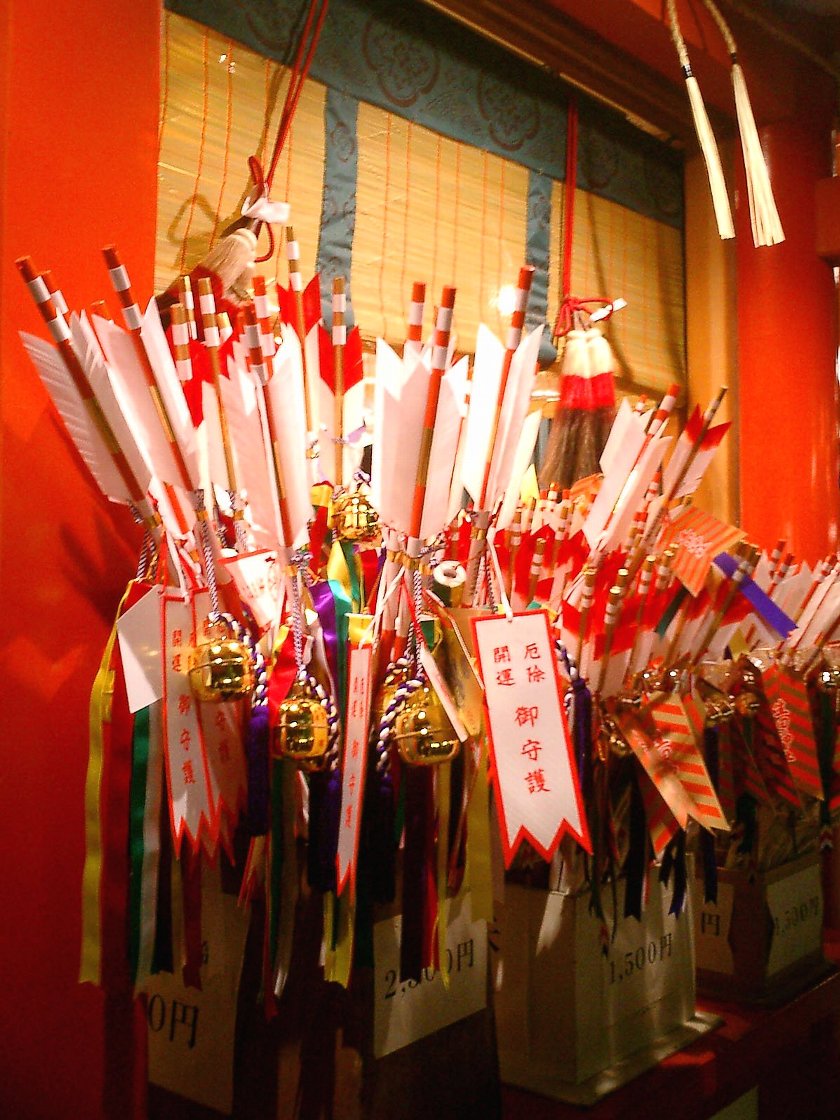
Hamaya
In its own language: 破魔矢
from Japanese hama (target) and ya (arrow), later homophonous with hama meaning 'destroying demons'
A blunt arrow given at shrines to ward off evil and secure good luck for the new year
The hamaya is a Japanese talismanic arrow distributed at Shinto shrines and Buddhist temples. It is traditionally used during New Year celebrations and at births to symbolically shoot down evil spirits and protect the recipient.
- Blunt tip prevents physical harm while destroying evil
- Placed on roofs facing northeast to block oni
- Originates from New Year archery contests called Jarai
- Given to newborns during their first annual festival
- NHK once avoided the name due to a trademark dispute
What it is
The hamaya is a sacred arrow used in Japan as a protective talisman. It is typically given at Shinto shrines and Buddhist temples. The arrow is blunt rather than sharp, designed to purify and destroy evil intentions without causing physical harm. It is often paired with a small bow called the hama yumi. Together, they form a set used to ward off negative forces and bring good fortune.
Where it comes from
The custom likely originated from Jarai, an archery contest held on New Year's Day. Originally, arrows shot at targets called hama were known as hama-ya. The word evolved through homophones; hama also means 'to break' or 'destroy,' and ma means 'demon.' Thus, the term came to signify destroying demonic power. Buddhist traditions also link it to Umāraka, one of the Four Yaksha, who holds a golden bow and arrow.
How it is done
It may also be given to newborns during their first annual festival. Relatives present the arrow to symbolize shooting down evil. Technically, the arrow is considered most effective when shot with its corresponding bow, but holding the arrow alone is accepted as sufficient protection.
Tools and materials
The primary tool is the hamaya itself, a wooden arrow with a blunt tip. It is often accompanied by the hama yumi, a matching bow. In some Buddhist contexts, such as at Rinnō-ji, a specific variant called ryūjin hamaya is sold. The arrow represents the projectile that destroys evil, while the bow represents the unseen divine force or priest enabling the act.
Hamaya, drawn and placed
- Living
- Revived
- Fading
- Historical
- Legendary
- Performed
- Lineage
- Shinto and Buddhist folk practice
- Timing
- New Year, birth, construction of buildings
What it is for
The main intent is protection against evil spirits and bad luck. It is used to cleanse a space or a person of negative influences. Families seek it for newborns to ensure their safety. Homeowners place it on roofs to protect the building. It serves as a symbolic weapon against misfortune, securing a lucky year ahead.
Who does it
Ordinary households use the hamaya. It is obtained from religious sites like shrines and temples. While priests or unseen gods are conceptually involved in 'shooting' the arrow, the layperson simply possesses or displays it. No special training is required to hold or display the talisman.
Peoples and places
The practice is specific to Japan. It is found in both Shinto and Buddhist contexts. The custom is widespread among Japanese families, particularly during New Year visits (Hatsumode) and at births. The distinction between the secular target origin and the religious demon-destroying meaning is unique to this culture.
At a glance: who, where and when
Who does it
Peoples
Belief worlds
Occasions


What people believe
The underlying belief is that evil can be actively destroyed or repelled. The blunt tip signifies that the goal is purification, not violence. Evil is viewed as a tangible force that can be targeted. The northeast direction is culturally significant as the gate of oni (demons). The arrow acts as a conduit for divine or spiritual power to remove these threats.
When it is done
The hamaya is prominently featured during the New Year. It is given during Hatsumode, the first shrine visit of the year. It is also associated with Children's Day for boys and Hinamatsuri for girls, marking a child's first festival. Roof placements occur after the construction of new homes.
Questions people ask about Hamaya
What is a hamaya?
It is a Japanese talismanic arrow given at shrines and temples. It is used to ward off evil spirits and bring good luck for the new year. The arrow is blunt to avoid harming people.
Where does the name come from?
It comes from old archery terms where arrows shot at targets were called hama-ya. The word hama also sounds like 'destroying demons,' merging the meanings over time.
Why is the arrow tip blunt?
The blunt tip shows the intent is to purify and destroy evil intentions, not to cause physical injury to people or objects. It is a symbolic act of cleansing.
When is it used?
It is commonly given during the New Year at shrines. It is also presented to newborns during their first annual festival, such as Children's Day or Hinamatsuri.
Does it need a bow to work?
Technically, it is most effective when shot with the matching hama yumi bow. However, holding the arrow alone is considered sufficient protection for ordinary people.
Good reading and sources
- Hamaya on WikipediaEncyclopedia
- More photos on Wikimedia CommonsPhotos and video
- Wikidata recordOpen data
The facts on this page come from the Wikipedia article "Hamaya", written by its contributors and used under the CC BY-SA 4.0 licence, and from its Wikidata record (CC0). EveryJaadu rewrote the text in its own words, with AI assistance, and compares every page with the article to make sure no passage is copied. It may be reused under the same CC BY-SA 4.0 licence with a link back.
It may contain mistakes. Names and customs differ from one community to the next, and some knowledge is closed to outsiders and left out here. This page describes belief and practice. It does not say that any of it works, it is not a how-to, and it is not medical advice. If something is wrong, tell us. Last refreshed 2026-10-06.
More from Japan
All the entries from Japan 🇯🇵 JapanOfudaお札/御札 (ofuda)
Paper and wooden talismans from Japanese Shinto shrines and Buddhist templesCharm · Protection · Cleansing and purification Living
🇯🇵 JapanOfudaお札/御札 (ofuda)
Paper and wooden talismans from Japanese Shinto shrines and Buddhist templesCharm · Protection · Cleansing and purification Living
 🇯🇵 JapanOmamori御守/お守り
Japanese amulets from shrines and temples for luck and protectionCharm · Protection · Luck and prosperity Living
🇯🇵 JapanOmamori御守/お守り
Japanese amulets from shrines and temples for luck and protectionCharm · Protection · Luck and prosperity Living
 🇨🇳 China and 1 moreFulu符籙
Taoist talismans with cryptic symbols used for healing and protectionCharm · Healing · Protection Living
🇨🇳 China and 1 moreFulu符籙
Taoist talismans with cryptic symbols used for healing and protectionCharm · Healing · Protection Living
 🇨🇳 China and 5 moreChinese guardian lions石獅 (shíshī)
Stone lion pairs placed at entrances to ward off harm and welcome fortuneCharm · Protection · Luck and prosperity Living
🇨🇳 China and 5 moreChinese guardian lions石獅 (shíshī)
Stone lion pairs placed at entrances to ward off harm and welcome fortuneCharm · Protection · Luck and prosperity Living
Related elsewhere
All charm 🇧🇪 Belgium and 2 moreHorseshoe
A metal shoe for a horse's hoof and a talisman of good fortuneCharm · Protection · Luck and prosperity Living
🇧🇪 Belgium and 2 moreHorseshoe
A metal shoe for a horse's hoof and a talisman of good fortuneCharm · Protection · Luck and prosperity Living
 🇪🇬 Egypt and 3 moreAmulet
A portable object worn or carried to ward off harm and invite fortuneCharm · Protection · Luck and prosperity Living
🇳🇿 New ZealandKarakia
Māori recitations used for spiritual guidance, protection, and formal greetingsTradition · Protection · Speaking with spirits and the dead Living
🇪🇬 Egypt and 3 moreAmulet
A portable object worn or carried to ward off harm and invite fortuneCharm · Protection · Luck and prosperity Living
🇳🇿 New ZealandKarakia
Māori recitations used for spiritual guidance, protection, and formal greetingsTradition · Protection · Speaking with spirits and the dead Living
 🇮🇳 India and 5 moreKolamகோலம்
A daily geometric floor drawing made with rice flour at the home entrance in South IndiaTradition · Protection · Luck and prosperity Living
🇮🇳 India and 5 moreKolamகோலம்
A daily geometric floor drawing made with rice flour at the home entrance in South IndiaTradition · Protection · Luck and prosperity Living