
Green Man
from the English term for a nature spirit associated with vegetation
A carved face made of leaves, used as a decorative motif in architecture and art.
The Green Man is an architectural motif featuring a face surrounded by or emerging from foliage. It appears on buildings across Europe and is traditionally interpreted as a symbol of rebirth and the cycle of new growth.
- Faces emerge from dense leaf patterns in stone carvings.
- Lady Raglan coined the name in 1939 based on Welsh churches.
- Scholars trace origins to India via Arab and monastic routes.
- The motif appeared on Charles III coronation invitations in 2023.
- Victorian architects revived the style during the Gothic Revival.
What it is
The Green Man is a visual theme found in art and building design. It shows a human face made of, or hidden within, leaves and vines. The image usually spreads outward from the center of the face. People see it as a sign of spring and new life. It stands for the yearly return of plants after winter. The figure is often male, though female versions exist rarely. It serves as a decoration on walls, pillars, and ceilings.
Where it comes from
Art historians link the style to Iron Age Celtic metalwork. Those older pieces showed faces inside plant patterns. Late Roman art also used leaf masks for gods. A silver dish from Suffolk shows a sea god with seaweed hair. Some scholars trace the idea to India. They say it moved through Arab lands into Christian Europe. There it decorated monk books before moving to stone carvings.
Tools and materials
Stone masons use chisels to shape rock. Woodworkers carve timber beams. Artists paint the image on manuscripts. Metalworkers stamp the design onto plates. Glassmakers create stained window versions. The materials change, but the leafy face remains the same.
Green Man, drawn and placed
- Living
- Revived
- Fading
- Historical
- Legendary
- Performed
- Lineage
- European architectural sculpture
What it is for
Builders placed these figures on churches and homes. They wanted to add natural beauty to stone structures. Some believe the images taught religious stories. One tale links the leaves to the True Cross. Another view sees them as pagan symbols of nature. Modern architects use them for pure decoration.
Who does it
Medieval stonemasons created the original carvings. Monks drew early versions in prayer books. Victorian architects revived the style in the 1800s. Modern designers still use the motif today. They apply it to both sacred and secular buildings.
Peoples and places
The motif spread across Western Europe. England has many examples in its churches. France contributed early designs that influenced English work. Cyprus features carved heads on church facades. Australian builders adopted the style for local structures. The image traveled far from its likely Indian roots.
At a glance: who, where and when
Who does it


What people believe
Lady Raglan called the figure a pagan myth in 1939. Scholars now doubt this ancient origin theory. Some Christians link the leaves to the legend of Seth. He planted seeds in Adam's grave to grow the Cross tree. This story appeared in popular medieval religious books. The connection helps explain the image in church settings.
When it is done
The Green Man represents springtime renewal. It marks the cycle of plant growth. No specific festival days are tied to the carving. It appears year-round on permanent structures. The image celebrates the seasonal return of greenery.
How scholars and sceptics see it
Historians study the motif's path from India to Europe. Kathleen Basford and Mercia MacDermott traced its spread. They found it started in manuscripts before becoming stone art. Experts reject the idea that it is purely pagan. They see it as a European artistic development with varied influences.
Cautions and what is closed
Some royal invitations used the image recently. This caused public debate about its meaning. Critics noted it was not ancient British folklore. It was a European import adapted for modern use. The controversy highlights how people interpret old symbols differently.
Compare and confuse
The Green Man resembles foliate masks in Roman art. It shares traits with Celtic vegetal ornament. It differs from animal-headed grotesques found later. The term covers many visual variations. All share the core idea of a face made of plants.
Law and persecution
No laws restrict the use of the Green Man. It is a common artistic theme. Buildings with these carvings are protected as heritage sites. The motif is free for artists to use today.
Questions people ask about Green Man
What is the Green Man?
It is an architectural motif showing a face made of leaves. It appears on buildings in Europe and symbolizes rebirth and spring growth.
Where did the Green Man originate?
Scholars suggest it began in India, moved through Arab lands, and entered Europe via manuscript decorations before appearing in stone carvings.
Is the Green Man a pagan god?
Lady Raglan proposed this in 1939, but modern evidence does not support it. It is likely a European artistic motif with Christian and classical influences.
Why is it found in churches?
It may illustrate sermons about the True Cross growing from Adam's grave. It also simply decorated Gothic and Romanesque architecture.
Is the Green Man still used today?
Yes, architects and artists use it for decoration. It appeared on recent royal invitations and remains popular in modern building design.
Good reading and sources
- The coronation invitation reviewed – is Charles planning a pumping pagan party?The Guardian, Article
- The Remarkable Persistence of the Green ManThe New Yorker, Article
- Green Man on WikipediaEncyclopedia
- More photos on Wikimedia CommonsPhotos and video
- Wikidata recordOpen data
The facts on this page come from the Wikipedia article "Green Man", written by its contributors and used under the CC BY-SA 4.0 licence, and from its Wikidata record (CC0). EveryJaadu rewrote the text in its own words, with AI assistance, and compares every page with the article to make sure no passage is copied. It may be reused under the same CC BY-SA 4.0 licence with a link back.
It may contain mistakes. Names and customs differ from one community to the next, and some knowledge is closed to outsiders and left out here. This page describes belief and practice. It does not say that any of it works, it is not a how-to, and it is not medical advice. If something is wrong, tell us. Last refreshed 2026-10-05.
More from the United Kingdom
All the entries from the United Kingdom 🇩🇪 Germany and 2 morePhantasmagoria
A horror theatre using magic lanterns to project frightening images in the darkIllusion · Wonder and entertainment Historical
🇩🇪 Germany and 2 morePhantasmagoria
A horror theatre using magic lanterns to project frightening images in the darkIllusion · Wonder and entertainment Historical
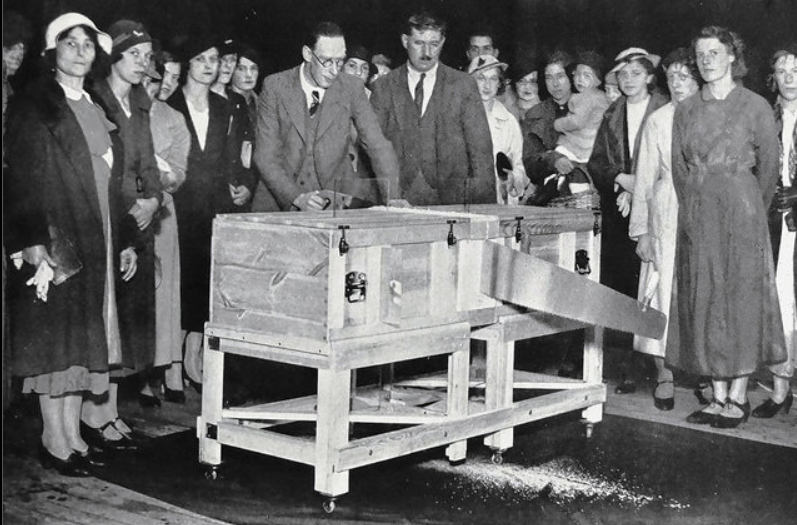 🇬🇧 United Kingdom and 1 moreSawing a woman in half
A stage illusion where an assistant appears to be cut into pieces inside a box or on a tableIllusion · Wonder and entertainment Living
🇬🇧 United Kingdom and 1 moreSawing a woman in half
A stage illusion where an assistant appears to be cut into pieces inside a box or on a tableIllusion · Wonder and entertainment Living
 🇬🇧 United KingdomEgyptian Hall
A London exhibition hall known for magic shows and Egyptian-style architecture, demolished in 1905.Illusion · Wonder and entertainment Historical
🇬🇧 United KingdomEgyptian Hall
A London exhibition hall known for magic shows and Egyptian-style architecture, demolished in 1905.Illusion · Wonder and entertainment Historical
Related elsewhere
All illusion 🇪🇬 Egypt and 1 moreSphinx
A mythical hybrid with a human head and lion body, serving as guardian or riddler in Egyptian and Greek traditions.Being · Protection · Wonder and entertainment Legendary
🇷🇺 Russia and 3 moreNart sagaНарты кадджытæ
A collection of epic tales from the North Caucasus about a legendary group of heroes.Text · Wonder and entertainment Historical
🇪🇬 EgyptDjedi
A fictional magician from the Westcar Papyrus who resurrects animals and foretells a king's lineage.Figure · Seeing and foretelling · Wonder and entertainment Legendary
🇨🇱 ChileChilean mythology
The myths and legends of Chile, blending indigenous roots with colonial influences.Tradition · Wonder and entertainment Living
🇪🇬 Egypt and 1 moreSphinx
A mythical hybrid with a human head and lion body, serving as guardian or riddler in Egyptian and Greek traditions.Being · Protection · Wonder and entertainment Legendary
🇷🇺 Russia and 3 moreNart sagaНарты кадджытæ
A collection of epic tales from the North Caucasus about a legendary group of heroes.Text · Wonder and entertainment Historical
🇪🇬 EgyptDjedi
A fictional magician from the Westcar Papyrus who resurrects animals and foretells a king's lineage.Figure · Seeing and foretelling · Wonder and entertainment Legendary
🇨🇱 ChileChilean mythology
The myths and legends of Chile, blending indigenous roots with colonial influences.Tradition · Wonder and entertainment Living