
Gorakhnath
In its own language: गोरक्षनाथ
A Hindu yogi and saint who founded the Nath monastic order in India.
Gorakhnath was a medieval Indian yogi and the founder of the Nath monastic movement. He is revered as a great master in Hindu tradition and is considered one of the nine saints in a spiritual lineage that traces back to Shiva.
- Founder of the Nath monastic movement in India.
- Revered as a Mahayogi in Hindu tradition.
- Patron saint of Nepal until the monarchy ended.
- Known as Korakkar in the Tamil Siddhar tradition.
- Established free community kitchens in Punjab.
What it is
Gorakhnath stands as a central figure in Hindu spiritual history. He is recognized as a mahasiddha, a term for an accomplished yogi, and a saint who established the Nath monastic community in India. Devotees view him as a Maha-yogi, or great master, who guides seekers toward spiritual liberation. His teachings focus on the pursuit of truth through disciplined practice rather than rigid metaphysical dogma. Followers believe he transcended ordinary time, appearing across different ages to instruct humanity.
Where it comes from
Scholars place his life in the first half of the second millennium CE, though exact dates vary. Estimates range from the eleventh to the fourteenth century based on textual and archaeological evidence. Some historians suggest he may have originally followed Buddhist traditions before converting to Hinduism and championing Shaivism. Hagiographies describe him as superhuman, with legends placing his origins in northwest India or the eastern regions, but these accounts lack concrete biographical details.
How it is done
Gorakhnath emphasized yoga and the guidance of an enlightened guru as paths to samadhi, a state of spiritual liberation. He taught that the unbiased search for truth is a natural goal for humans. The Nath order he founded developed specific yogic practices, including hatha yoga, which some scholars link directly to his influence. Others argue these practices originated from other Hindu groups like the Dashanami Sampradaya.
Gorakhnath, drawn and placed
- Living
- Revived
- Fading
- Historical
- Legendary
- Performed
- Lineage
- Nath Sampradaya
What it is for
The Nath order serves as a cultural and social hub in many Indian communities. Monasteries and temples dedicated to Gorakhnath provide free community kitchens, known as langars, to pilgrims and visitors. These institutions preserve his philosophical texts and maintain the spiritual lineage. In Nepal, he is worshipped as a patron saint, reflecting his broad regional significance beyond India.
Who does it
His followers are known by various names, including Jogi, Gorakhnathi, Darshani, and Kanphata. The Nath Sampradaya operates monasteries that publish texts on his philosophy. Scholars study his impact on yoga history and religious movements. In Tamil Nadu, the Siddhar tradition reveres him as Korakkar, one of eighteen esteemed siddhars, linking him to local medicinal and poetic traditions.
Peoples and places
Gorakhnath is widely venerated in rural India, with temples in states like Maharashtra, Odisha, and Uttar Pradesh. In Nepal, he holds a special status, with historical districts and caves named after him. The Bengali Hindu community in West Bengal, Tripura, Assam, and Bangladesh also follows the Nath tradition. In South India, the Siddhar tradition incorporates him into their own lineage of masters.
At a glance: who, where and when


What people believe
Hagiographies depict Gorakhnath as existing outside normal laws of time. He is said to have appeared multiple times throughout history. The Nath lineage traces back to Adinath and Matsyendranath, with Shiva as the ultimate source. Gorakhnath viewed debates between dualism and nondualism as impractical, focusing instead on personal spiritual discipline leading to illumination.
How scholars and sceptics see it
Historians debate the exact century of his life, citing evidence from Gujarat, Punjab, and literary references. James Mallinson argues against attributing hatha yoga's origins solely to Gorakhnath, pointing to other Hindu groups. Guy Beck maintains that connections between Gorakhnath, the Kanphatas, and hatha yoga are undeniable. Scholars also note his role in establishing community kitchens before the rise of Sikhism.
Today
The Gorakhnath Math in Gorakhpur continues to serve as a center for cultural activities and syncretism in a Muslim-majority area. Temples and shrines across India and Nepal remain active sites of worship. The Nath order persists in Bengal and Bangladesh, maintaining its distinct identity despite historical marginalization. His legacy endures through both monastic institutions and popular devotion.
Questions people ask about Gorakhnath
Who was Gorakhnath?
He was a medieval Hindu yogi and saint who founded the Nath monastic order in India. Devotees consider him a great master who guides seekers toward spiritual liberation through yoga and disciplined practice.
Where did Gorakhnath come from?
Legends place his origins in northwest India or eastern regions like Assam. Historians estimate he lived between the eleventh and fourteenth centuries CE, though exact dates remain disputed among scholars.
What is his connection to Nepal?
He is worshipped as a patron saint in Nepal. Historical districts and caves bear his name, and locals celebrate festivals honoring his meditation and spiritual presence in the region.
How is he viewed in South India?
In Tamil Nadu, the Siddhar tradition reveres him as Korakkar, one of eighteen esteemed siddhars. He is linked to local medicinal poetry and alchemical practices in this cultural context.
What did Gorakhnath teach?
He emphasized the unbiased search for truth and spiritual discipline under a guru. He believed these paths lead to samadhi, a state of liberation, regardless of specific metaphysical theories.
Good reading and sources
- Gorakhnath on WikipediaEncyclopedia
- More photos on Wikimedia CommonsPhotos and video
- Wikidata recordOpen data
The facts on this page come from the Wikipedia article "Gorakhnath", written by its contributors and used under the CC BY-SA 4.0 licence, and from its Wikidata record (CC0). EveryJaadu rewrote the text in its own words, with AI assistance, and compares every page with the article to make sure no passage is copied. It may be reused under the same CC BY-SA 4.0 licence with a link back.
It may contain mistakes. Names and customs differ from one community to the next, and some knowledge is closed to outsiders and left out here. This page describes belief and practice. It does not say that any of it works, it is not a how-to, and it is not medical advice. If something is wrong, tell us. Last refreshed 2026-10-05.
More from India
All the entries from India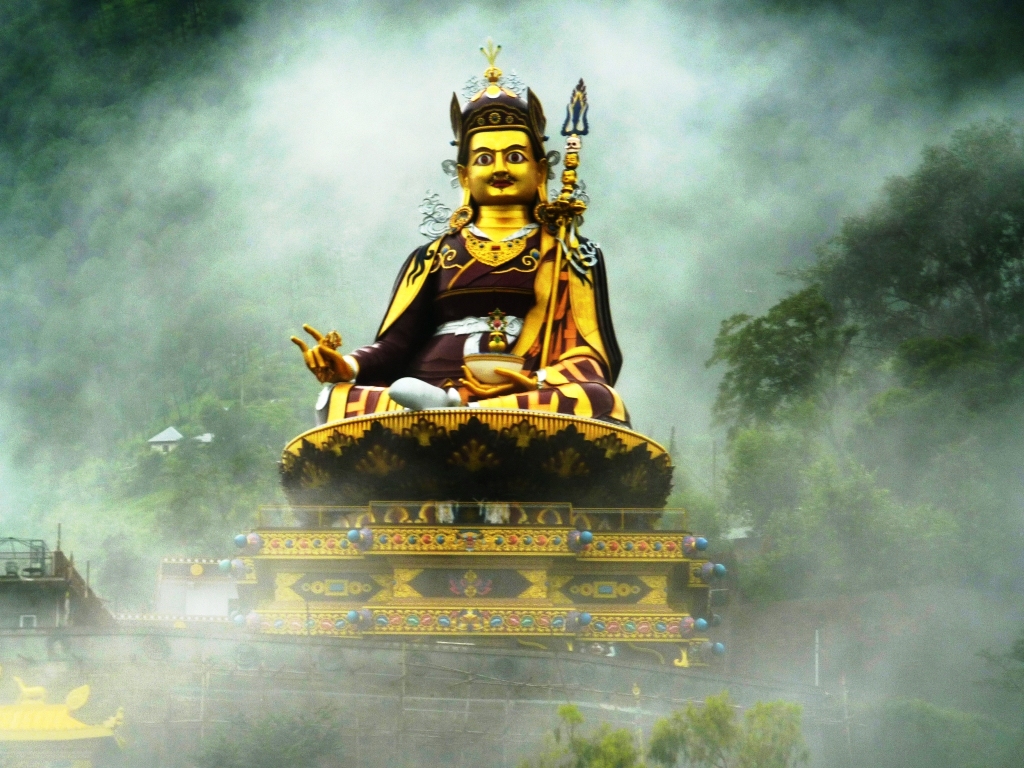 🇮🇳 India and 2 morePadmasambhavaཔདྨ་འབྱུང་གནས།
A tantric master credited with establishing Buddhism in Tibet and founding the Nyingma school.Figure · Protection · Power and authority Living
🇮🇳 India and 2 morePadmasambhavaཔདྨ་འབྱུང་གནས།
A tantric master credited with establishing Buddhism in Tibet and founding the Nyingma school.Figure · Protection · Power and authority Living
 🇳🇵 Nepal and 1 moreMatsyendranathMacchindranāth, Mīnanātha
A yogi and rain deity revered across Hindu and Buddhist traditions in South Asia.Figure · Speaking with spirits and the dead · Power and authority Living
🇳🇵 Nepal and 1 moreMatsyendranathMacchindranāth, Mīnanātha
A yogi and rain deity revered across Hindu and Buddhist traditions in South Asia.Figure · Speaking with spirits and the dead · Power and authority Living
 🇮🇳 India and 1 moreYoginiयोगिनी
A female master of yoga and tantra, or a fierce goddess aspect in Indian temples.Tradition · Power and authority · Protection Historical
🇮🇳 India and 1 moreYoginiयोगिनी
A female master of yoga and tantra, or a fierce goddess aspect in Indian temples.Tradition · Power and authority · Protection Historical
 🇮🇳 India and 1 moreTilopa
A tenth-century Buddhist tantric master who transmitted Mahamudra and the Six Yogas of Naropa.Figure · Change and initiation · Power and authority Historical
🇮🇳 India and 1 moreTilopa
A tenth-century Buddhist tantric master who transmitted Mahamudra and the Six Yogas of Naropa.Figure · Change and initiation · Power and authority Historical
Related elsewhere
All figure 🇪🇬 Egypt and 4 moreAnimal sacrifice
The ritual killing of livestock or wild animals as an offering to deitiesRite · Speaking with spirits and the dead · Power and authority Historical
🇪🇬 Egypt and 4 moreAnimal sacrifice
The ritual killing of livestock or wild animals as an offering to deitiesRite · Speaking with spirits and the dead · Power and authority Historical
 🇫🇷 France and 2 moreÉliphas Lévi
A French writer who shaped modern occult thought and ceremonial magic.Text · Power and authority · Speaking with spirits and the dead Historical
🇳🇴 NorwayEsbat
A monthly Wiccan ritual held at the full or new moon for worship and community.Rite · Speaking with spirits and the dead · Love and attraction Living
🇫🇷 France and 2 moreÉliphas Lévi
A French writer who shaped modern occult thought and ceremonial magic.Text · Power and authority · Speaking with spirits and the dead Historical
🇳🇴 NorwayEsbat
A monthly Wiccan ritual held at the full or new moon for worship and community.Rite · Speaking with spirits and the dead · Love and attraction Living
 🇮🇩 IndonesiaNyepiᬜᬾᬧᬶ
A Balinese day of total silence, fasting, and self-reflection to mark the new year.Rite · Cleansing and purification · Speaking with spirits and the dead Living
🇮🇩 IndonesiaNyepiᬜᬾᬧᬶ
A Balinese day of total silence, fasting, and self-reflection to mark the new year.Rite · Cleansing and purification · Speaking with spirits and the dead Living