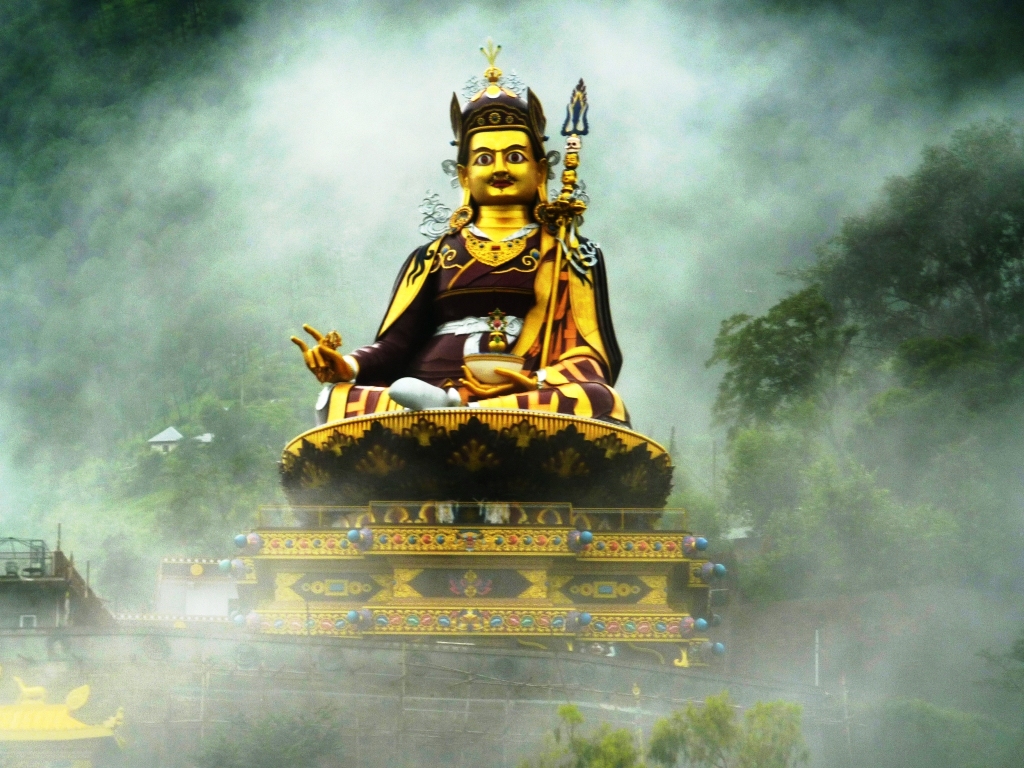
Padmasambhava
In its own language: པདྨ་འབྱུང་གནས།
Sanskrit for 'Born from a Lotus'
A tantric master credited with establishing Buddhism in Tibet and founding the Nyingma school.
Padmasambhava is a semi-legendary Vajra master from medieval India who introduced Vajrayana Buddhism to Tibet in the eighth century. He is revered as an emanation of Shakyamuni Buddha and the founder of the Nyingma school, known for taming local spirits and concealing secret teachings.
- Founded Samye Monastery, the first Buddhist monastery in Tibet.
- Considered an emanation of Shakyamuni Buddha.
- Concealed secret texts known as terma for future discovery.
- Subdued local spirits to protect the Buddhist Dharma.
- Founder of the Nyingma school of Tibetan Buddhism.
What it is
Padmasambhava is a central figure in Tibetan Buddhism, regarded as a historical tantric master who brought Vajrayana practices to the Himalayas during the eighth century. He is viewed as an emanation of Shakyamuni Buddha and the primary founder of the Nyingma school. His legacy includes the establishment of the first monastery in Tibet and the concealment of secret teachings for future discovery. Devotees see him as a powerful protector who subdued local deities to ensure the spread of Buddhist doctrine.
Where it comes from
Early sources like the Testament of Ba place his arrival in Tibet under King Trisong Detsen to help build Samye Monastery. While earlier scholars questioned his historicity, modern Tibetology cautiously accepts his existence based on textual evidence and rock formations believed to be his footprints. Hagiographies began appearing around the twelfth century, expanding his role from a historical adept to a mythic figure who tamed all spirits and concealed treasures.
How it is done
Traditional accounts describe Padmasambhava using ritual power to identify and subdue hostile local gods, turning them into guardians of the Dharma. He taught tantric yoga and initiated the king into sacred rites. In practice, followers visualize his form during guru yoga and seek visions of him through meditation. The tradition holds that he hid texts called termas, which are later discovered by tertöns when conditions are ripe.
Tools and materials
Key symbols include the lotus blossom, representing his miraculous birth, and the khatvanga staff, a ritual implement used in tantric practice. He is associated with terma, or hidden treasure texts, which serve as spiritual resources for future generations. The copper palace biography and other hagiographical works act as textual tools for understanding his life and deeds.
Padmasambhava, drawn and placed
- Living
- Revived
- Fading
- Historical
- Legendary
- Performed
- Lineage
- Nyingma school of Tibetan Buddhism
What it is for
Practitioners venerate Padmasambhava for protection, spiritual power, and communion with enlightened beings. He is invoked to remove obstacles and provide guidance through the revealed termas. The Nyingma school traces its Dzogchen lineage to him, viewing him as a source of ultimate wisdom. Devotees believe his presence ensures the stability of the Dharma and the well-being of the community.
Who does it
The Nyingma school considers him a founding figure, and his teachings are preserved by lamas and practitioners within this tradition. Scholars study the extensive hagiographical corpus to understand the development of Tibetan Buddhist mythology. Historians examine early manuscripts to distinguish between historical events and later legendary expansions of his life story.
Peoples and places
Padmasambhava is widely venerated across Tibet, Nepal, Bhutan, and parts of India. In Nepal, sites like Maratika Cave and Muktinath Temple are linked to his meditative practices. In India, Rewalsar Lake is a major pilgrimage site associated with his teachings. The tradition has spread globally, with devotees worldwide participating in rituals and visualizations centered on his life and teachings.
At a glance: who, where and when


What people believe
He is considered an emanation of Shakyamuni Buddha, foretold to appear in Tibet. The worldview holds that enlightened beings can manifest in various forms, including miraculous births from lotuses or human wombs. His taming of demons reflects the Buddhist principle of transforming negative forces into protectors of the faith. The concept of terma suggests that teachings are hidden until the time is right for their revelation.
How scholars and sceptics see it
Lewis Doney notes that while early Tibetologists doubted his authenticity, contemporary scholarship cautiously accepts his historical basis. Researchers analyze texts like the Testament of Ba and Dunhuang manuscripts to trace the evolution of his legend. Studies highlight how hagiographies expanded his profile from a tantric adept to a central mythic architect of Tibetan Buddhism, linking him to key lineages and practices.
Compare and confuse
He is often compared to other Indian masters like Vimalamitra and Songtsen Gampo, who also played roles in introducing Buddhism to Tibet. However, the Padmasambhava narrative eventually dominated these parallel traditions. His role as a spirit-tamer parallels figures like Vajrapani, but his specific association with the Nyingma school and terma tradition distinguishes him uniquely.
Today
Padmasambhava remains a vital figure in living Tibetan Buddhist communities. Pilgrimages to sites like Rewalsar and Samye continue, and his teachings are actively practiced. The global spread of Tibetan Buddhism has introduced his veneration to international audiences. Contemporary practitioners engage with his legacy through meditation, study of termas, and participation in rituals that honor his contributions to the Dharma.
Questions people ask about Padmasambhava
Who was Padmasambhava?
He was a tantric master from medieval India who introduced Vajrayana Buddhism to Tibet in the eighth century. He is revered as an emanation of Buddha and the founder of the Nyingma school.
What does his name mean?
Padmasambhava means 'Born from a Lotus' in Sanskrit. It refers to the legend that he appeared miraculously from a lotus flower in a lake.
Why is he important to Tibetans?
He established the first monastery at Samye and tamed local spirits, ensuring the spread of Buddhism. He is seen as a protector and a source of hidden teachings.
What are terma?
Terma are secret texts hidden by Padmasambhava. They are believed to be discovered by special individuals called tertöns when the time is right for their teachings.
Good reading and sources
- Padmasambhava on WikipediaEncyclopedia
- More photos on Wikimedia CommonsPhotos and video
- Wikidata recordOpen data
The facts on this page come from the Wikipedia article "Padmasambhava", written by its contributors and used under the CC BY-SA 4.0 licence, and from its Wikidata record (CC0). EveryJaadu rewrote the text in its own words, with AI assistance, and compares every page with the article to make sure no passage is copied. It may be reused under the same CC BY-SA 4.0 licence with a link back.
It may contain mistakes. Names and customs differ from one community to the next, and some knowledge is closed to outsiders and left out here. This page describes belief and practice. It does not say that any of it works, it is not a how-to, and it is not medical advice. If something is wrong, tell us. Last refreshed 2026-10-05.
More from India
All the entries from India 🇮🇳 IndiaChakraचक्र
Meditation points in the subtle body used in Hindu and Buddhist yogaTradition · Speaking with spirits and the dead · Change and initiation Living
🇮🇳 IndiaChakraचक्र
Meditation points in the subtle body used in Hindu and Buddhist yogaTradition · Speaking with spirits and the dead · Change and initiation Living
 🇮🇳 IndiaKamakhya Templekamakhya mondir
A Hindu temple in Assam known for its yoni shrine and the Ambubachi Mela festivalTradition · Protection · Healing Living
🇮🇳 IndiaMuhurtamuhūrta
A Hindu unit of time used to select auspicious moments for rituals and daily practiceBelief · Power and authority · Speaking with spirits and the dead Living
🇮🇳 IndiaKamakhya Templekamakhya mondir
A Hindu temple in Assam known for its yoni shrine and the Ambubachi Mela festivalTradition · Protection · Healing Living
🇮🇳 IndiaMuhurtamuhūrta
A Hindu unit of time used to select auspicious moments for rituals and daily practiceBelief · Power and authority · Speaking with spirits and the dead Living
 🇮🇳 India and 1 moreAshtamangalaअष्टमङ्गल
A set of eight sacred symbols used in Indian religions to mark auspicious occasions and teach spiritual truths.Tradition · Power and authority · Wonder and entertainment Living
🇮🇳 India and 1 moreAshtamangalaअष्टमङ्गल
A set of eight sacred symbols used in Indian religions to mark auspicious occasions and teach spiritual truths.Tradition · Power and authority · Wonder and entertainment Living
Related elsewhere
All figure 🇳🇬 Nigeria and 5 moreIfá
A Yoruba divination system using palm nuts to access spiritual guidanceTradition · Seeing and foretelling · Speaking with spirits and the dead Living
🇳🇬 Nigeria and 5 moreIfá
A Yoruba divination system using palm nuts to access spiritual guidanceTradition · Seeing and foretelling · Speaking with spirits and the dead Living
 🇪🇬 Egypt and 4 moreAnimal sacrifice
The ritual killing of livestock or wild animals as an offering to deitiesRite · Speaking with spirits and the dead · Power and authority Historical
🇪🇬 Egypt and 4 moreAnimal sacrifice
The ritual killing of livestock or wild animals as an offering to deitiesRite · Speaking with spirits and the dead · Power and authority Historical
 🇪🇬 Egypt and 5 moreSacred dance
Movement used in worship to honour deities, heal communities, or connect with the spirit world.Tradition · Protection · Healing Living
🇪🇬 Egypt and 5 moreSacred dance
Movement used in worship to honour deities, heal communities, or connect with the spirit world.Tradition · Protection · Healing Living