
Egyptian Hall
named for its architectural style inspired by ancient Egypt
A London exhibition hall known for magic shows and Egyptian-style architecture, demolished in 1905.
The Egyptian Hall was an exhibition venue in Piccadilly, London, built in the ancient Egyptian style in 1812. It became famous as a centre for magic performances and spiritualism, earning the nickname England's Home of Mystery before its demolition in 1905.
- Built in 1812 by architect Peter Frederick Robinson
- Known as England's Home of Mystery
- Hosted Maskelyne and Cooke for 31 years
- Demolished in 1905 for flats and offices
- Featured Napoleon's carriage exhibition in 1816
What it is
The Egyptian Hall served as a prominent entertainment venue in London during the nineteenth century. Located in Piccadilly, it functioned primarily as a space for public spectacles, including art exhibitions, lectures, and popular theatre. The structure itself was designed to resemble ancient Egyptian temples, featuring distinctive architectural elements that drew public interest. Over time, the hall gained a specific reputation within the performing arts community. It became widely recognized as a central location for conjuring acts and magical demonstrations. This association with illusion work defined its later years and established its legacy in British performance history.
Where it comes from
William Bullock commissioned the building to house his personal museum collection. Construction began after he sought a dedicated London space for his artifacts, which included items from Captain Cook's voyages. Architect Peter Frederick Robinson designed the structure, completing it in 1812 at a significant cost. The design reflected a growing European fascination with Egyptian antiquities, influenced by recent publications and earlier interior designs. Bullock initially used the venue to display ethnographical and natural history specimens. He charged admission fees, generating substantial profit from ticket sales. The museum operated under several names, including Bullock's Museum and the London Museum, before shifting focus toward broader public entertainment.
Tools and materials
The venue relied on standard theatrical equipment suitable for large-scale productions. Illusionists employed mechanical devices, hidden compartments, and specialized lighting to create visual effects. Props varied depending on the specific act, ranging from simple cards to elaborate apparatuses for vanishing acts. The architecture itself, with its high ceilings and open floor plan, facilitated the movement of large sets and performers. No single tool defines the hall; rather, it was the combination of stagecraft and architectural space that enabled its famous performances.
Egyptian Hall, drawn and placed
- Living
- Revived
- Fading
- Historical
- Legendary
- Performed
- Lineage
- British stage magic tradition
- Timing
- regular public performances
What it is for
The primary purpose was public amusement and education through spectacle. Visitors paid to view art, learn about distant cultures, or experience magical wonders. For performers, the hall offered a prestigious platform to reach wide audiences and establish professional reputations. The exposure of spiritualist frauds served both an entertaining and critical function, challenging supernatural claims through practical demonstration. The venue catered to diverse interests, from high art to popular curiosity, making it a versatile cultural hub in London.
Who does it
Professional magicians and entertainers formed the core community associated with the hall. Maskelyne and Cooke were the most notable figures, maintaining long residencies that defined the venue's identity. They trained in the craft of illusion and developed routines tailored to the hall's specific dimensions. Other lecturers and artists also used the space, contributing to its varied program. The performers were skilled technicians who combined manual dexterity with theatrical presentation to engage their audiences effectively.
Peoples and places
The Egyptian Hall was a distinctly British institution, located in the heart of London. It attracted visitors from across the United Kingdom and beyond, drawn by its unique architecture and programming. The magic community in Britain adopted it as a key venue, influencing the development of stage illusion in the country. While the architectural style referenced ancient Egypt, the practice and culture surrounding the hall were firmly rooted in Victorian and Edwardian British society.
At a glance: who, where and when
Who does it

What people believe
The performances often addressed contemporary beliefs in spiritualism and the supernatural. By exposing fraudulent mediums, the magicians engaged directly with popular religious and metaphysical trends of the era. The audience generally accepted the reality of the magical effects as artistic creations rather than literal supernatural occurrences. The hall provided a space where skepticism and wonder coexisted, allowing viewers to enjoy the thrill of illusion while critically examining claims of psychic power.
When it is done
The hall operated continuously throughout the year, hosting regular exhibitions and performances. Special events, such as the display of Napoleon's carriage or Turner's watercolours, drew crowds during specific periods. The magic shows followed a consistent schedule, with Maskelyne and Cooke appearing frequently over many years. The venue remained active until its closure in January 1905, when the final performance marked the end of its operational life.
How scholars and sceptics see it
Historians of magic and architecture study the Egyptian Hall as a key site in the development of stage illusion. Scholars note its role in professionalizing conjuring and establishing standards for public performance. The exposure of spiritualist fraud is analyzed as a significant cultural moment, reflecting broader societal debates about science and belief. The building's architectural significance is also recognized, representing the Egyptian Revival style in British urban design. Its demolition is documented in historical records and artistic depictions, preserving its memory in cultural history.
Cautions and what is closed
The hall ceased to exist due to urban development pressures. The building was demolished in 1905 to make room for modern flats and offices. This transformation reflects the changing priorities of London's urban landscape during the early twentieth century. No specific harms or accidents are recorded in relation to the performances themselves. The loss of the building is noted as a遗憾 in the history of London's architectural heritage, though it was replaced by functional commercial spaces.
Compare and confuse
The Egyptian Hall is distinct from other Victorian entertainment venues like Drury Lane or the Alhambra, which focused more on opera, ballet, or variety acts. Its specific association with magic and spiritualism sets it apart. The term England's Home of Mystery highlights its unique niche. Unlike permanent museums, it evolved into a dynamic performance space, blending educational exhibits with theatrical entertainment. Its architectural style links it to other Egyptian Revival structures, but its cultural impact is tied specifically to the history of British stage magic.
Law and persecution
No specific legal restrictions or persecution affected the hall's operation. It functioned legally as a commercial entertainment venue. The demolition was authorized through standard urban planning processes of the time. The replacement buildings complied with contemporary housing and office regulations. The hall's history does not involve significant legal controversies or protective status debates, as it was removed before modern heritage conservation movements gained prominence.
Questions people ask about Egyptian Hall
What was the Egyptian Hall?
It was an exhibition hall in Piccadilly, London, built in 1812. It hosted art, lectures, and magic shows, becoming famous as a centre for stage illusion and spiritualism.
Where was it located?
The Egyptian Hall stood in Piccadilly, in the City of Westminster, London. It occupied the site until its demolition in 1905.
Why was it called England's Home of Mystery?
The nickname arose because the hall hosted long-running magic performances by Maskelyne and Cooke. They staged illusions and exposed spiritualist frauds, defining the venue's identity.
When did it close?
The final performance occurred on 5 January 1905. The building was subsequently demolished to make way for new residential and commercial developments.
Good reading and sources
- Egyptian Hall on WikipediaEncyclopedia
- More photos on Wikimedia CommonsPhotos and video
- Wikidata recordOpen data
The facts on this page come from the Wikipedia article "Egyptian Hall", written by its contributors and used under the CC BY-SA 4.0 licence, and from its Wikidata record (CC0). EveryJaadu rewrote the text in its own words, with AI assistance, and compares every page with the article to make sure no passage is copied. It may be reused under the same CC BY-SA 4.0 licence with a link back.
It may contain mistakes. Names and customs differ from one community to the next, and some knowledge is closed to outsiders and left out here. This page describes belief and practice. It does not say that any of it works, it is not a how-to, and it is not medical advice. If something is wrong, tell us. Last refreshed 2026-10-05.
More from the United Kingdom
All the entries from the United Kingdom 🇩🇪 Germany and 2 morePhantasmagoria
A horror theatre using magic lanterns to project frightening images in the darkIllusion · Wonder and entertainment Historical
🇩🇪 Germany and 2 morePhantasmagoria
A horror theatre using magic lanterns to project frightening images in the darkIllusion · Wonder and entertainment Historical
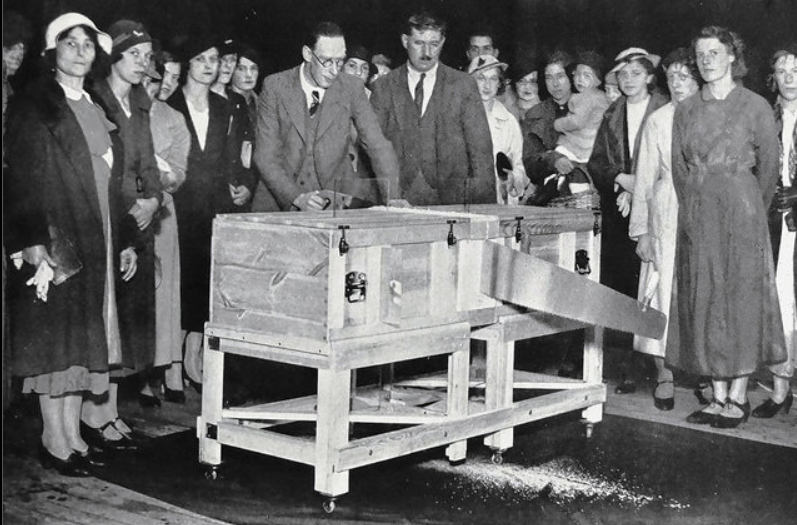 🇬🇧 United Kingdom and 1 moreSawing a woman in half
A stage illusion where an assistant appears to be cut into pieces inside a box or on a tableIllusion · Wonder and entertainment Living
🇬🇧 United Kingdom and 1 moreSawing a woman in half
A stage illusion where an assistant appears to be cut into pieces inside a box or on a tableIllusion · Wonder and entertainment Living
 🇬🇧 United KingdomIsaac Fawkes
An English conjurer who moved magic from the fairground to fashionable London society.Illusion · Wonder and entertainment Historical
🇬🇧 United KingdomIsaac Fawkes
An English conjurer who moved magic from the fairground to fashionable London society.Illusion · Wonder and entertainment Historical
Related elsewhere
All illusion 🇪🇬 Egypt and 1 moreSphinx
A mythical hybrid with a human head and lion body, serving as guardian or riddler in Egyptian and Greek traditions.Being · Protection · Wonder and entertainment Legendary
🇷🇺 Russia and 3 moreNart sagaНарты кадджытæ
A collection of epic tales from the North Caucasus about a legendary group of heroes.Text · Wonder and entertainment Historical
🇨🇱 ChileChilean mythology
The myths and legends of Chile, blending indigenous roots with colonial influences.Tradition · Wonder and entertainment Living
🇪🇬 EgyptDjedi
A fictional magician from the Westcar Papyrus who resurrects animals and foretells a king's lineage.Figure · Seeing and foretelling · Wonder and entertainment Legendary
🇪🇬 Egypt and 1 moreSphinx
A mythical hybrid with a human head and lion body, serving as guardian or riddler in Egyptian and Greek traditions.Being · Protection · Wonder and entertainment Legendary
🇷🇺 Russia and 3 moreNart sagaНарты кадджытæ
A collection of epic tales from the North Caucasus about a legendary group of heroes.Text · Wonder and entertainment Historical
🇨🇱 ChileChilean mythology
The myths and legends of Chile, blending indigenous roots with colonial influences.Tradition · Wonder and entertainment Living
🇪🇬 EgyptDjedi
A fictional magician from the Westcar Papyrus who resurrects animals and foretells a king's lineage.Figure · Seeing and foretelling · Wonder and entertainment Legendary