
Wheel of Fortune
from Latin rota fortunae, meaning wheel of fortune
A medieval allegory of fate's unpredictable turns and the fall of kings
The Wheel of Fortune is a philosophical symbol representing the shifting nature of destiny. It traces its roots to ancient Greek and Babylonian thought before becoming a central theme in medieval European literature and art.
- Boethius popularized the wheel in Consolation of Philosophy around 520 AD
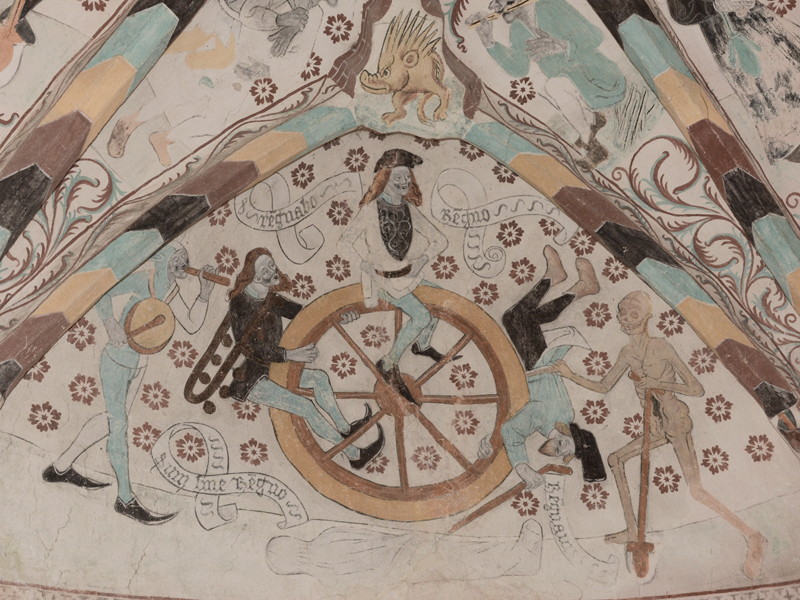
- Medieval art showed four stages: I shall reign, I reign, I have reigned, I am without a kingdom
- Chaucer used the wheel in The Canterbury Tales to show the fall of great men
- Shakespeare referenced the wheel in Hamlet, Henry V, and King Lear
- The concept originated in Babylon and was developed by ancient Greeks
What it is
The Wheel of Fortune serves as an allegory for the unpredictable shifts of destiny. It depicts a force that spins at random, moving individuals between high status and ruin without warning. This image was adopted into medieval philosophy to illustrate how worldly power is temporary and fragile. The concept suggests that no one remains at the top forever, as the wheel inevitably turns downward for even the most powerful figures.
Where it comes from
The idea originated in Babylon and was later refined by ancient Greek thinkers. Early versions described a three-dimensional sphere rather than a flat wheel, linking cosmic cycles to human events. Roman writers like Cicero and Pacuvius expanded on this, describing Fortune as blind and unstable. The metaphor became a standard rhetorical device, though some ancient authors complained it was overused.
How it is done
The symbol operates through visual and literary representation rather than ritual action. Artists depicted Fortuna turning a mill-like wheel with figures attached at different heights. Writers used the image to structure narratives about the rise and fall of historical leaders. The method relies on the contrast between ascending and descending positions on the wheel to convey moral lessons about humility.
Tools and materials
The primary tool is the wheel itself, often compared to a watermill wheel. Figures are placed on four shelves or stages, labeled with Latin phrases indicating their changing status. These labels include regnabo (I shall reign), regno (I reign), regnavi (I have reigned), and sum sine regno (I am without a kingdom). The imagery often includes a blindfolded goddess standing on a rolling stone.
Wheel of Fortune, drawn and placed
- Living
- Revived
- Fading
- Historical
- Legendary
- Performed
- Lineage
- Greek mythology
- Timing
- daily
What it is for
The symbol was used to teach religious and political lessons. In religious contexts, it reminded viewers of the fleeting nature of earthly life and the need for spiritual preparation. In political writing, such as Mirrors for Princes, it warned rulers that their power could vanish suddenly. It served as a cautionary tale against pride and arrogance in leadership.
Who does it
Scholars, poets, and artists employed the symbol in their works. Medieval writers like Boethius and Chaucer integrated it into philosophical and literary texts. The concept was studied and adapted by various intellectuals across Europe. It was not practiced by a specific group of ritual specialists but was widely understood by the educated classes.
Peoples and places
The symbol is deeply rooted in Western European tradition, particularly among Romans and Medieval Europeans. It appears in Italian manuscripts and Tarot decks. References also connect it to Cypriot history through literary accounts. While similar concepts exist in Indian art, the Wheel of Fortune specifically refers to the Greco-Roman and medieval European interpretation.
At a glance: who, where and when
Who does it
Belief worlds
![Model for the Three Superior Planets and Venus from Georg von Peuerbach, Theoricae novae planetarum . Image enhanced for legibility. The abbreviations in the center of the diagram read: C[entrum] æquantis (Center of the](https://upload.wikimedia.org/wikipedia/commons/a/a4/PeuerbachSuperioribus2.png)


What people believe
The worldview behind the wheel assumes that fate is governed by a capricious force. This force is often personified as the goddess Fortuna or Tyche. Believers held that human affairs were subject to these cosmic cycles, which operated independently of personal merit. The belief emphasized that stability was an illusion and that change was the only constant in human existence.
When it is done
The symbol was not tied to specific festivals or seasonal events. Instead, it appeared in daily life through literature, art, and public sculptures. It was featured in cathedral windows and manuscripts throughout the year. Its presence was constant in cultural discourse rather than limited to particular dates or rituals.
How scholars and sceptics see it
Historians view the wheel as a key element in medieval intellectual history. Anthropologists note its function as a social control mechanism, reinforcing humility among the elite. Psychologists see it as a reflection of anxiety regarding uncertainty and loss of status. Scholars trace its evolution from ancient cosmology to medieval moral instruction.
Cautions and what is closed
The symbol carries no physical danger but serves as a warning against hubris. It cautions that reliance on worldly power is foolish because such power is inherently unstable. Historical accounts show that those who ignored this lesson often faced sudden downfall. The concept reminds observers that success is temporary and should not be taken for granted.
Compare and confuse
The Wheel of Fortune is sometimes confused with the Indian Bhavachakra, or Wheel of Becoming. While both use wheel imagery to describe cycles, the Indian version focuses on rebirth and suffering within samsara. The European wheel focuses on social status and political power. Other related symbols include the ouroboros and various zodiac representations.
Law and persecution
There were no laws prohibiting the use of the Wheel of Fortune symbol. It was widely accepted in Christian societies as a moral teaching tool. The Church incorporated it into art and literature to support its messages about the vanity of worldly goods. It faced no legal persecution and remained a mainstream cultural motif.
Today
The symbol persists in modern language and popular culture. Phrases like 'on top of the world' or 'down in the dumps' echo its imagery. It appears in tarot decks, video games, and contemporary literature. The concept continues to resonate as a metaphor for the unpredictability of life and career trajectories.
Questions people ask about Wheel of Fortune
What is the Wheel of Fortune?
It is a medieval allegory representing the unpredictable nature of fate. It depicts a wheel that spins randomly, moving people between prosperity and ruin regardless of their worth.
Where does the Wheel of Fortune come from?
The concept originated in Babylon and was developed by ancient Greek philosophers. It was later adopted by Roman writers and became central to medieval European thought through Boethius.
Who is associated with the Wheel of Fortune?
The goddess Fortuna (or Tyche in Greek) is traditionally shown turning the wheel. Medieval writers like Boethius, Chaucer, and Shakespeare used her as a symbol of chance and destiny.
What does the wheel symbolize?
It symbolizes the temporary nature of worldly power and success. It teaches that no one stays at the top forever and that humility is necessary because fortune can turn at any moment.
Good reading and sources
- Wheel of Fortune (medieval) on WikipediaEncyclopedia
- More photos on Wikimedia CommonsPhotos and video
- Wikidata recordOpen data
The facts on this page come from the Wikipedia article "Wheel of Fortune (medieval)", written by its contributors and used under the CC BY-SA 4.0 licence, and from its Wikidata record (CC0). EveryJaadu rewrote the text in its own words, with AI assistance, and compares every page with the article to make sure no passage is copied. It may be reused under the same CC BY-SA 4.0 licence with a link back.
It may contain mistakes. Names and customs differ from one community to the next, and some knowledge is closed to outsiders and left out here. This page describes belief and practice. It does not say that any of it works, it is not a how-to, and it is not medical advice. If something is wrong, tell us. Last refreshed 2026-10-14.
More from Italy
All the entries from Italy 🇬🇷 Greece and 5 moreBay Laurelδάφνη
An aromatic Mediterranean plant used in cooking and as a symbol of victory and purification.Substance · Protection · Cleansing and purification Living
🇬🇷 Greece and 5 moreBay Laurelδάφνη
An aromatic Mediterranean plant used in cooking and as a symbol of victory and purification.Substance · Protection · Cleansing and purification Living
 🇫🇷 France and 1 moreNostradamus
A French astrologer and physician known for a book of poetic propheciesText · Seeing and foretelling · Power and authority Historical
🇫🇷 France and 1 moreNostradamus
A French astrologer and physician known for a book of poetic propheciesText · Seeing and foretelling · Power and authority Historical
 🇩🇪 Germany and 5 moreWitch trials in the Holy Roman Empire
A wave of executions across Central Europe between the fifteenth and eighteenth centuries.Belief · Cursing and harm Historical
🇩🇪 Germany and 5 moreWitch trials in the Holy Roman Empire
A wave of executions across Central Europe between the fifteenth and eighteenth centuries.Belief · Cursing and harm Historical
 🇮🇹 ItalyFortunaFortūna
The Roman goddess of luck and fate, shown with a wheel and a horn of plentyBeing · Luck and prosperity · Seeing and foretelling Historical
🇮🇹 ItalyFortunaFortūna
The Roman goddess of luck and fate, shown with a wheel and a horn of plentyBeing · Luck and prosperity · Seeing and foretelling Historical
Related elsewhere
All belief 🇯🇲 Jamaica and 5 moreObeah
A Caribbean tradition of ritual healing and spell-casting with African rootsTradition · Protection · Healing Living
🇲🇾 Malaysia and 1 moreBomohبوموه
A Malay shaman and traditional healer who works with spirits, herbs, and geomancy.Tradition · Healing · Seeing and foretelling Living
🇯🇲 Jamaica and 5 moreObeah
A Caribbean tradition of ritual healing and spell-casting with African rootsTradition · Protection · Healing Living
🇲🇾 Malaysia and 1 moreBomohبوموه
A Malay shaman and traditional healer who works with spirits, herbs, and geomancy.Tradition · Healing · Seeing and foretelling Living
 🇮🇳 India and 5 moreHoliहोली
A Hindu spring festival marked by coloured powders and bonfires to celebrate love and virtue.Tradition · Love and attraction · Cursing and harm Living
🇮🇳 India and 5 moreHoliहोली
A Hindu spring festival marked by coloured powders and bonfires to celebrate love and virtue.Tradition · Love and attraction · Cursing and harm Living
 🇺🇸 United States and 2 moreLouisiana Voodoo
An African diasporic religion practiced in Louisiana from the 18th to early 20th centuriesTradition · Healing · Protection Historical
🇺🇸 United States and 2 moreLouisiana Voodoo
An African diasporic religion practiced in Louisiana from the 18th to early 20th centuriesTradition · Healing · Protection Historical