Up Helly Aa
from Old Norse uppi (up) and helgr (holy day), meaning 'all holy days'
A Shetland fire festival marking the end of Yule with a torchlit procession and burning of a Viking galley
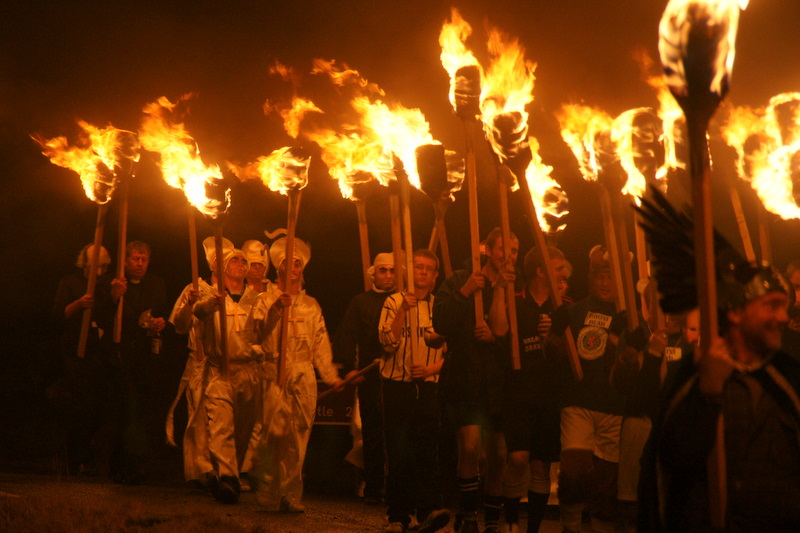
Up Helly Aa is an annual fire festival held in Shetland, Scotland, from January to March to mark the end of the Yule season. It features a torchlit procession by costumed participants known as guizers, culminating in the burning of a replica Viking longship.
- First torch procession held in 1876
- Replica Viking galley burned annually
- Leader of squad called Jarl
- Blackface banned in 2020
- Women allowed in Lerwick squads since 2023
What it is
Up Helly Aa is a seasonal fire festival celebrated across the Shetland Islands in Scotland. It serves as the traditional conclusion to the local Yule celebrations. The event centers on a large torchlit parade led by squads of men dressed in costumes called guizers. The procession ends with the burning of a specially built replica Viking longship. This spectacle marks the final release of the winter holiday period.
Where it comes from
The festival evolved from older customs like tar barrelling, where young men dragged burning barrels through streets. Concerns over safety and drunkenness prompted a shift toward a more organized event inspired by Shetland's Viking heritage. The first torch procession occurred in 1876, followed by the first Up Helly Aa celebration in 1881. The name derives from Upholiday, a Scots term for Twelfth Day brought to the islands in the nineteenth century. Victorian reform groups helped establish the modern format to provide constructive activities for local youth.
How it is done
Squads of guizers march through town carrying lit torches. They visit various community halls to perform skits, sing songs, or dance. The main event culminates in the burning of a wooden Viking galley. Participants throw their torches into the boat until it is consumed by flames. The processions are accompanied by specific songs written for the occasion.
Tools and materials
The primary tools include lit torches carried by each participant. Historically, tar-filled barrels were used in earlier versions of the festival. The central prop is a replica Viking longship, constructed specifically for the annual burning. Costumes worn by the guizers vary, though blackface usage has been banned recently.
Up Helly Aa, drawn and placed
- Living
- Revived
- Fading
- Historical
- Legendary
- Performed
- Lineage
- Victorian-era Scottish fire festival
- Timing
- last Tuesday of January through March
What it is for
The festival provides a communal outlet for celebrating the end of the Yule season. It offers a structured activity for young men, historically replacing rowdy behavior with organized pageantry. The burning of the ship symbolizes the closing of the winter festivities. Communities use the event to strengthen local bonds through shared performance and attendance.
Who does it
Participants are known as guizers. The leader of a squad is titled Jarl. Selection for this role requires membership on a committee for fifteen years. Traditionally, only men participated, though women have joined since 1901. Some rural festivals now allow female Jarls and mixed squads. The Lerwick festival removed restrictions on women's participation in 2023.
Peoples and places
The festival is practiced by residents of the Shetland Islands. The largest celebration takes place in the capital city of Lerwick. Other communities such as Scalloway, Uyeasound, and Northmavine hold smaller versions. These rural gatherings adapt the tradition to fit their local populations while maintaining the core elements of torches and the galley.
At a glance: who, where and when


What people believe
Scholars view the festival as a product of Victorian social reform rather than ancient pagan survival. It reflects a conscious effort to reshape local traditions using historical themes. The Viking imagery was popularized by early twentieth-century writings about Shetland's past. The event functions as a cultural marker for the end of the Christmas cycle.
When it is done
The festival runs from January to March. The main date is the last Tuesday of January. Specific locations celebrate at different times within this window. The timing aligns with the conclusion of the traditional Yule period in Scotland.
How scholars and sceptics see it
Historians note the festival's roots in nineteenth-century attempts to curb public disorder. The shift from tar barrelling to torch processions was driven by civic authorities. Writers like Haldane Burgess influenced the Viking theme through literature. Anthropologists see the event as a modern construction that utilizes local history to create community identity.
Cautions and what is closed
Past practices included blackface, which has been officially banned since 2020. Historical versions involved significant risks due to open fires and alcohol consumption. Modern organizers enforce safety rules to prevent injuries. The transition from unregulated street mischief to controlled pageantry reduced these dangers.
Compare and confuse
Up Helly Aa shares similarities with other northern European fire festivals. It differs from Celtic traditions by focusing on Viking heritage rather than pre-Christian deities. The burning of a ship echoes broader maritime folklore found in coastal regions.
Law and persecution
The festival operates under local permits and safety regulations. Civic bodies oversee the organization and funding. Changes to participation rules reflect evolving social standards regarding gender and representation.
Today
The event remains a vital part of Shetland culture. Eleven communities currently host variations of the festival. The Lerwick celebration attracts thousands of participants and spectators. Adaptations continue to address modern concerns while preserving the core ritual of the torchlit procession and galley burning.
Questions people ask about Up Helly Aa
What does Up Helly Aa mean?
The name comes from Old Norse words meaning 'all holy days'. It marks the end of the Yule season in Shetland, Scotland.
When is Up Helly Aa celebrated?
It takes place annually from January to March. The main event occurs on the last Tuesday of January.
Who participates in the festival?
Local residents form squads called guizers. The leader is known as the Jarl. Women have increasingly joined in recent years.
Why is there a Viking theme?
The theme was introduced in the late nineteenth century. It draws inspiration from Shetland's historical ties to Norse culture.
What happens to the Viking ship?
A replica longship is built each year. It is burned at the end of the torchlit procession to conclude the festivities.
Good reading and sources
- Encyclopaedia BritannicaArticle
- Blackface 'will not be tolerated' at Up Helly Aa festivalBBC, Article
- Up Helly Aa: The songwriter who introduced Vikings to Shetland's fire festivalBBC, Article
- Up Helly Aa on WikipediaEncyclopedia
- More photos on Wikimedia CommonsPhotos and video
- Wikidata recordOpen data
The facts on this page come from the Wikipedia article "Up Helly Aa", written by its contributors and used under the CC BY-SA 4.0 licence, and from its Wikidata record (CC0). EveryJaadu rewrote the text in its own words, with AI assistance, and compares every page with the article to make sure no passage is copied. It may be reused under the same CC BY-SA 4.0 licence with a link back.
It may contain mistakes. Names and customs differ from one community to the next, and some knowledge is closed to outsiders and left out here. This page describes belief and practice. It does not say that any of it works, it is not a how-to, and it is not medical advice. If something is wrong, tell us. Last refreshed 2026-10-06.
More from the United Kingdom
All the entries from the United Kingdom 🇬🇧 United KingdomDeath knell
A church bell rung to announce a person's death and mark the funeral.Rite · Speaking with spirits and the dead Fading
🇬🇧 United Kingdom and 4 moreTelling the bees
A Western European custom of informing bees about major household eventsRite · Protection · Speaking with spirits and the dead Living
🇬🇧 United KingdomDeath knell
A church bell rung to announce a person's death and mark the funeral.Rite · Speaking with spirits and the dead Fading
🇬🇧 United Kingdom and 4 moreTelling the bees
A Western European custom of informing bees about major household eventsRite · Protection · Speaking with spirits and the dead Living
 🇬🇧 United KingdomPricking
A method used to locate a witch's mark during early modern European witch trialsRite · Cursing and harm Historical
🇬🇧 United KingdomPricking
A method used to locate a witch's mark during early modern European witch trialsRite · Cursing and harm Historical
 🇪🇸 Spain and 5 moreSt John's Eve
A Christian vigil marked by bonfires and plant gathering on the summer solstice eveRite · Protection · Speaking with spirits and the dead Living
🇪🇸 Spain and 5 moreSt John's Eve
A Christian vigil marked by bonfires and plant gathering on the summer solstice eveRite · Protection · Speaking with spirits and the dead Living
Related elsewhere
All rite 🇪🇬 Egypt and 1 moreSphinx
A mythical hybrid with a human head and lion body, serving as guardian or riddler in Egyptian and Greek traditions.Being · Protection · Wonder and entertainment Legendary
🇪🇬 EgyptDjedi
A fictional magician from the Westcar Papyrus who resurrects animals and foretells a king's lineage.Figure · Seeing and foretelling · Wonder and entertainment Legendary
🇨🇱 ChileChilean mythology
The myths and legends of Chile, blending indigenous roots with colonial influences.Tradition · Wonder and entertainment Living
🇷🇺 Russia and 3 moreNart sagaНарты кадджытæ
A collection of epic tales from the North Caucasus about a legendary group of heroes.Text · Wonder and entertainment Historical
🇪🇬 Egypt and 1 moreSphinx
A mythical hybrid with a human head and lion body, serving as guardian or riddler in Egyptian and Greek traditions.Being · Protection · Wonder and entertainment Legendary
🇪🇬 EgyptDjedi
A fictional magician from the Westcar Papyrus who resurrects animals and foretells a king's lineage.Figure · Seeing and foretelling · Wonder and entertainment Legendary
🇨🇱 ChileChilean mythology
The myths and legends of Chile, blending indigenous roots with colonial influences.Tradition · Wonder and entertainment Living
🇷🇺 Russia and 3 moreNart sagaНарты кадджытæ
A collection of epic tales from the North Caucasus about a legendary group of heroes.Text · Wonder and entertainment Historical