Religious aspects of Nazism
The study of how Nazi ideology borrowed religious forms and esoteric beliefs to build a political movement.
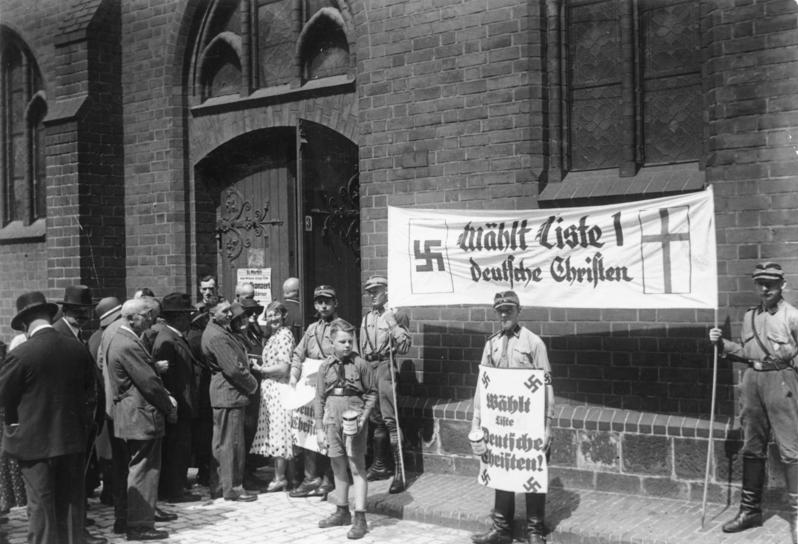
Scholars examine Nazism as a political religion that adopted Christian imagery while promoting racial purity. The regime also fostered interest in Germanic occultism and Aryan myths to legitimize its rule.
- Scholars view Nazism as a political religion with its own dogmas.
- Hitler is widely considered irreligious and anti-Christian by historians.
- The regime promoted Positive Christianity to remove Jewish biblical elements.
- Ariosophy blended occult ideas with völkisch racial theories.
- Popular theories of Nazi occultism are largely dismissed as cryptohistory.
What it is
Historians and political scientists analyze Nazism through the lens of religion and pseudo-religion. Scholars debate whether the movement functioned as a political religion with its own dogmas and rituals. Research focuses on millenarian hopes, messianic figures, and esoteric elements within the ideology. The study covers how the regime used spiritual language to mobilize support and justify its actions.
Where it comes from
Early writers like Aurel Kolnai and Eric Voegelin explored these themes before 1980. Voegelin published his work on political religion in 1938. Later scholars such as Emilio Gentile and Roger Griffin expanded on these concepts. Academic interest in Nazi occultism grew significantly in the 1980s following key doctoral theses.
How it is done
The regime promoted Positive Christianity, which sought to remove Jewish elements from the Bible. This involved reinterpreting Jesus as an Aryan fighter against Pharisees. The goal was to create a cleansed faith aligned with Völkisch ideology. Simultaneously, some leaders engaged with Ariosophy, an esoteric movement blending occult ideas with racial theories about root races like Atlantis and Thule.
Tools and materials
Key texts included Alfred Rosenberg's The Myth of the Twentieth Century and Ernst Bergmann's Twenty-five Points of the German Religion. These works argued for the inaccuracy of the Old Testament and proposed Jesus had Nordic blood. Symbols and rhetoric were used to bridge Protestant and Catholic divides while emphasizing racial purity.
Religious aspects of Nazism, drawn and placed
- Living
- Revived
- Fading
- Historical
- Legendary
- Performed
- Lineage
- Völkisch ideology
What it is for
The primary intent was to consolidate political power by aligning the state with spiritual authority. Leaders sought to reduce the independence of Christian churches. They aimed to replace traditional doctrines with a race-based worldview. Occult interests served to validate claims of ancient Aryan superiority and destiny.
Who does it
Leading Nazis held divergent personal views. Some, like Erich Koch, were active church officials. Hitler is generally considered irreligious and anti-Christian by historians, though he publicly feigned belief. Private statements reveal skepticism toward Christian tenets. Theologians like Bergmann provided intellectual frameworks for the regime's racial theology.
Peoples and places
The movement originated in Germany and Austria. It influenced regions under occupation or control, including parts of Ukraine. The ideology drew upon existing völkisch currents in Central Europe. Post-war interest extended to Argentina and other countries where former Nazis settled.
At a glance: who, where and when
Who does it
Peoples
Belief worlds
What people believe
Central to the belief system was the concept of the master race versus lesser races. Ariosophists claimed a glorious past destroyed by interbreeding. They posited locations like Hyperborea as ancestral homelands. The regime viewed Christianity as incompatible with racial science, seeking to transform it into a tool for national unity.
How scholars and sceptics see it
Academic consensus views Hitler as anti-Christian and irreligious, despite public posturing. Historians dismiss popular theories of deep Nazi occult involvement as cryptohistory. Works like Nicholas Goodrick-Clarke's The Occult Roots of Nazism provide rigorous analysis. Scholars distinguish between genuine esoteric influence and later sensationalist speculation.
Cautions and what is closed
The pursuit of this racial theology led to severe persecution of Christians and Jews. The US Office of Strategic Services documented the systematic attack on church institutions. The ideology justified violence and genocide under the guise of spiritual cleansing. Modern fascination often ignores the deadly consequences of these beliefs.
Compare and confuse
Nazism is compared to other political religions that sacralize the state. It differs from traditional Christianity by rejecting universal love and focusing on racial exclusivity. Popular culture often conflates Nazi practices with generic black magic, whereas academic research focuses on specific ideological adaptations.
Questions people ask about Religious aspects of Nazism
Was Nazism a religion?
Scholars describe it as a political religion. It adopted religious forms and rituals to serve political goals. It did not function as a traditional faith but created a secular cult of the leader and the race.
What was Positive Christianity?
It was a Nazi interpretation of faith. It rejected the Old Testament and Pauline epistles. It portrayed Jesus as an Aryan warrior fighting Jewish materialism. It aimed to align Christianity with racial ideology.
Did Nazis practice magic?
Popular culture suggests yes, but historians call this cryptohistory. Some leaders studied Ariosophy, an esoteric movement. Direct evidence of widespread occult practice is sparse. Interest peaked in academic studies after the war.
How did Hitler view Christianity?
Most historians believe he was anti-Christian and irreligious. He privately criticized Christian doctrines as superstition. Publicly, he feigned belief to maintain political support among the German population.
Good reading and sources
The facts on this page come from the Wikipedia article "Religious aspects of Nazism", written by its contributors and used under the CC BY-SA 4.0 licence, and from its Wikidata record (CC0). EveryJaadu rewrote the text in its own words, with AI assistance, and compares every page with the article to make sure no passage is copied. It may be reused under the same CC BY-SA 4.0 licence with a link back.
It may contain mistakes. Names and customs differ from one community to the next, and some knowledge is closed to outsiders and left out here. This page describes belief and practice. It does not say that any of it works, it is not a how-to, and it is not medical advice. If something is wrong, tell us. Last refreshed 2026-10-10.
More from Germany
All the entries from Germany 🇩🇪 GermanyPied Piper of Hamelinder Rattenfänger von Hameln
A medieval legend about a piper who leads children away from the town of HamelinFigure · Cursing and harm · Luck and prosperity Legendary
🇩🇪 GermanyPied Piper of Hamelinder Rattenfänger von Hameln
A medieval legend about a piper who leads children away from the town of HamelinFigure · Cursing and harm · Luck and prosperity Legendary
 🇬🇧 United Kingdom and 5 moreAleister Crowley
English occultist and founder of the religion of ThelemaText · Power and authority · Change and initiation Living
🇬🇧 United Kingdom and 5 moreAleister Crowley
English occultist and founder of the religion of ThelemaText · Power and authority · Change and initiation Living
 🇩🇪 Germany and 5 moreWitch trials in the Holy Roman Empire
A wave of executions across Central Europe between the fifteenth and eighteenth centuries.Belief · Cursing and harm Historical
🇩🇪 Germany and 5 moreWitch trials in the Holy Roman Empire
A wave of executions across Central Europe between the fifteenth and eighteenth centuries.Belief · Cursing and harm Historical
 🇺🇦 Ukraine and 5 moreMugwortчорнобиль (chornóbyl')
An aromatic herb used in folk medicine, cooking, and magical protection across Eurasia.Substance · Protection · Healing Living
🇺🇦 Ukraine and 5 moreMugwortчорнобиль (chornóbyl')
An aromatic herb used in folk medicine, cooking, and magical protection across Eurasia.Substance · Protection · Healing Living
Related elsewhere
All tradition 🇿🇦 South AfricaSympathetic magic
A magical principle based on imitation and contact to influence the worldTradition · Protection · Healing Historical
🇭🇹 HaitiBois Caïman
The sacred site where enslaved Africans planned the Haitian Revolution through a Vodou ceremony.Rite · Cursing and harm · Power and authority Historical
🇿🇦 South AfricaSympathetic magic
A magical principle based on imitation and contact to influence the worldTradition · Protection · Healing Historical
🇭🇹 HaitiBois Caïman
The sacred site where enslaved Africans planned the Haitian Revolution through a Vodou ceremony.Rite · Cursing and harm · Power and authority Historical
 🇮🇳 India and 4 moreTantraतन्त्र
An esoteric yogic tradition from India focusing on ritual, mantra, and body-based spiritual practices.Tradition · Power and authority · Change and initiation Living
🇿🇦 South Africa and 5 moreMurder for body parts
The killing of people to harvest body parts for traditional medicine or the illegal organ trade.Belief · Cursing and harm · Power and authority Living
🇮🇳 India and 4 moreTantraतन्त्र
An esoteric yogic tradition from India focusing on ritual, mantra, and body-based spiritual practices.Tradition · Power and authority · Change and initiation Living
🇿🇦 South Africa and 5 moreMurder for body parts
The killing of people to harvest body parts for traditional medicine or the illegal organ trade.Belief · Cursing and harm · Power and authority Living