
Oungan
From Gbe languages, meaning chief priest or chief of spirits.
A male priest in Haitian Vodou who leads rituals and serves as a medium for spirits.
The Oungan is a male religious leader within Haitian Vodou, an African diasporic faith that blends West African traditions with Roman Catholicism. He acts as a mediator between the community and the lwa, or spirits, leading ceremonies and preserving sacred knowledge. The role traces its origins to the Fon people of Dahomey.
- Oungan means chief priest in Gbe languages.
- Chosen through dreams or visions from lwa.
- Receives an asson during consecration.
- Dutty Boukman sparked the 1791 revolution.
- Pilgrimage to Saut-d'Eau happens annually.
What it is
The Oungan is a male priest in Haitian Vodou, a religion formed from West African traditions and Catholicism. He serves as a spiritual leader and community guide. His counterpart is the Mambo, a female priest. Oungans are responsible for maintaining the relationship between the living community and the lwa, which are spirits derived from Yoruba, Fon, Kongo, and Taíno sources, as well as Catholic saints. They lead services in temples known as ounfò and act as intermediaries who can be possessed by these spirits during rituals.
Where it comes from
Haitian Vodou originated from the Kingdom of Dahomey, located in present-day Benin and western Nigeria. Enslaved peoples from this region, primarily the Fon and Ewe, brought their religious practices to Haiti during the French colonial period. These traditions merged with Roman Catholicism imposed by colonizers, creating a unique syncretic faith. The title Oungan comes from Gbe languages, where it signifies a chief priest. The role has deep roots in West African spiritual leadership structures.
How it is done
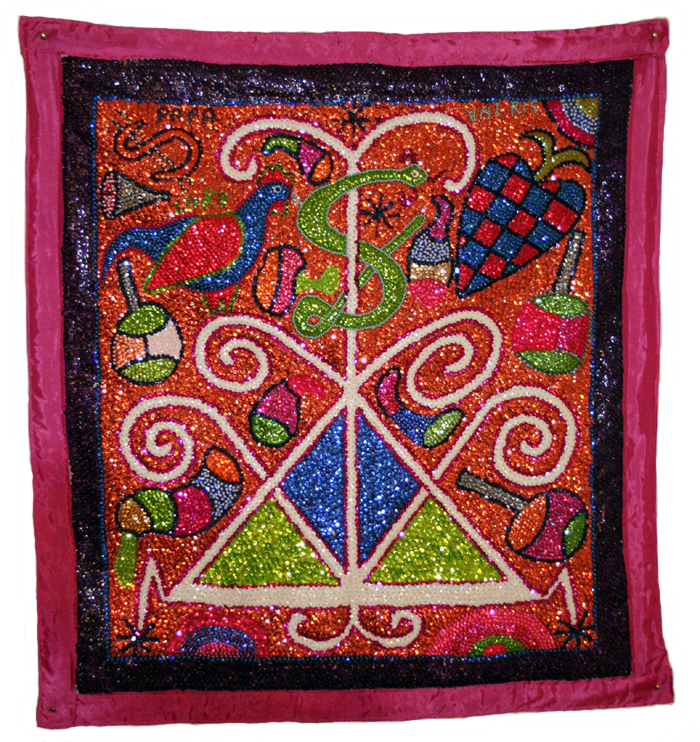
Ceremonies involve drumming, singing, and dancing to invite lwa into the physical world. The Oungan directs these events, often entering a state of spirit possession himself. He uses specific symbols called vèvè, drawn on the ground, to call upon particular spirits. Rituals include offerings of food and drink, animal sacrifices, and the use of sacred objects. The Oungan may also perform healing rites, dream interpretations, and initiations for new members of the community.
Tools and materials
Key tools include the asson, a sacred rattle given during consecration, which marks the priest's authority. Oungans draw vèvè using powders like cornmeal to create geometric designs that serve as portals for spirits. They use candles, water, and herbs for blessings and cleansing. Specific colors like red, black, and white are associated with the priestly role. Personal notebooks containing secret formulas and diagrams for summoning spirits are also essential.
Oungan, drawn and placed
- Living
- Revived
- Fading
- Historical
- Legendary
- Performed
- Lineage
- Haitian Vodou
- Timing
- during ceremonies, pilgrimages, and life events like birth and death
What it is for
Oungans serve multiple purposes within their communities. They facilitate communication with ancestors and deities through spirit possession. They provide healing for physical and spiritual ailments. They lead important life-cycle events such as weddings, funerals, and initiations. They also interpret dreams and offer guidance on personal matters. In some cases, they may engage in protective magic or sorcery, though this varies by individual practice.
Who does it
Becoming an Oungan requires rigorous initiation. Candidates are often chosen through dreams or visions from the lwa. The process includes isolation, ritual washing of the head with plant mixtures, and various sacrifices. Upon completion, the initiate receives an asson and a spiritual name. There is no central hierarchy; each Oungan holds authority within their own temple. Training involves learning complex rituals, songs, and the specific requirements of different lwa.
Peoples and places
The practice is central to Haitian society but has roots in Benin, Nigeria, Togo, and Ghana among the Fon and Ewe peoples. In Haiti, Oungans are respected figures who adapt ancient traditions to modern contexts. Some have been involved in political movements, such as Dutty Boukman, who helped spark the Haitian Revolution. The faith spread through the diaspora, influencing communities in Jamaica, France, and other Caribbean islands, while maintaining its core West African identity.
At a glance: who, where and when
Who does it
Belief worlds
What people believe
Haitian Vodou believes in a supreme creator, the Grand Maître, who is distant from daily affairs. The lwa are intermediary spirits who interact with humans. They have distinct personalities, preferences, and domains. Possession occurs when a lwa enters a person's body, allowing direct communication. The dead retain a presence, and rituals help guide their spirits. Balance between the physical and spiritual worlds is maintained through proper ritual observance and respect for ancestors.
When it is done
Rituals occur throughout the year, often aligned with Catholic feast days due to syncretism. Major gatherings happen at pilgrimage sites like Saut-d'Eau, where believers bathe in holy waters for healing. Ceremonies mark births, deaths, and initiations. The calendar also follows the rhythms of the lwa, with specific days dedicated to certain spirits. Seasonal changes and agricultural cycles may also influence the timing of communal prayers and offerings.
How scholars and sceptics see it
Anthropologists study Oungans as key figures in maintaining cultural identity among Afro-Haitians. Historians examine their role in social and political upheavals, such as the slave revolt. Psychologists analyze spirit possession as a form of altered consciousness or therapeutic release. Critics sometimes misinterpret Vodou practices, leading to stigma. Scholars emphasize the complexity of the religion, noting its blend of African heritage and local adaptation, rather than viewing it through simplistic lenses.
Cautions and what is closed
Historically, Oungans faced persecution under regimes like Duvalier's, where some were co-opted into secret police forces. Misunderstandings about Vodou have led to fraud by fake healers and exploitation of practitioners. Outsiders are often excluded from sacred knowledge and restricted rituals. The religion emphasizes respect for spirits and community norms; violating these can result in social ostracization or spiritual consequences. Serious illness requires professional medical care alongside spiritual support.
Compare and confuse
The Oungan is similar to shamans in other indigenous traditions, acting as mediators between worlds. Unlike Christian priests, Oungans do not follow a single centralized church structure. Their role overlaps with that of diviners and healers. The term is sometimes confused with generic terms for African priests, but it specifically denotes the Vodou context. Female counterparts, Mambos, share many duties but may focus on different aspects of community service.
Questions people ask about Oungan
What is an Oungan?
An Oungan is a male priest in Haitian Vodou who leads rituals and serves as a medium for spirits known as lwa. He acts as a bridge between the community and the divine world.
Where does the term come from?
The word originates from Gbe languages spoken in West Africa, particularly among the Fon people of Dahomey. It translates to chief priest or chief of spirits.
How does one become an Oungan?
Candidates are often chosen through dreams or visions. They undergo a lengthy initiation involving isolation, ritual cleansing, and sacrifices before receiving their sacred rattle and spiritual name.
What is the role of an Oungan in ceremonies?
He directs drums, songs, and dances to invite spirits. He may enter a state of possession himself and performs rituals for healing, protection, and life-cycle events.
Are there famous historical Oungans?
Yes, Dutty Boukman was a prominent Oungan who helped organize the Haitian Slave Revolt of 1791, using his spiritual authority to inspire freedom fighters.
Good reading and sources
The facts on this page come from the Wikipedia article "Oungan", written by its contributors and used under the CC BY-SA 4.0 licence, and from its Wikidata record (CC0). EveryJaadu rewrote the text in its own words, with AI assistance, and compares every page with the article to make sure no passage is copied. It may be reused under the same CC BY-SA 4.0 licence with a link back.
It may contain mistakes. Names and customs differ from one community to the next, and some knowledge is closed to outsiders and left out here. This page describes belief and practice. It does not say that any of it works, it is not a how-to, and it is not medical advice. If something is wrong, tell us. Last refreshed 2026-10-06.
More from Haiti
All the entries from Haiti 🇹🇹 Trinidad and Tobago and 3 moreCaribbean folklore
The blended tales and spirits of the Caribbean islandsTradition · Wonder and entertainment Living
🇹🇹 Trinidad and Tobago and 3 moreCaribbean folklore
The blended tales and spirits of the Caribbean islandsTradition · Wonder and entertainment Living
 🇭🇹 Haiti and 2 moreManbo
A female priestess in Haitian Vodou who leads rituals and healing workTradition · Healing · Speaking with spirits and the dead Living
🇭🇹 Haiti and 2 moreManbo
A female priestess in Haitian Vodou who leads rituals and healing workTradition · Healing · Speaking with spirits and the dead Living
 🇭🇹 Haiti and 2 moreHaitian VodouVodou
An Afro-Haitian religion blending West African traditions with Catholicism and FreemasonryTradition · Protection · Healing Living
🇭🇹 Haiti and 2 moreHaitian VodouVodou
An Afro-Haitian religion blending West African traditions with Catholicism and FreemasonryTradition · Protection · Healing Living
 🇭🇹 Haiti and 2 moreBokorbòkò
A Haitian Vodou practitioner said to serve spirits for both protection and harmTradition · Protection · Cursing and harm Living
🇭🇹 Haiti and 2 moreBokorbòkò
A Haitian Vodou practitioner said to serve spirits for both protection and harmTradition · Protection · Cursing and harm Living
Related elsewhere
All tradition 🇸🇳 Senegal and 1 moreSerer religionA ƭat Roog
The traditional faith of the Serer people, centred on the supreme deity Roog and ancestral veneration.Tradition · Protection · Speaking with spirits and the dead Living
🇸🇳 Senegal and 1 moreSerer religionA ƭat Roog
The traditional faith of the Serer people, centred on the supreme deity Roog and ancestral veneration.Tradition · Protection · Speaking with spirits and the dead Living
 🇰🇪 Kenya and 1 moreMaasai religion
The spiritual beliefs of the semi-nomadic Maasai people of East AfricaTradition · Protection · Healing Living
🇰🇪 Kenya and 1 moreMaasai religion
The spiritual beliefs of the semi-nomadic Maasai people of East AfricaTradition · Protection · Healing Living
 🇹🇭 Thailand and 3 moreThai Buddha amuletsพระเครื่อง (phrakhrueang)
Sacred Buddhist images and relics worn for protection, merit, and fortune in Thailand.Charm · Protection · Luck and prosperity Living
🇹🇭 Thailand and 3 moreThai Buddha amuletsพระเครื่อง (phrakhrueang)
Sacred Buddhist images and relics worn for protection, merit, and fortune in Thailand.Charm · Protection · Luck and prosperity Living
 🇮🇶 Iraq and 5 moreGrimoire
A textbook containing instructions for spells, rituals, and the creation of magical objects.Text · Protection · Healing Historical
🇮🇶 Iraq and 5 moreGrimoire
A textbook containing instructions for spells, rituals, and the creation of magical objects.Text · Protection · Healing Historical