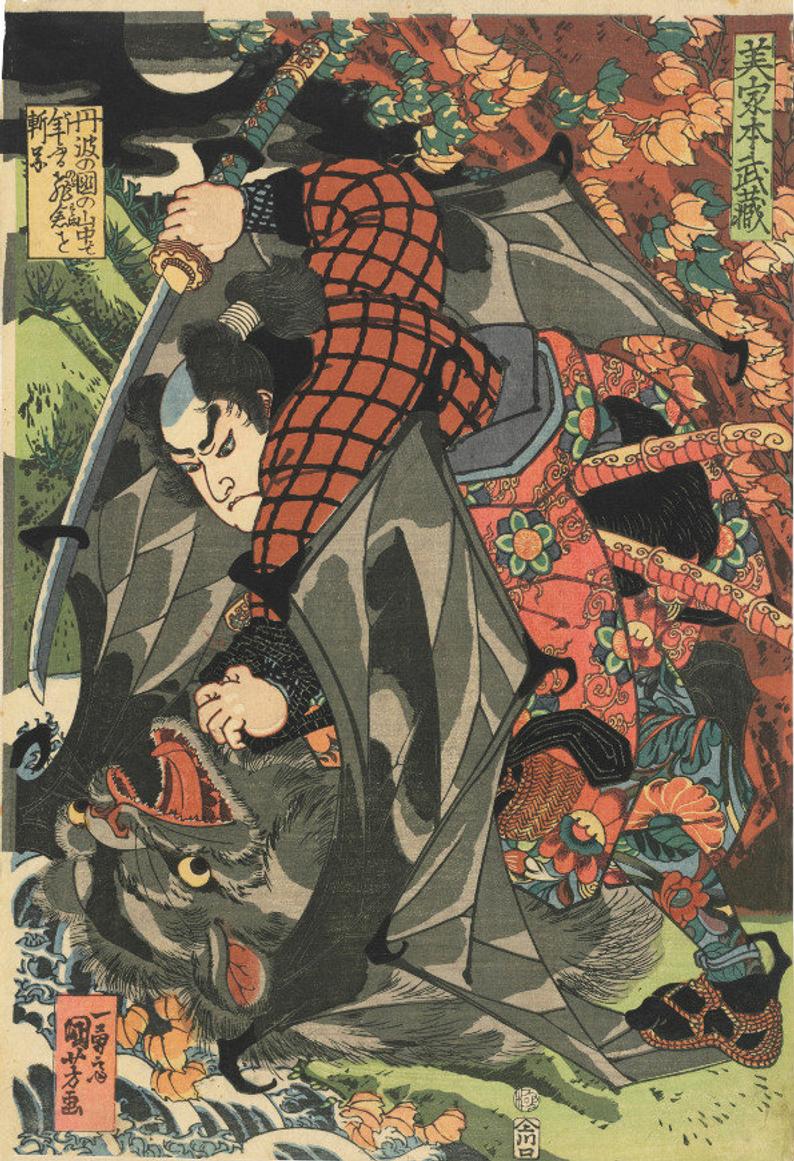
Nobusuma
In its own language: 野衾
from Japanese nobusuma, meaning "field bedding"
A Japanese yōkai said to be a flying squirrel or bat that attacks travelers at night.
The nobusuma is a creature from Edo period folklore in Japan. It is described as a large flying squirrel or an aging bat that glides through the air. People believed it attacked humans and animals to feed on blood, fruits, or even fire.
- Name means "field bedding" in Japanese.
- Described as a giant flying squirrel or bat.
- Attacks travelers to suck blood or steal breath.
- Illustrated by Toriyama Sekien in 1779.
- Associated with the vampire-like yamachichi.
What it is
The nobusuma is a type of yōkai, a supernatural monster in Japanese folklore. Its name translates to "field bedding." Some accounts describe it as a giant flying squirrel, while others identify it as a transmuted bat. The creature is known for gliding through the sky and latching onto people. It is said to cover a victim's eyes and mouth, potentially to suck blood. Other sources claim it attacks animals or consumes fruits and tree nuts. In some legends, it exhibits fire-eating behavior after biting a torch.
Where it comes from
The lore is localized to the Edo region, now Tokyo. Early illustrations by Toriyama Sekien in 1779 depicted it as a flying squirrel with fleshy wings. Later works, such as the Ehon Hyaku Monogatari published in 1841, linked it to bats. One theory suggests the creature begins as a bat, ages into a nobusuma, and eventually becomes a vampire-like entity called yamachichi. This final form is said to suck the breath from sleepers, causing death if unseen.
How it is done
The creature is said to fly onto travelers on mountain paths. It uses its forepaws to blindfold and gag the victim. Once the person is restrained, the nobusuma feeds on their blood. Another variation involves the creature extinguishing a traveler's torch by biting it, then breathing the smoke or flame. If a yamachichi attacks a sleeper, the act causes death unless another human witnesses it, which supposedly lengthens the victim's life.
Tools and materials
The primary tool of the nobusuma is its body. It possesses fleshy wings that resemble those of a bat when folded. It has fur and claws used to latch onto prey. In artistic depictions, it is shown interacting with torches and covering human faces. The creature is also associated with hollow trees where it rests during the day.
Nobusuma, drawn and placed
- Living
- Revived
- Fading
- Historical
- Legendary
- Performed
- Lineage
- Edo period yōkai folklore
- Timing
- at night
What it is for
People feared the nobusuma as a threat to travelers and livestock. It was believed to cause illness or death through blood-sucking or breath-stealing. The legend served to explain unexplained ailments or attacks on cats and humans in the Edo period. The fear of the creature influenced how people viewed nocturnal animals like flying squirrels and bats.
Who does it
Scholars and artists documented the nobusuma. Toriyama Sekien illustrated it in his 1779 work Konjaku Gazu Zoku Hyakki. Utagawa Kuniyoshi depicted a swordsman fighting a bat-like version in the 1820s. Researchers like Katsumi Tada and Hiroshi Aramata have analyzed the creature's origins, linking it to real animals like the musasabi and momonga.
Peoples and places
The nobusuma is part of Japanese folklore, specifically from the Edo period. Different regions had varying names for similar creatures. In the Kantō region, it was called momoka, while western provinces used the term itaojiki. The Wakan Sansai Zue encyclopedia noted these regional differences. The legend may have arisen from confusion between different species of flying squirrels and tanuki.
At a glance: who, where and when
Peoples
Belief worlds
What people believe
The belief system places the nobusuma within the category of yōkai. It is seen as a transformation of ordinary animals due to age or spiritual change. The connection to the yamachichi highlights a belief in creatures that steal life force. The idea that witnessing an attack can reverse its effect reflects folk beliefs about spirits and omens.
When it is done
The creature is active at night. Legends mention foggy and windy nights as times when it transforms or appears. Travelers were most vulnerable on mountain paths after dark. The creature rests in hollow trees during the day, emerging only when darkness falls.
How scholars and sceptics see it
Researchers view the nobusuma as a mythological interpretation of natural animal behavior. Flying squirrels may have been mistaken for monsters when they glided near torches or latched onto people blinded by light. The Wakan Sansai Zue traced the legend to Chinese texts about flying squirrels. Scholars note that the creature's attributes evolved over time, blending features of bats, squirrels, and vampires.
Cautions and what is closed
No specific cautions are recorded beyond the general fear of the creature. The legends warn of blood-sucking and breath-stealing. There are no reports of modern fraud or legal issues related to the nobusuma, as it is a historical figure.
Compare and confuse
The nobusuma is related to other yōkai like the momonjī and yamachichi. It shares traits with the mami, a beast sometimes identified as a tanuki or flying squirrel. The tobikura is another name for a similar creature that covers human faces. These entities often overlap in descriptions, reflecting a fluid folklore tradition.
Questions people ask about Nobusuma
What is a nobusuma?
It is a Japanese yōkai from Edo period folklore. It is described as a large flying squirrel or an aging bat that glides through the air and attacks people.
Where does the nobusuma come from?
The creature originates from Japanese folklore, specifically the Edo region, now Tokyo. It appears in illustrated books from the 18th and 19th centuries.
What does the nobusuma do?
It is believed to latch onto travelers, cover their faces, and suck blood. Some stories say it eats fruits, nuts, or even breathes fire after biting a torch.
Is the nobusuma a real animal?
It is likely based on the Japanese giant flying squirrel (musasabi). Folklore may have exaggerated its behavior, turning nocturnal gliding into a monster attack.
Good reading and sources
The facts on this page come from the Wikipedia article "Nobusuma", written by its contributors and used under the CC BY-SA 4.0 licence, and from its Wikidata record (CC0). EveryJaadu rewrote the text in its own words, with AI assistance, and compares every page with the article to make sure no passage is copied. It may be reused under the same CC BY-SA 4.0 licence with a link back.
It may contain mistakes. Names and customs differ from one community to the next, and some knowledge is closed to outsiders and left out here. This page describes belief and practice. It does not say that any of it works, it is not a how-to, and it is not medical advice. If something is wrong, tell us. Last refreshed 2026-10-15.
More from Japan
All the entries from Japan 🇯🇵 JapanOni鬼(おに)
A horned demon of Japanese folklore known for strength and evil deedsBeing · Cursing and harm · Luck and prosperity Legendary
🇯🇵 JapanKuda-gitsune管狐 (kuda-gitsune)
A small spirit kept in a tube or sleeve to aid fortune-telling and cursing in Japanese folklore.Being · Seeing and foretelling · Cursing and harm Legendary
🇯🇵 JapanOni鬼(おに)
A horned demon of Japanese folklore known for strength and evil deedsBeing · Cursing and harm · Luck and prosperity Legendary
🇯🇵 JapanKuda-gitsune管狐 (kuda-gitsune)
A small spirit kept in a tube or sleeve to aid fortune-telling and cursing in Japanese folklore.Being · Seeing and foretelling · Cursing and harm Legendary
 🇯🇵 JapanBaku獏
A Japanese spirit said to eat bad dreams and protect sleepersBeing · Protection Living
🇯🇵 JapanBaku獏
A Japanese spirit said to eat bad dreams and protect sleepersBeing · Protection Living
 🇯🇵 JapanInugami犬神
A Japanese spirit of dog possession and folk sorceryBelief · Cursing and harm · Power and authority Historical
🇯🇵 JapanInugami犬神
A Japanese spirit of dog possession and folk sorceryBelief · Cursing and harm · Power and authority Historical
Related elsewhere
All being 🇮🇪 IrelandPúca
A shape-shifting spirit of Celtic folklore that brings fortune or mischiefBeing · Luck and prosperity · Cursing and harm Legendary
🇮🇪 IrelandPúca
A shape-shifting spirit of Celtic folklore that brings fortune or mischiefBeing · Luck and prosperity · Cursing and harm Legendary
 🇺🇸 United States and 2 moreLouisiana Voodoo
An African diasporic religion practiced in Louisiana from the 18th to early 20th centuriesTradition · Healing · Protection Historical
🇺🇸 United States and 2 moreLouisiana Voodoo
An African diasporic religion practiced in Louisiana from the 18th to early 20th centuriesTradition · Healing · Protection Historical
 🇮🇳 India and 5 moreHoliहोली
A Hindu spring festival marked by coloured powders and bonfires to celebrate love and virtue.Tradition · Love and attraction · Cursing and harm Living
🇧🇷 Brazil and 1 moreQuimbanda
An Afro-Brazilian religion focused on male and female street spirits for worldly mattersTradition · Protection · Luck and prosperity Living
🇮🇳 India and 5 moreHoliहोली
A Hindu spring festival marked by coloured powders and bonfires to celebrate love and virtue.Tradition · Love and attraction · Cursing and harm Living
🇧🇷 Brazil and 1 moreQuimbanda
An Afro-Brazilian religion focused on male and female street spirits for worldly mattersTradition · Protection · Luck and prosperity Living