
Musica universalis
Latin, literally universal music
The idea that the planets move in musical proportions, silent to the ear
A philosophical idea from ancient Greece holding that the Sun, Moon and planets move in the same proportions that make musical intervals, so their motion amounts to a silent music. Pythagoras is credited with the first argument, Boethius reshaped it for Latin learning, and Kepler tied it to a Christian maker.
- Pythagoras is credited with tying string length to pitch and pleasant intervals to whole-number ratios
- Boethius set out three kinds of music in De Musica, one of them the music of the world
- Kepler's Harmonices Mundi of 1619 matched planetary speeds to musical intervals
- Earth's fastest and slowest orbital speeds sit near the ratio 16 to 15, a semitone
- Kepler heard Saturn and Jupiter as basses, Mars as tenor, Venus and Earth as altos, Mercury as soprano
What it is
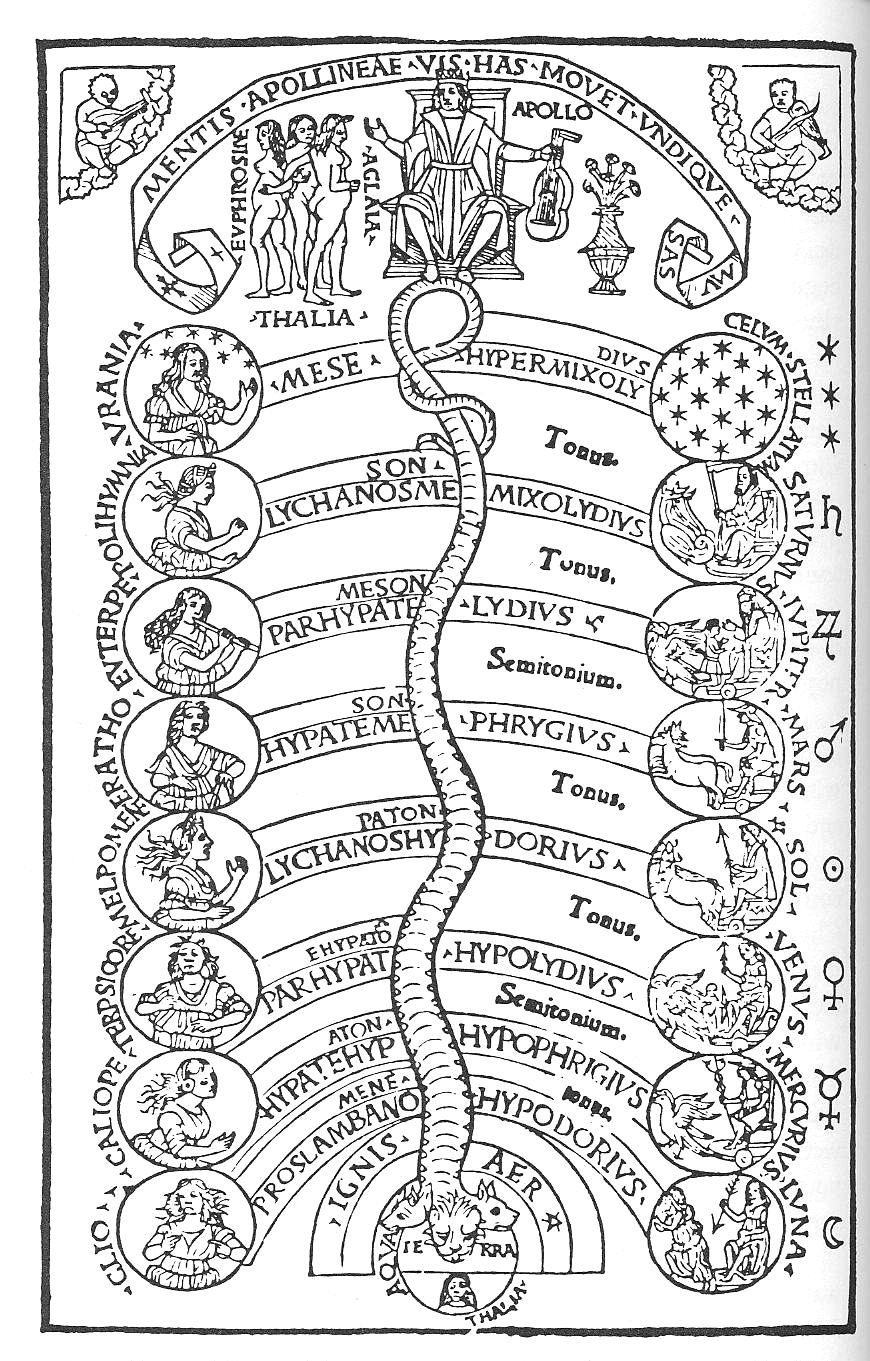
Musica universalis is the Latin name for an idea about the sky as music. It holds that the sizes, speeds and spacing of the Sun, Moon and planets sit in the same proportions that make musical intervals, so their motions amount to a kind of tune. The tune is not something the ear catches. What matters is number and ratio. The concept belongs to philosophy and cosmology rather than to ritual, and scholars argued over it for roughly two thousand years, from Greek mathematics to Renaissance astronomy. Those who held it treated astronomy and music as paired studies, one for the eyes and one for the ears, both resting on proportion.
Where it comes from
Pythagoras is credited with the first observation: a string's pitch falls as its length grows, and pleasant intervals come out as simple number ratios. From this he is said to have reasoned that the Sun, Moon and planets, each on its orbit, give out a separate hum, and that life on Earth takes its character from sounds no ear registers. Plato treated music and astronomy as paired studies, both needing number. Boethius, centuries later in De Musica, sorted music into three kinds, one being the music of the world, and held that this kind is reached by intellect alone. The scheme entered the quadrivium, the four-subject curriculum of medieval schools, and Johannes Kepler took it up again in Harmonices Mundi of 1619. Scholarly interest lasted until the Renaissance closed, feeding currents such as humanism.
How it is done
A follower performs nothing; the work is arithmetic. Boethius held that the music of the world is found through the intellect, not the ear, and that its order matches the order heard in sounding music. Kepler's method was to compare a planet's speed at its nearest and farthest points from the Sun and treat the resulting ratio as an interval. Earth came out near 16 to 15, a semitone. Venus, on a nearly circular path, gave a single note. Mercury, with the most stretched orbit, gave a minor tenth. Across the planets he heard two basses in Saturn and Jupiter, a tenor in Mars, altos in Venus and Earth, and Mercury as soprano.
Tools and materials
The working materials are numbers rather than objects. Chief among them is the ratio between a string's length and the note it gives, which Pythagoras is credited with finding, together with the simple ratios behind consonant intervals. Kepler added the geometry of the five regular solids known since antiquity, which he had already used to set out the spacing of planetary orbits in Mysterium Cosmographicum, and the shape of the elliptical paths themselves. Consonance and dissonance, and the tuning problems that go with them, served as the vocabulary in which these measurements were read.
Musica universalis, drawn and placed
- Living
- Revived
- Fading
- Historical
- Legendary
- Performed
- Lineage
- Pythagorean philosophy, later Christian cosmology
What it is for
The idea served explanation before it served devotion. It offered a reason why the heavens should follow number at all, and it let scholars treat the sky as a subject legible to the same mathematics as a plucked string. Boethius used the order he found there as evidence of divine beauty. Kepler used the naturalness of the harmony as an argument for a Sun-centred cosmos, and as grounds for saying that the planets had been arranged by an intelligent maker. In his account the harmony was silent yet open to the soul, and he described the pleasure it gave him as a kind of bliss.
Who does it
No priesthood or guild is attached to it. Those who worked on it were mathematicians, astronomers and philosophers: Pythagoras and his followers, Plato, Boethius, and much later Kepler, who spent years after Mysterium Cosmographicum poring over tables to fit observation to what he took to be the plan of the cosmos. Aristotle engaged with the idea only to refuse it. Sir Thomas Browne kept Kepler's books in his library and wrote that ordered motion, though it makes no sound for the ear, strikes a note for the understanding.
Peoples and places
The idea begins with Greek thinkers, and it reached Latin Europe through Boethius, whose textbook placed it among the four subjects of the quadrivium alongside arithmetic, geometry and astronomy. That curriculum carried it into medieval schools and on into the Renaissance. Kepler worked on it in the early seventeenth century, and it was still being weighed when Browne set down his thoughts. The concept travelled as a learned idea rather than as a local custom, so it has no regional variants to compare.
At a glance: who, where and when
Who does it
Belief worlds

What people believe
Behind the arithmetic sits a claim about reality: that number carries quality, and that the same proportions turn up in shapes, in visible angles and in sound. Boethius held that the world's music reflects the beauty of God, and that human and instrumental music share its order. Kepler's version is explicitly Christian: a maker who joined geometry, astronomy and music on purpose, and whose work the soul can hear even when the ear cannot. Aristotle had refused the whole notion, arguing that bodies so large moving so fast would make a noise of enormous force, enough to break solid things.
How scholars and sceptics see it
Ancient criticism came from Aristotle, who judged the scheme incompatible with his own cosmos and thought the sound would be violent rather than sweet. Modern readers note that Kepler's tables do not all work: several ratios miss the true interval by more than measurement error would explain, and the pair formed by Mars and Jupiter gives no consonance, though other pairings do. Astronomers have since borrowed the language, calling orbital resonance, where orbiting bodies keep periods in ratios of small whole numbers, a present-day version of the old idea. An animator at the European Southern Observatory set the resonant planets of TOI-178 to music.
Compare and confuse
English speakers usually call the idea the music of the spheres, and sometimes the harmony of the spheres; the Latin title is the one used in philosophy. It should not be confused with orbital resonance, a matter of celestial mechanics that borrows the imagery. Related notions include Boethius's musica humana, the music of the human body, and his third category for music made by voices and instruments.
Today
The image has had a long second life in the arts. Shakespeare refers to it in The Merchant of Venice, the Danish composer Rued Langgaard wrote an orchestral work titled Music of the Spheres in the 1910s, and Paul Hindemith based a 1957 opera, Die Harmonie der Welt, on Kepler's life. Pop and rock musicians have used the phrase as an album title, and it appears in games and television, including a short Doctor Who piece shown during the 2008 BBC Proms.
Questions people ask about Musica universalis
What is musica universalis?
A philosophical idea holding that the Sun, Moon and planets move in the same proportions that make musical intervals, so their motion forms a kind of music. The Latin phrase means universal music. It is a claim about number and order in the sky, not a piece to be played.
Where does it come from?
It starts in ancient Greece with Pythagoras and his followers, who linked musical pitch to the length of a string. Plato paired music with astronomy. Boethius carried the scheme into Latin learning, and Johannes Kepler reworked it in Harmonices Mundi in 1619.
Is this music meant to be heard?
No. Pythagoras is said to have held that the celestial hum is imperceptible to the human ear, and Kepler was clear that his harmony was silent. He held that the soul could hear it and took a kind of bliss from it. Aristotle doubted the whole idea.
Why did Aristotle object?
He argued that bodies as large as the stars, moving as fast as they do, would produce a tremendous noise, and that such force would shatter solid things. The scheme also clashed with his own model of the cosmos, so he set it aside.
What did Kepler add?
He compared each planet's speed at its nearest and farthest point from the Sun, read the ratio as a musical interval, and assigned the six planets then known to voice parts. He also used the harmony as an argument for a Sun-centred cosmos and for an intelligent maker.
Good reading and sources
- Musica universalis on WikipediaEncyclopedia
- More photos on Wikimedia CommonsPhotos and video
- Wikidata recordOpen data
The facts on this page come from the Wikipedia article "Musica universalis", written by its contributors and used under the CC BY-SA 4.0 licence, and from its Wikidata record (CC0). EveryJaadu rewrote the text in its own words, with AI assistance, and compares every page with the article to make sure no passage is copied. It may be reused under the same CC BY-SA 4.0 licence with a link back.
It may contain mistakes. Names and customs differ from one community to the next, and some knowledge is closed to outsiders and left out here. This page describes belief and practice. It does not say that any of it works, it is not a how-to, and it is not medical advice. If something is wrong, tell us. Last refreshed 2026-10-18.
More from Greece
All the entries from Greece 🇬🇷 Greece and 5 moreCrossroads (folklore)
A junction between worlds where spirits are met and deals are madeBelief · Speaking with spirits and the dead · Cursing and harm Living
🇬🇷 Greece and 5 moreCrossroads (folklore)
A junction between worlds where spirits are met and deals are madeBelief · Speaking with spirits and the dead · Cursing and harm Living
 🇬🇷 Greece and 5 moreBay Laurelδάφνη
An aromatic Mediterranean plant used in cooking and as a symbol of victory and purification.Substance · Protection · Cleansing and purification Living
🇬🇷 Greece and 5 moreBay Laurelδάφνη
An aromatic Mediterranean plant used in cooking and as a symbol of victory and purification.Substance · Protection · Cleansing and purification Living
 🇮🇪 Ireland and 5 moreCairn
A human-made stack of stones used as a marker, memorial, or religious symbol across many cultures.Tradition · Protection · Speaking with spirits and the dead Living
🇮🇪 Ireland and 5 moreCairn
A human-made stack of stones used as a marker, memorial, or religious symbol across many cultures.Tradition · Protection · Speaking with spirits and the dead Living
 🇬🇷 Greece and 2 moreNumerology
The belief that numbers hold hidden meanings and influence human events.Belief · Seeing and foretelling · Luck and prosperity Historical
🇬🇷 Greece and 2 moreNumerology
The belief that numbers hold hidden meanings and influence human events.Belief · Seeing and foretelling · Luck and prosperity Historical
Related elsewhere
All belief 🇮🇶 Iraq and 4 moreAstrology
A system of divination that links human affairs to the positions of celestial bodiesTradition · Seeing and foretelling · Luck and prosperity Living
🇮🇶 Iraq and 4 moreAstrology
A system of divination that links human affairs to the positions of celestial bodiesTradition · Seeing and foretelling · Luck and prosperity Living
 🇺🇸 United States and 5 moreSatanism
A modern set of beliefs using the figure of Satan as a symbol or deity.Tradition · Power and authority · Cursing and harm Living
🇺🇸 United States and 5 moreSatanism
A modern set of beliefs using the figure of Satan as a symbol or deity.Tradition · Power and authority · Cursing and harm Living
 🇪🇬 Egypt and 1 moreLilithלִילִית
A feminine figure from Mesopotamian and Jewish mythology, often depicted as a night demon or spirit.Being · Cursing and harm Legendary
🇪🇬 Egypt and 1 moreLilithלִילִית
A feminine figure from Mesopotamian and Jewish mythology, often depicted as a night demon or spirit.Being · Cursing and harm Legendary
 🇪🇬 EgyptCurse
A spoken wish for harm, often backed by ritual or divine authorityBelief · Cursing and harm · Protection Historical
🇪🇬 EgyptCurse
A spoken wish for harm, often backed by ritual or divine authorityBelief · Cursing and harm · Protection Historical