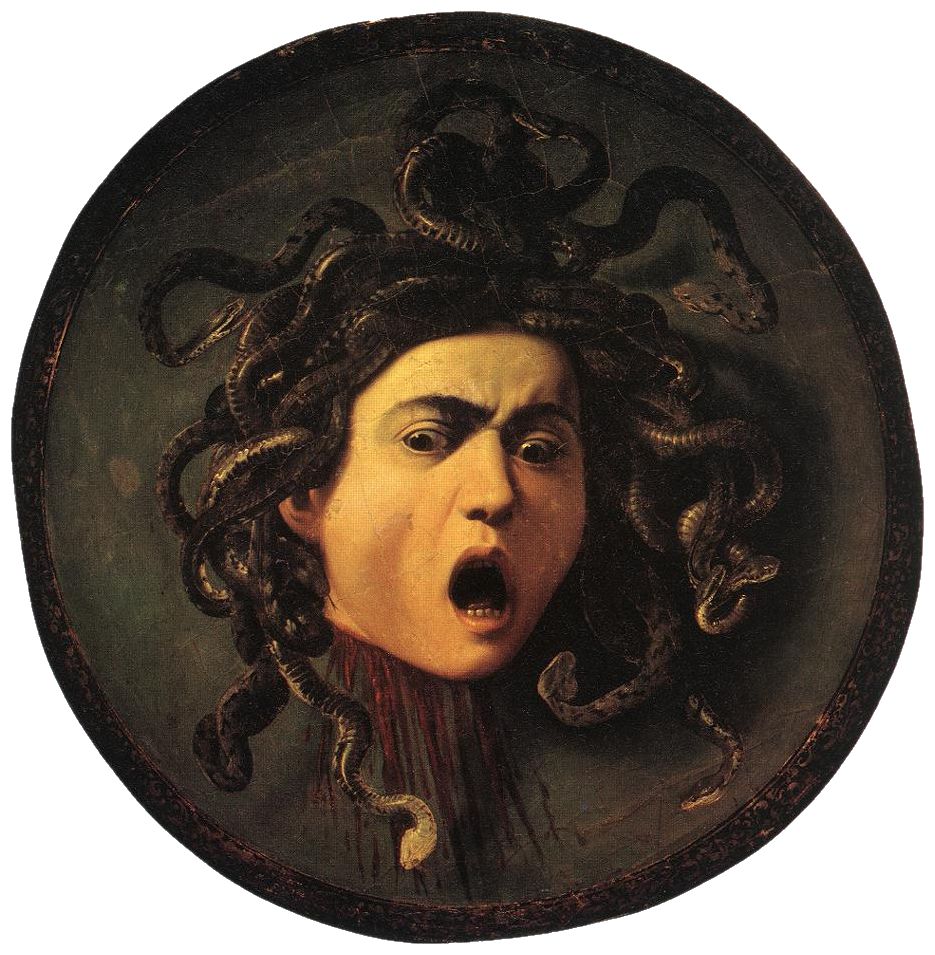
Medusa
In its own language: Μέδουσα
from Ancient Greek Médousa, meaning guardian or protectress
A mortal Greek monster whose gaze turns onlookers to stone
Medusa is a figure from ancient Greek myth who possessed hair made of living snakes. Her terrible appearance caused anyone who met her eyes to become stone.
- Medusa had hair made of living snakes
- Her gaze turned anyone who looked at her to stone
- Perseus beheaded her using a mirrored shield
- Athena placed her head on her shield as a weapon
- Only Medusa of the three Gorgons was mortal
What it is
Medusa stands as one of the three Gorgons in ancient Greek storytelling. She is widely known as a woman with living snakes for hair. Anyone who looked directly at her face turned into stone. This power made her a feared presence in the myths. Her sisters Euryale and Stheno shared her monstrous nature but remained immortal. Only Medusa could be killed by mortals.
Where it comes from
Ancient sources place her origins differently. Hesiod and Aeschylus locate her home near Cisthene on Sarpedon. Later writers like Dionysius Scytobrachion placed the Gorgons in Libya. Herodotus also linked them to Libyan traditions. Some scholars view the story as a memory of early invasions. Joseph Campbell suggested it reflects the stripping of priestesses' masks during historical conflicts.
How it is done
The hero Perseus slew Medusa using divine aids. He wore a helm of invisibility and used a mirrored shield to avoid her direct gaze. Athena provided the mirror, Hermes gave winged sandals, and Hephaestus forged the sword. Perseus cut off her head while viewing her reflection. Pegasus and Chrysaor emerged from her neck upon death.
Tools and materials
Her defining feature was hair made of living snakes. The severed head retained its petrifying power. Perseus carried this head as a weapon. King Polydectes was turned to stone by its sight. Perseus later gave the head to Athena. She mounted it on her shield, the Aegis. This created the Gorgoneion, an evil-averting symbol.
Medusa, drawn and placed
- Living
- Revived
- Fading
- Historical
- Legendary
- Performed
- Lineage
- Greek mythology
What it is for
People feared her gaze as a lethal force. The image of her head served as protection. The Gorgoneion warded off evil spirits and harm. It appeared on shields and buildings in antiquity. Modern interpretations sometimes view her as a symbol of female rage. Feminists have adopted her image to represent power and anger against oppression.
Who does it
No living practitioners perform rituals for Medusa. She belongs to the realm of ancient myth. Scholars analyze her role in literature and art. Psychoanalysts study her as a symbol of fear. Feminist critics examine her transformation into a figure of resistance. Her story continues to influence modern cultural representations.
Peoples and places
The Greeks created the original myths. Roman poets like Ovid adapted the tale. Ovid added details about her past beauty and punishment by Athena. These versions shifted her image from beast to victim. Classical art eventually portrayed her as beautiful yet terrifying. Modern Western culture views her through various lenses, including feminism and psychology.
At a glance: who, where and when
Peoples


What people believe
Greek myths describe her as a daughter of Phorcys and Ceto. She lived among other sea monsters. Her gaze was a divine curse or natural trait. Turning men to stone represented ultimate power. The myth explores themes of mortality and divine intervention. Perseus succeeded because she alone was mortal. Her death birthed new creatures from her blood.
When it is done
No specific festivals celebrate Medusa. Her story appears in seasonal myths involving heroes. Perseus's journey connects to various local legends. He saved Andromeda in Ethiopia after visiting her remains. Coral and vipers were said to form from her spilled blood. These events mark narrative points rather than calendar dates.
How scholars and sceptics see it
Anthropologists see the Gorgon mask as a ritual object misunderstood over time. Jane Harrison argued her power begins when decapitated. Freud interpreted her head as a symbol of castration anxiety. Feminist scholars view her as a victim of male violence. They highlight her use as a symbol of female strength. Critics debate whether she represents terror or compassion.
Cautions and what is closed
Looking at Medusa causes immediate petrification. This serves as a warning against forbidden knowledge. Her story warns of dangerous feminine power. Modern readers may interpret her fate as unjust. The myth reflects societal fears of strong women. It also highlights the consequences of divine wrath. Victims of her gaze lose their humanity forever.
Compare and confuse
Medusa differs from her immortal sisters. Only she could die by mortal hands. Other gorgon-like figures exist in global myths. The Gorgoneion shares traits with other apotropaic symbols. Versace uses her image as a fashion logo. Modern media often reimagines her as a tragic heroine. Her name sometimes signifies pure malice in common usage.
Questions people ask about Medusa
What does the name Medusa mean?
The name comes from Ancient Greek Médousa, which translates to guardian or protectress. It reflects her role as a powerful figure in Greek mythology.
How did Perseus kill Medusa without looking at her?
He used a polished shield given by Athena to see her reflection. This allowed him to approach and behead her without meeting her deadly gaze directly.
Where did Medusa live according to ancient texts?
Hesiod and Aeschylus placed her near Cisthene in Greece. Later writers associated her with Libya, reflecting different regional traditions about the Gorgons.
Why is Medusa's head still dangerous after death?
The myth states her petrifying power remained intact. Perseus used it as a weapon against enemies before giving it to Athena for her shield.
Is Medusa always depicted as a monster?
Later Roman versions described her as a beautiful maiden cursed by Athena. Classical art also began showing her as attractive, adding complexity to her character.
Good reading and sources
- Medusa on WikipediaEncyclopedia
- More photos on Wikimedia CommonsPhotos and video
- Wikidata recordOpen data
The facts on this page come from the Wikipedia article "Medusa", written by its contributors and used under the CC BY-SA 4.0 licence, and from its Wikidata record (CC0). EveryJaadu rewrote the text in its own words, with AI assistance, and compares every page with the article to make sure no passage is copied. It may be reused under the same CC BY-SA 4.0 licence with a link back.
It may contain mistakes. Names and customs differ from one community to the next, and some knowledge is closed to outsiders and left out here. This page describes belief and practice. It does not say that any of it works, it is not a how-to, and it is not medical advice. If something is wrong, tell us. Last refreshed 2026-10-05.
More from Greece
All the entries from Greece 🇷🇸 Serbia and 5 moreVampire
An undead creature from folklore that feeds on the blood or life force of the livingBeing · Cursing and harm · Luck and prosperity Legendary
🇷🇸 Serbia and 5 moreVampire
An undead creature from folklore that feeds on the blood or life force of the livingBeing · Cursing and harm · Luck and prosperity Legendary
 🇮🇹 Italy and 1 morePietro d'Abano
A medieval physician and astrologer accused of heresy and magic.Text · Healing · Wonder and entertainment Historical
🇮🇹 Italy and 1 morePietro d'Abano
A medieval physician and astrologer accused of heresy and magic.Text · Healing · Wonder and entertainment Historical
 🇬🇷 GreeceCassandraΚασσάνδρα
A Trojan priestess cursed to speak truth that no one acceptsFigure · Seeing and foretelling Legendary
🇬🇷 GreeceCassandraΚασσάνδρα
A Trojan priestess cursed to speak truth that no one acceptsFigure · Seeing and foretelling Legendary
 🇬🇷 GreeceOrpheusὈρφεύς
A Thracian bard whose music charms nature and who journeys to the underworldFigure · Wonder and entertainment Legendary
🇬🇷 GreeceOrpheusὈρφεύς
A Thracian bard whose music charms nature and who journeys to the underworldFigure · Wonder and entertainment Legendary
Related elsewhere
All figure 🇪🇬 Egypt and 1 moreLilithלִילִית
A feminine figure from Mesopotamian and Jewish mythology, often depicted as a night demon or spirit.Being · Cursing and harm Legendary
🇪🇬 Egypt and 1 moreLilithלִילִית
A feminine figure from Mesopotamian and Jewish mythology, often depicted as a night demon or spirit.Being · Cursing and harm Legendary
 🇪🇬 EgyptCurse
A spoken wish for misfortune to befall a person or placeBelief · Cursing and harm · Luck and prosperity Historical
🇺🇸 United StatesDeliverance ministry
A Christian practice to remove evil spirits believed to cause personal afflictionRite · Cursing and harm · Cleansing and purification Living
🇪🇬 EgyptCurse
A spoken wish for misfortune to befall a person or placeBelief · Cursing and harm · Luck and prosperity Historical
🇺🇸 United StatesDeliverance ministry
A Christian practice to remove evil spirits believed to cause personal afflictionRite · Cursing and harm · Cleansing and purification Living
 🇮🇶 Iraq and 1 moreRabisu
A wind spirit in Akkadian myth sent to correct human transgressionsBeing · Cursing and harm · Cleansing and purification Historical
🇮🇶 Iraq and 1 moreRabisu
A wind spirit in Akkadian myth sent to correct human transgressionsBeing · Cursing and harm · Cleansing and purification Historical