
Hu
In its own language: 笏
from Chinese hù, meaning a tablet or baton
A flat ceremonial baton used by East Asian officials and priests for ritual purposes.
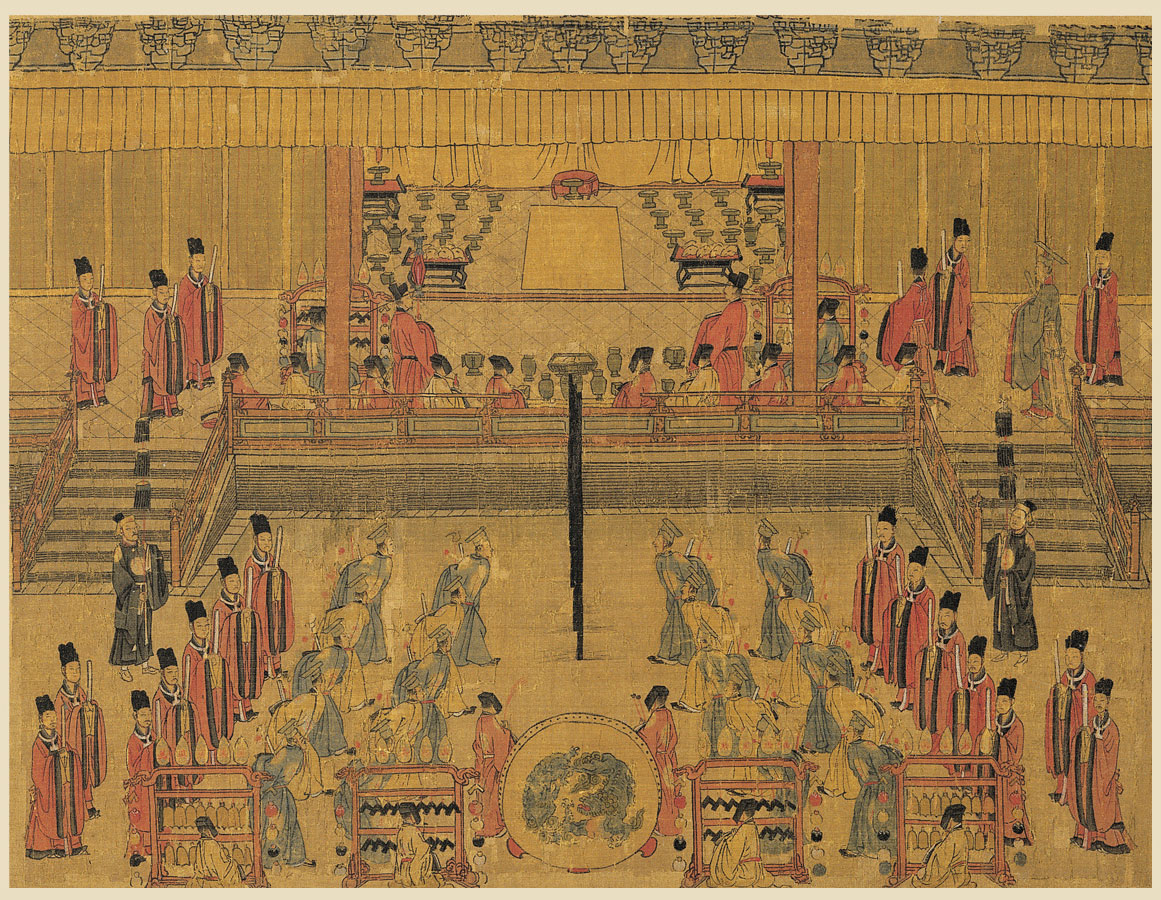
The hu is a flat scepter originating in China, initially serving as a writing tablet for court notes. It evolved into a symbol of rank worn by nobles across East Asia and remains part of Daoist and Shinto liturgical dress today.
- Originated in China as a bamboo writing tablet for court notes.
- Spread to Japan as the shaku, part of noble formal attire.
- Materials indicated rank: jade for emperors, ivory for nobles.
- Now used by Daoist priests and Shinto clergy in rituals.
- Banned in Chinese courts during the Qing dynasty era.
What it is
The hu is a flat, handheld scepter that began as a practical tool in ancient China. Officials used it to jot down imperial decrees during court audiences. Over time, the object shifted from a functional note-taking device to a formal emblem of authority. It spread throughout East Asia, adapting to local customs while retaining its core identity as a marker of status. Today, it appears primarily in religious contexts rather than secular government.
Where it comes from
The practice started in China, where early regulations specified precise dimensions for the tablet. Originally crafted from bamboo, it allowed scribes to record instructions before meeting with rulers. As paper became common, the need for writing vanished, leaving the object as a ceremonial prop. The shape varied by rank: jade for sovereigns, ivory for nobles, and bamboo for lower officials. This hierarchy reflected the social order of the imperial court.
How it is done
In China, holders typically gripped the baton with the wider end pointing downward. In Japan, the shaku is held vertically in the right hand. Historically, officials might shield their mouths with the object when speaking to superiors, a gesture of respect. The item was often attached to belts or carried on racks during palace proceedings. Its presence signaled the wearer's official capacity and adherence to strict protocol.
Tools and materials
Materials denoted social standing. Jade represented the highest rank, followed by ivory for nobility. Bamboo served lower-ranking officials due to its availability. In Japan, oak was prized for durability, though cherry, cedar, and holly were also common. The physical form changed over centuries; some versions featured curved fronts and straight backs, while others were angled or square depending on the user's position in the hierarchy.
Hu, drawn and placed
- Living
- Revived
- Fading
- Historical
- Legendary
- Performed
- Lineage
- East Asian court ritual tradition
- Timing
- during court audiences and religious ceremonies
What it is for
The primary function was to display authority and maintain court decorum. It acted as a visual cue of the holder's rank within the bureaucratic system. In later periods, it gained spiritual significance. Daoist priests use it during rites to invoke sacred space. Shinto clergy employ it in ceremonies to honor deities. The object bridges the gap between political power and spiritual duty.
Who does it
Historically, government officials and courtiers wielded the hu. Their training involved mastering complex etiquette rules regarding how to hold and present the baton. Today, the role has shifted to religious specialists. Daoist priests (daoshi) and Shinto priests (kannushi) are the main users. They undergo specific religious training to incorporate the baton into liturgical performances, preserving an ancient tradition within modern faith practices.
Peoples and places
The custom originated in China and expanded to neighboring regions. Japanese culture adopted the item as the shaku, integrating it into the sokutai formal attire. Vietnamese sources mention the hốt, reflecting similar administrative traditions. Each culture adapted the object to fit their specific hierarchical structures and aesthetic preferences, yet all maintained its connection to high office and ritual solemnity.
At a glance: who, where and when
Peoples
Belief worlds
Occasions


What people believe
The hu embodies the concept of ordered hierarchy and respectful communication. In religious settings, it represents a conduit for divine interaction. Daoists view it as a tool for channeling ritual energy. Shinto practitioners see it as a symbol of purity and connection to kami.
When it is done
The baton is used during formal court sessions and religious festivals. In historical contexts, it appeared whenever an official attended an audience with the emperor. In contemporary times, it features in regular temple services and annual shrine events. Specific life milestones do not typically involve the hu, but rather ongoing institutional duties and cyclical religious observances.
How scholars and sceptics see it
Researchers study the hu as an artifact of bureaucratic history and cultural exchange. Anthropologists analyze how the shift from writing tablet to ceremonial prop reflects changes in technology and administration. Historians trace the spread of the object across East Asia to understand diplomatic relations and shared elite cultures. Scholars note the linguistic variations, such as the Japanese avoidance of certain readings due to associations with bones.
Cautions and what is closed
The object is strictly regulated in traditional settings. Misuse or improper handling can be seen as a breach of etiquette. In religious contexts, only authorized clergy may handle the baton. There are no known health risks associated with the object itself, but its historical use in rigid hierarchies underscores the power dynamics of the societies that produced it. Modern replicas are collectibles rather than active ritual tools.
Compare and confuse
The hu is distinct from other scepters like the ruyi, which serves different symbolic functions. It shares similarities with the gohei, another Shinto ritual implement, though the gohei uses paper streamers. In Korea, the mokcheok served a comparable role. The English term 'baton' captures its general shape, but the hu is specifically tied to East Asian administrative and religious traditions.
Law and persecution
Imperial laws once dictated exactly who could possess which type of hu. Violations of these sumptuary laws were serious offenses. The Qing dynasty eventually banned the hu in court due to new greeting protocols requiring kowtowing. Modern legal systems do not regulate the object, but religious institutions maintain internal rules governing its use. Cultural heritage laws protect historical examples as artifacts of national importance.
Today
The hu survives in religious communities rather than government offices. Daoist temples in China and Shinto shrines in Japan continue to use the baton in daily worship. Collectors and museums preserve historical examples made of jade, ivory, and wood. The object remains a potent symbol of East Asian cultural heritage, linking contemporary practitioners to ancient traditions of ritual and authority.
Questions people ask about Hu
What is a hu?
A hu is a flat ceremonial baton that originated in China. It began as a tablet for recording imperial orders and evolved into a symbol of official rank and religious authority across East Asia.
Where does the hu come from?
The hu comes from ancient China, where it was first used by officials. It later spread to Japan, Vietnam, and Korea, adapting to local court and religious traditions in each region.
Who uses the hu today?
Today, the hu is primarily used by Daoist priests in China and Shinto priests in Japan. It is employed during formal religious ceremonies and rituals to denote sacred duty.
What materials are used to make a hu?
Historical hūs were made from jade, ivory, or bamboo depending on the user's rank. In Japan, wooden varieties like oak, cherry, and cedar are common for the shaku.
Good reading and sources
- Hu (ritual baton) on WikipediaEncyclopedia
- More photos on Wikimedia CommonsPhotos and video
- Wikidata recordOpen data
The facts on this page come from the Wikipedia article "Hu (ritual baton)", written by its contributors and used under the CC BY-SA 4.0 licence, and from its Wikidata record (CC0). EveryJaadu rewrote the text in its own words, with AI assistance, and compares every page with the article to make sure no passage is copied. It may be reused under the same CC BY-SA 4.0 licence with a link back.
It may contain mistakes. Names and customs differ from one community to the next, and some knowledge is closed to outsiders and left out here. This page describes belief and practice. It does not say that any of it works, it is not a how-to, and it is not medical advice. If something is wrong, tell us. Last refreshed 2026-10-16.
More from China
All the entries from China 🇨🇳 China and 5 moreChinese guardian lions石獅 (shíshī)
Stone lion pairs placed at entrances to ward off harm and welcome fortuneCharm · Protection · Luck and prosperity Living
🇨🇳 China and 5 moreChinese guardian lions石獅 (shíshī)
Stone lion pairs placed at entrances to ward off harm and welcome fortuneCharm · Protection · Luck and prosperity Living
 🇨🇳 China and 5 moreJoss paper金紙
Paper burned as money and goods for ancestors, gods and the deadCharm · Speaking with spirits and the dead · Luck and prosperity Living
🇨🇳 China and 5 moreJoss paper金紙
Paper burned as money and goods for ancestors, gods and the deadCharm · Speaking with spirits and the dead · Luck and prosperity Living
 🇨🇳 China and 1 moreFulu符籙
Taoist talismans with cryptic symbols used for healing and protectionCharm · Healing · Protection Living
🇨🇳 China and 1 moreFulu符籙
Taoist talismans with cryptic symbols used for healing and protectionCharm · Healing · Protection Living
 🇨🇳 China and 5 moreSky lantern天燈
A paper hot air balloon lifted by flame to carry wishes and blessingsRite · Luck and prosperity · Protection Living
🇨🇳 China and 5 moreSky lantern天燈
A paper hot air balloon lifted by flame to carry wishes and blessingsRite · Luck and prosperity · Protection Living
Related elsewhere
All charm 🇫🇷 France and 2 moreKing ArthurBrenin Arthur
A legendary British king and folk hero of medieval literature and Welsh mythologyFigure · Power and authority · Wonder and entertainment Legendary
🇫🇷 France and 2 moreKing ArthurBrenin Arthur
A legendary British king and folk hero of medieval literature and Welsh mythologyFigure · Power and authority · Wonder and entertainment Legendary
 🇮🇳 India and 1 moreMantraमन्त्रम्
A sacred sound or phrase repeated to focus the mind and invoke spiritual powerText · Speaking with spirits and the dead · Power and authority Living
🇮🇳 India and 1 moreMantraमन्त्रम्
A sacred sound or phrase repeated to focus the mind and invoke spiritual powerText · Speaking with spirits and the dead · Power and authority Living
 🇮🇳 India and 2 moreYantraयन्त्र
A geometric diagram from Indian traditions used for worship and meditationTradition · Protection · Speaking with spirits and the dead Living
🇮🇳 India and 2 moreYantraयन्त्र
A geometric diagram from Indian traditions used for worship and meditationTradition · Protection · Speaking with spirits and the dead Living
 🇮🇳 India and 1 moreAshtamangalaअष्टमङ्गल
A set of eight sacred symbols used in Indian religions to mark auspicious occasions and teach spiritual truths.Tradition · Power and authority · Wonder and entertainment Living
🇮🇳 India and 1 moreAshtamangalaअष्टमङ्गल
A set of eight sacred symbols used in Indian religions to mark auspicious occasions and teach spiritual truths.Tradition · Power and authority · Wonder and entertainment Living