
Hippocampus
In its own language: ἱππόκαμπος
from Ancient Greek hippókampos, meaning 'horse' and 'sea monster'
A mythological hybrid of a horse and fish from ancient Mediterranean cultures
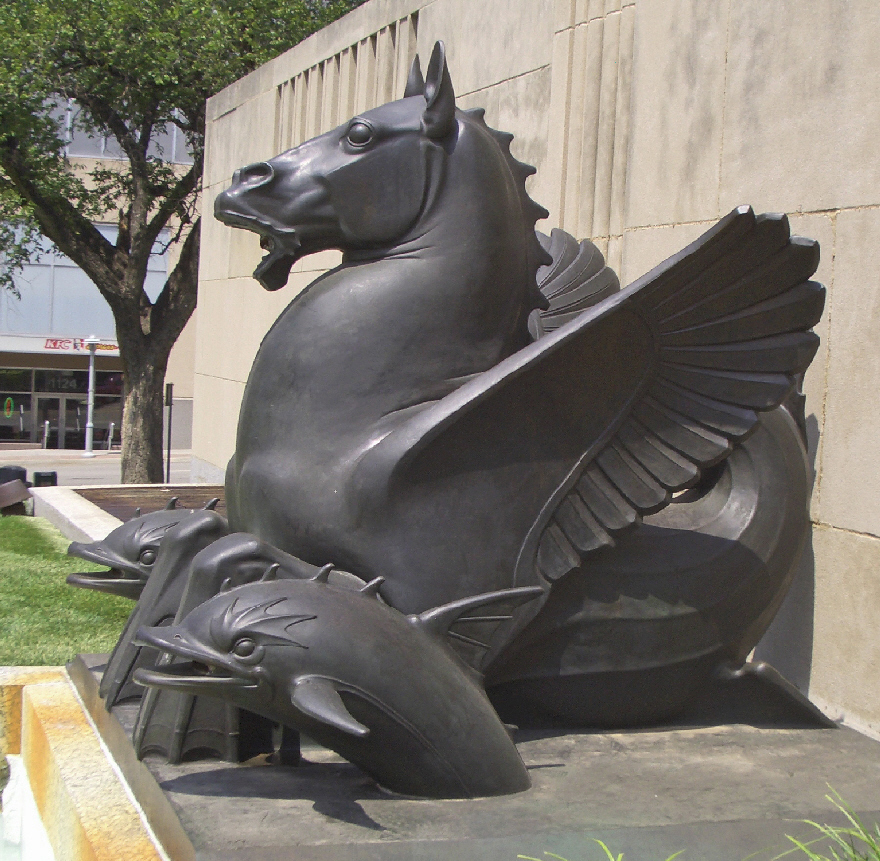
The hippocampus is a creature with the upper body of a horse and the lower body of a fish. It appears in Etruscan, Greek, Phoenician, Pictish, and Roman myths as a companion to sea gods like Poseidon.
- Depicted with horse front and fish rear
- Mount for the god Poseidon
- Found on ancient Greek and Roman coins
- Symbol for Air France since 1933
- Named after a moon of Neptune
What it is
The hippocampus is a legendary being described as having the front half of a horse and the back half of a fish. This hybrid form appears across several ancient Mediterranean cultures, including those of Greece, Rome, and Etruria. It is primarily known as a divine mount or companion to sea deities, most notably Poseidon. The creature represents the intersection of land and sea powers in ancient imagination.
Where it comes from
The term comes from Ancient Greek, combining words for horse and sea monster. The creature features in early Etruscan tomb paintings and reliefs, suggesting a belief in a sea journey to the afterlife. Greek texts describe it as part of the natural world, where sea water was thought to flow through underground caverns to become fresh springs. This geological view made freshwater and saltwater hybrids seem logical to ancient observers.
Tools and materials
Ancient artisans rendered hippocampi in bronze, gold, and ivory. They appear on coins from Tyre and Byblos, often showing the god Melqart riding one. A gold example was found in a Lydian hoard. Later, they decorated Roman baths and temples, such as the temple of Poseidon at Corinth, which featured gilt-bronze and ivory sculptures of the creatures pulling divine chariots.
Hippocampus, drawn and placed
- Living
- Revived
- Fading
- Historical
- Legendary
- Performed
- Lineage
- Greek mythology
What it is for
In myth, the hippocampus serves as a steed for gods who command both horses and oceans. It helps pull the sea-chariot of Poseidon. In modern times, the image is used for heraldic charges and corporate logos, such as Air France. It also appears on football club crests and public monuments, serving as a symbol of maritime heritage rather than active magical practice.
Who does it
No living practitioners perform rituals with the hippocampus. It is studied by scholars of classical antiquity and mythology. Artists and designers use its image for aesthetic purposes. Heraldic authorities grant it in coats of arms. Its role is purely symbolic and decorative in contemporary culture, detached from its original religious context.
Peoples and places
The creature is central to Greek and Roman mythology but also appears in Etruscan, Phoenician, and Pictish art. Greeks depicted it in literature and sculpture. Romans incorporated it into bathhouse mosaics and temple decorations. Etruscans used it in tomb art. Modern Irish and British contexts feature bronze statues and civic buildings adorned with the image, showing its spread beyond its ancient origins.
At a glance: who, where and when


What people believe
Ancient Greeks believed the sea flowed into land through aquifers, making hippocampi natural inhabitants of both fresh and salt water. They were companions to Poseidon, the god of earthquakes and the sea. The creature was seen as part of the divine entourage, helping to navigate the ocean's surface. It was not worshipped directly but revered as a manifestation of divine power over waters.
How scholars and sceptics see it
Scholars analyze the hippocampus as a cultural symbol of the sea-land boundary. Anthropologists note its presence in Etruscan funerary art as a guide to the afterlife. Historians trace its depiction on ancient coins and in literary texts like Homer's Iliad. Researchers study how the image evolved from a mythological beast to a heraldic charge and modern logo, reflecting changing attitudes toward nature and mythology.
Compare and confuse
The hippocampus is related to the sea-goat (Capricorn) and the ichthyocentaur. Unlike the centaur, which has a human torso, the hippocampus retains the full equine head and neck. It is distinct from the kelpie, a Scottish water spirit that takes the form of a horse without the fish tail. Both share associations with water and transformation.
Questions people ask about Hippocampus
What does a hippocampus look like?
It is a hybrid creature with the head, neck, and forebody of a horse, and the tail and hindquarters of a fish. Some artistic depictions add wings or fins to the mane.
Where did the hippocampus originate?
The concept originates in ancient Mediterranean cultures, particularly among the Greeks, Etruscans, and Romans. The word itself is Ancient Greek.
Why do Greeks imagine sea horses in fresh water?
Ancient Greeks believed sea water flowed through underground caves to replenish freshwater springs. This hydrological model made aquatic horse hybrids logical in all waters.
Good reading and sources
- Hippocampus (mythology) on WikipediaEncyclopedia
- More photos on Wikimedia CommonsPhotos and video
- Wikidata recordOpen data
The facts on this page come from the Wikipedia article "Hippocampus (mythology)", written by its contributors and used under the CC BY-SA 4.0 licence, and from its Wikidata record (CC0). EveryJaadu rewrote the text in its own words, with AI assistance, and compares every page with the article to make sure no passage is copied. It may be reused under the same CC BY-SA 4.0 licence with a link back.
It may contain mistakes. Names and customs differ from one community to the next, and some knowledge is closed to outsiders and left out here. This page describes belief and practice. It does not say that any of it works, it is not a how-to, and it is not medical advice. If something is wrong, tell us. Last refreshed 2026-10-06.
More from Greece
All the entries from Greece 🇷🇸 Serbia and 5 moreVampire
An undead creature from folklore that feeds on the blood or life force of the livingBeing · Cursing and harm · Luck and prosperity Legendary
🇷🇸 Serbia and 5 moreVampire
An undead creature from folklore that feeds on the blood or life force of the livingBeing · Cursing and harm · Luck and prosperity Legendary
 🇬🇷 GreeceTriple Goddess
A Neopagan deity representing three female life stages and lunar phasesBeing · Power and authority Living
🇬🇷 GreeceTriple Goddess
A Neopagan deity representing three female life stages and lunar phasesBeing · Power and authority Living
 🇬🇷 GreeceCirceΚίρκη
A Greek goddess and witch known for turning men into beasts with her potionsBeing · Cursing and harm · Love and attraction Legendary
🇬🇷 GreeceCirceΚίρκη
A Greek goddess and witch known for turning men into beasts with her potionsBeing · Cursing and harm · Love and attraction Legendary
 🇬🇷 Greece and 3 moreHellhound
A mythological canine that guards the underworld or serves demonic forces across global folkloreBeing · Protection · Cursing and harm Legendary
🇬🇷 Greece and 3 moreHellhound
A mythological canine that guards the underworld or serves demonic forces across global folkloreBeing · Protection · Cursing and harm Legendary
Related elsewhere
All being 🇪🇬 Egypt and 1 moreSphinx
A mythical hybrid with a human head and lion body, serving as guardian or riddler in Egyptian and Greek traditions.Being · Protection · Wonder and entertainment Legendary
🇷🇺 Russia and 3 moreNart sagaНарты кадджытæ
A collection of epic tales from the North Caucasus about a legendary group of heroes.Text · Wonder and entertainment Historical
🇨🇱 ChileChilean mythology
The myths and legends of Chile, blending indigenous roots with colonial influences.Tradition · Wonder and entertainment Living
🇪🇬 Egypt and 1 moreSphinx
A mythical hybrid with a human head and lion body, serving as guardian or riddler in Egyptian and Greek traditions.Being · Protection · Wonder and entertainment Legendary
🇷🇺 Russia and 3 moreNart sagaНарты кадджытæ
A collection of epic tales from the North Caucasus about a legendary group of heroes.Text · Wonder and entertainment Historical
🇨🇱 ChileChilean mythology
The myths and legends of Chile, blending indigenous roots with colonial influences.Tradition · Wonder and entertainment Living
 🇨🇳 ChinaLan Caihe藍采和
An ambiguous Taoist immortal known for a flower basket and wandering songsBeing · Wonder and entertainment Legendary
🇨🇳 ChinaLan Caihe藍采和
An ambiguous Taoist immortal known for a flower basket and wandering songsBeing · Wonder and entertainment Legendary