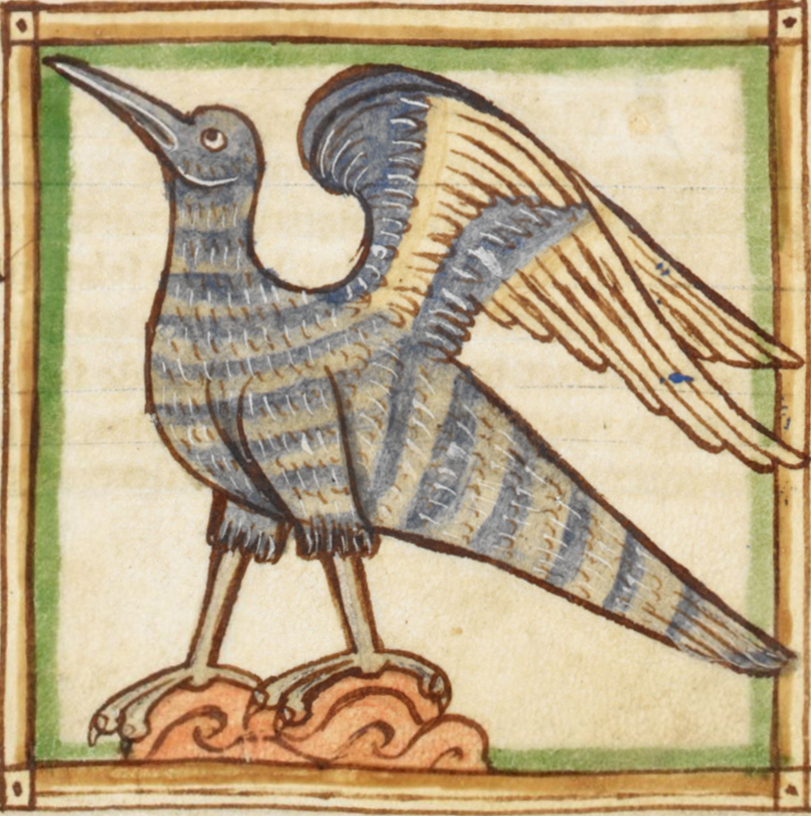
Hercinia is a legendary bird said to live in the Hercynian Forest of ancient Germany. Its feathers were described as shining in darkness, and the creature appears in medieval bestiaries and in writings by Pliny the Elder and Isidore of Seville.
- Pliny the Elder described a bird in Germany whose feathers shone at night like fire.
- Isidore of Seville wrote in the 7th century that the feathers lit the ground and marked a path.
- Its identity is uncertain; iridescent feathers or bioluminescent fungi are suggested explanations.
- Thomas Moore's poem "A Dream of Antiquity" drew on the glowing birds of the Hercynian Forest.
What it is
Hercinia is a bird of legend, placed in the Hercynian Forest of ancient Germany. It is known from written descriptions and from medieval bestiaries. Writers say its feathers gave off light in the dark. Pliny the Elder, in the 1st century, told of a bird whose plumage shone at night like fire. Isidore of Seville, in the 7th century, said the feathers sparkled in shade and could light the ground, helping to mark the way. The shining feathers are the creature's main sign.
Where it comes from
The earliest account named here comes from Pliny the Elder in the 1st century. He placed the bird in the Hercynian Forest, in Germany, and described feathers that shone at night like fire. Isidore of Seville took up the subject in the 7th century and added the detail that the feathers could light the ground and show direction. Medieval bestiaries repeated the bird. The question of what lay behind the reports is open. Suggested explanations include birds with iridescent feathers that caught moonlight, and birds whose feathers carried bioluminescent fungi or bacteria.
Tools and materials
The creature is defined by its feathers. Isidore of Seville adds a practical detail: when the feathers are put on the ground, their glow helps mark a path, and their glitter shows direction. That is the main sign tied to the bird in the accounts.
Hercinia, drawn and placed
- Living
- Revived
- Fading
- Historical
- Legendary
- Performed
- Lineage
- medieval bestiary tradition
- Timing
- at night
How scholars and sceptics see it
Later commentary treats the bird's identity as uncertain. One line of explanation points to birds with iridescent feathers that reflect moonlight; the barn owl and the bittern are named as species where such an effect has been reported. Another suggestion is that the reports came from birds carrying bioluminescent fungi or bacteria in their feathers. Neither explanation is presented as settled. The notices in Pliny and Isidore are the basis for the medieval bestiary descriptions.
Today
The legend has had an afterlife in art. Thomas Moore's poem "A Dream of Antiquity" draws on the glowing birds of the Hercynian Forest. The account also records that the legend inspired various works of art, though it names only Moore's poem. The bird is remembered through such writings and through the medieval bestiaries.
Questions people ask about Hercinia
What is the hercinia?
A legendary bird of the Hercynian Forest in ancient Germany. Its feathers were said to shine in darkness, and it appears in medieval bestiaries and in writings by Pliny the Elder and Isidore of Seville.
Where does the bird come from?
Accounts place it in the Hercynian Forest, in ancient Germany. Pliny the Elder recorded it in the 1st century, and Isidore of Seville wrote about it in the 7th. Medieval bestiaries also describe it.
Did a bird of this kind exist?
The accounts say its identity cannot be settled. Suggested explanations are birds with iridescent feathers that reflect moonlight, such as the barn owl and bittern, or birds carrying bioluminescent fungi or bacteria in their feathers.
What were the feathers said to do?
Isidore of Seville says they sparkled in shade. When placed on the ground, they gave light that helped mark the way, and the glittering feathers made the direction of the path clear.
How is it remembered in art?
Thomas Moore's poem "A Dream of Antiquity" was inspired by the glowing birds of the Hercynian Forest. The legend is also said to have inspired various works of art, though Moore's poem is the one named.
Good reading and sources
- Hercinia on WikipediaEncyclopedia
- More photos on Wikimedia CommonsPhotos and video
- Wikidata recordOpen data
The facts on this page come from the Wikipedia article "Hercinia", written by its contributors and used under the CC BY-SA 4.0 licence, and from its Wikidata record (CC0). EveryJaadu rewrote the text in its own words, with AI assistance, and compares every page with the article to make sure no passage is copied. It may be reused under the same CC BY-SA 4.0 licence with a link back.
It may contain mistakes. Names and customs differ from one community to the next, and some knowledge is closed to outsiders and left out here. This page describes belief and practice. It does not say that any of it works, it is not a how-to, and it is not medical advice. If something is wrong, tell us. Last refreshed 2026-10-20.
More from Germany
All the entries from Germany 🇩🇪 Germany and 3 moreMare
A spirit that sits on sleepers to cause nightmares and physical distressBeing · Cursing and harm Historical
🇩🇪 Germany and 1 moreNachzehrer
A German revenant believed to consume the living from beyond the graveBeing · Cursing and harm Legendary
 🇷🇺 Russia and 4 moreLady MiddayPoludnitsa
A Slavic noon spirit who watches over fields and punishes those who work during the hottest hours.Being · Cursing and harm · Protection Historical
 🇮🇪 Ireland and 3 moreChangeling
A substitute left by supernatural beings in place of a stolen human child or adultBeing · Cursing and harm · Luck and prosperity Legendary
Related elsewhere
All being 🇪🇬 Egypt and 1 moreSphinx
A composite creature of human head and lion body found in Egyptian and Greek mythBeing · Protection Legendary
 🇪🇬 Egypt and 1 moreLilithלִילִית
A feminine figure from Mesopotamian and Jewish mythology, often depicted as a night demon or spirit.Being · Cursing and harm Legendary
 🇨🇳 China and 1 moreLoong龍
A water deity and imperial symbol in Chinese culture, depicted as a coiled serpent with four legs.Being · Protection · Luck and prosperity Historical
 🇨🇳 China and 5 moreGuanyin觀音 (Guānyīn)
The Bodhisattva of compassion, worshipped across East Asia as a listener to human sufferingBeing · Protection · Healing Living