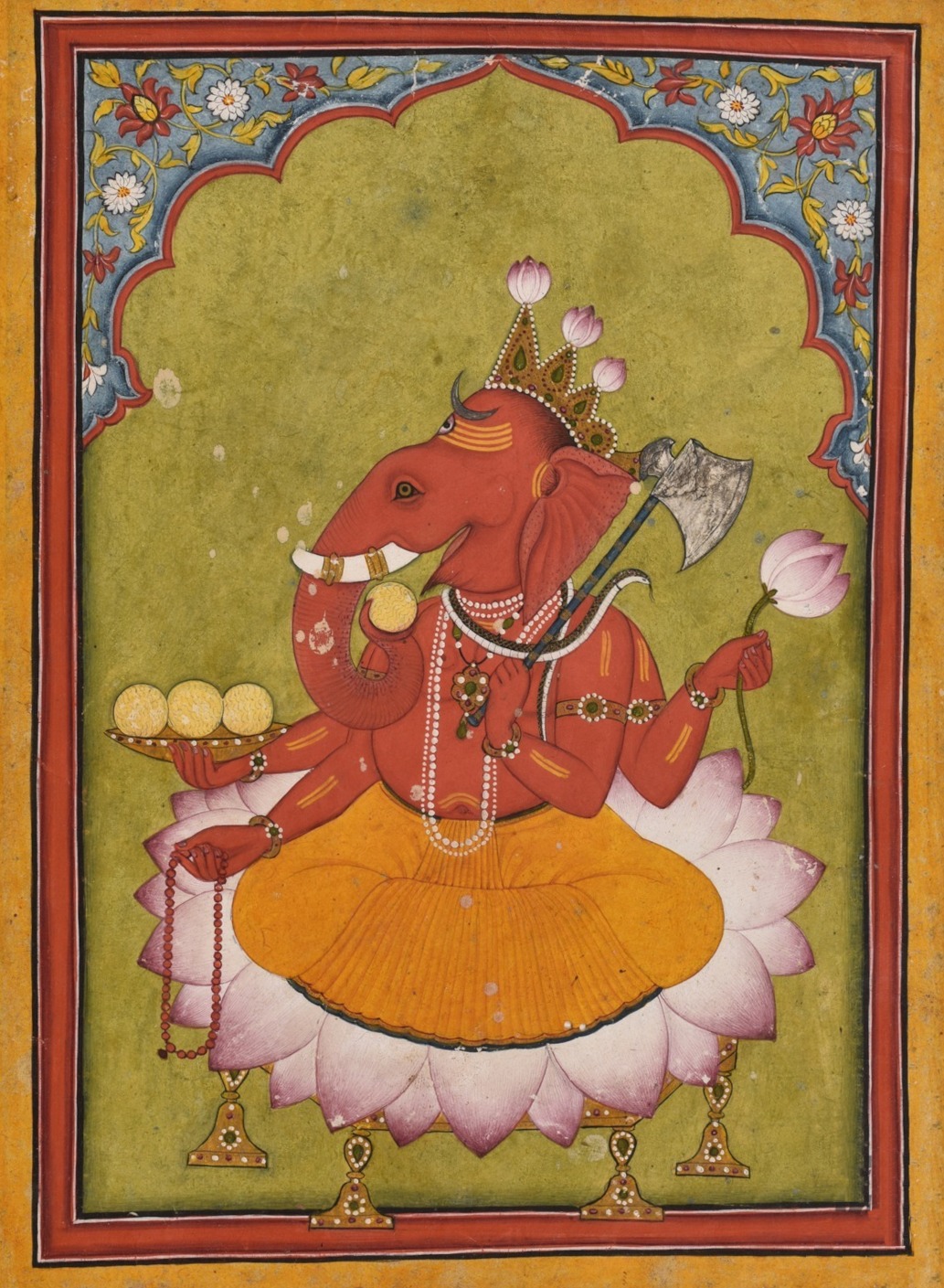
Ganesha
In its own language: गणेश (Gaṇeśa)
from Sanskrit gana (group) and isha (lord), meaning Lord of the Gaṇas
An elephant-headed Hindu deity worshipped as the remover of obstacles and patron of wisdom.
Ganesha is a widely revered Hindu deity with an elephant head and four arms. He is invoked at the start of rituals to remove barriers and grant success in arts, sciences, and learning.
- Elephant-headed Hindu deity known as the remover of obstacles.
- Son of Shiva and Parvati, worshipped before other gods.
- Holds a broken tusk and offers modaka sweets to devotees.
- Mount is a mouse, symbolizing control over desires.
- Festivals include Ganesh Chaturthi and Sankashti Chaturthi.
What it is
Ganesha is a prominent figure in Hinduism, instantly recognized by his elephant head and four arms. He serves as the god of new beginnings, logic, intellect, and wisdom. Devotees view him as the remover of obstacles and the bringer of good luck. He is also the patron of arts, sciences, and letters, often invoked during writing sessions. In the Ganapatya sect, he is considered the Supreme Being. His title Pratham Pujya marks him as the first deity to be worshipped before any other ritual begins.
Where it comes from
Texts mention Ganesha between the 1st and 2nd centuries BCE, with images appearing by the 4th century CE. He is identified as the son of Shiva and Parvati. Myths explain his elephant head through various stories: some say Parvati created him from clay, while others claim Shiva replaced his original head after a battle. The name Ganapati appears in the Rigveda, though its specific link to Ganesha is debated. Synonyms like Vinayaka and Vighneshvara highlight his role as the master who clears barriers.
How it is done
Devotion involves invoking Ganesha at the beginning of ceremonies, journeys, or creative work. Rituals often include offerings of modakas, which are round sweet dumplings. Statues depict him holding a broken tusk, symbolizing sacrifice, and tasting a modaka with his trunk. Worshippers may chant mantras such as Oṃ Śrī Gaṇeśāya Namaḥ. Festivals like Ganesh Chaturthi celebrate his birth with processions and public installations of his image.
Tools and materials
Iconography features specific items that carry symbolic weight. A broken tusk represents self-sacrifice and the use of intellect. Modakas symbolize the nectar of knowledge. An axe cuts through ignorance, while a noose binds negative tendencies. A mouse, his mount, signifies the control of desires. Colors also matter; red is common, but white or blue may appear in specific meditation forms. A serpent around his neck denotes power over fear.
Ganesha, drawn and placed
- Living
- Revived
- Fading
- Historical
- Legendary
- Performed
- Lineage
- Hindu pantheon
- Timing
- at the start of rites and ceremonies
What it is for
People seek Ganesha’s help to clear hurdles in life and ensure smooth starts to ventures. Students pray to him for wisdom and success in exams. Writers invoke him to overcome creative blocks. As the lord of obstacles, he is asked to remove both physical and spiritual barriers. His blessings are believed to bring prosperity and protect against misfortune. He is also associated with healing and releasing bondage.
Who does it
Worship spans households, temples, and scholarly circles. Both men and women participate, with no strict gender restrictions on devotion. Priests conduct formal rituals in temples, while families perform daily prayers at home. Scholars study the Puranas and iconographic texts to understand his symbolism. The practice is inclusive, extending across various Hindu denominations without requiring specific sectarian affiliation.
Peoples and places
Ganesha is central to Hindu practice in India, with temples like the Ashtavinayaka complex in Maharashtra. His worship extends to Jains and Buddhists, who incorporate him into their traditions. In Southeast Asia, particularly Thailand and Indonesia, he appears as Khanet or Ganet, reflecting ancient cultural exchanges. Sri Lankan Buddhists revere him alongside other deities. These variations show how his image adapted to local contexts while retaining core attributes.
At a glance: who, where and when
Who does it
Belief worlds
Occasions


What people believe
The worldview behind Ganesha links him to cosmic order and intellectual clarity. His elephant head represents wisdom and the ability to discern truth. The broken tusk illustrates the trade-off between material comfort and spiritual insight. His belly, often large, holds the universes, symbolizing containment of all existence. Obstacles are not just physical barriers but internal states like ego and desire, which his mouse mount helps subdue.
When it is done
Festivals mark key moments in his veneration. Ganesh Chaturthi celebrates his birth with ten-day observances. Sankashti Chaturthi occurs on the fourth day of the dark fortnight, focusing on fasting and prayer. Tuesdays and Wednesdays are considered auspicious days for his worship. Life events like weddings, housewarmings, and starting a business often begin with a prayer to him to ensure success.
How scholars and sceptics see it
Researchers analyze Ganesha’s evolution from a regional deity to a pan-Hindu figure. Anthropologists note his role in reinforcing social values like removing obstacles and valuing intellect. Historians trace his iconography through Gupta period statues and later temple carvings. Scholars debate whether early Vedic references to Ganapati specifically denoted Ganesha. Psychological interpretations view his symbols as representations of mental processes and desire management.
Cautions and what is closed
The tradition emphasizes respect and proper ritual conduct. Closed knowledge aspects are not detailed in the provided text. The focus remains on reverence and the removal of barriers rather than restrictive practices or dangers associated with the deity.
Compare and confuse
Ganesha is sometimes confused with other elephant-headed figures in Asian traditions, though he remains distinct. In Japan, he is equivalent to Kangiten, a Buddhist deity with similar obstacle-removing functions. Names like Pillaiyar in Tamil and Maha Peinne in Burmese reflect linguistic adaptations. While sharing traits with other wisdom gods, his specific iconography and role as the first worshipped deity set him apart.
Law and persecution
The practice is widely accepted and protected within India and other regions where it is prevalent. No historical episodes of legal conflict regarding his veneration are mentioned in the provided text.
Questions people ask about Ganesha
Who is Ganesha?
Ganesha is a Hindu deity with an elephant head and four arms. He is worshipped as the remover of obstacles and the god of wisdom, new beginnings, and luck.
Where does the name Ganesha come from?
The name comes from Sanskrit gana (group) and isha (lord). It means Lord of the Gaṇas, referring to the troop of semi-divine beings that serve as Shiva's retinue.
Why does Ganesha have one broken tusk?
The broken tusk symbolizes sacrifice and the use of intellect. Myth says he broke it to write the Mahabharata, using it as a pen, showing dedication to knowledge.
When is Ganesha worshipped?
He is invoked at the start of rituals, journeys, and creative work. Major festivals like Ganesh Chaturthi celebrate his birth, and Tuesdays and Wednesdays are auspicious.
What does Ganesha's mouse represent?
The mouse, or Mushaka, represents the control of desires and ego. It symbolizes the need to subdue destructive impulses to achieve wisdom and spiritual progress.
Good reading and sources
- Ganesha on WikipediaEncyclopedia
- More photos on Wikimedia CommonsPhotos and video
- Wikidata recordOpen data
The facts on this page come from the Wikipedia article "Ganesha", written by its contributors and used under the CC BY-SA 4.0 licence, and from its Wikidata record (CC0). EveryJaadu rewrote the text in its own words, with AI assistance, and compares every page with the article to make sure no passage is copied. It may be reused under the same CC BY-SA 4.0 licence with a link back.
It may contain mistakes. Names and customs differ from one community to the next, and some knowledge is closed to outsiders and left out here. This page describes belief and practice. It does not say that any of it works, it is not a how-to, and it is not medical advice. If something is wrong, tell us. Last refreshed 2026-10-06.
More from India
All the entries from India 🇮🇳 India and 5 morePretaप्रेत
A suffering spirit of insatiable hunger found in Asian religious traditionsBeing · Speaking with spirits and the dead Living
🇮🇳 IndiaAlakshmiदेवी अलक्ष्मी
A Hindu goddess of misfortune and the shadow opposite to LakshmiBeing · Cursing and harm Living
🇮🇳 India and 5 morePretaप्रेत
A suffering spirit of insatiable hunger found in Asian religious traditionsBeing · Speaking with spirits and the dead Living
🇮🇳 IndiaAlakshmiदेवी अलक्ष्मी
A Hindu goddess of misfortune and the shadow opposite to LakshmiBeing · Cursing and harm Living
 🇮🇳 IndiaTaraतारा (Sanskrit), তারা (Bengali)
A fierce Hindu goddess of protection and wisdom, central to the Mahavidya tradition.Being · Protection · Power and authority Living
🇮🇳 IndiaTaraतारा (Sanskrit), তারা (Bengali)
A fierce Hindu goddess of protection and wisdom, central to the Mahavidya tradition.Being · Protection · Power and authority Living
 🇮🇳 India and 1 moreLakshmiलक्ष्मी
A Hindu goddess of wealth, prosperity, and beauty, worshipped as the consort of Vishnu.Being · Luck and prosperity · Power and authority Living
🇮🇳 India and 1 moreLakshmiलक्ष्मी
A Hindu goddess of wealth, prosperity, and beauty, worshipped as the consort of Vishnu.Being · Luck and prosperity · Power and authority Living
Related elsewhere
All being 🇨🇳 China and 5 moreGuanyin觀音 (Guānyīn)
The Bodhisattva of compassion, worshipped across East Asia as a listener to human sufferingBeing · Protection · Healing Living
🇨🇳 China and 5 moreGuanyin觀音 (Guānyīn)
The Bodhisattva of compassion, worshipped across East Asia as a listener to human sufferingBeing · Protection · Healing Living
 🇨🇳 China and 2 moreEight Immortals八仙
Eight legendary Taoist figures of China, each with a power and a vesselFigure · Protection · Healing Living
🇨🇳 China and 2 moreEight Immortals八仙
Eight legendary Taoist figures of China, each with a power and a vesselFigure · Protection · Healing Living
 🇹🇭 Thailand and 3 moreThai Buddha amuletsพระเครื่อง (phrakhrueang)
Sacred Buddhist images and relics worn for protection, merit, and fortune in Thailand.Charm · Protection · Luck and prosperity Living
🇹🇭 Thailand and 3 moreThai Buddha amuletsพระเครื่อง (phrakhrueang)
Sacred Buddhist images and relics worn for protection, merit, and fortune in Thailand.Charm · Protection · Luck and prosperity Living
 🇮🇹 Italy and 5 morePrecious coral
A marine skeleton harvested for jewelry and worn as a protective charm in several culturesSubstance · Protection · Healing Living
🇮🇹 Italy and 5 morePrecious coral
A marine skeleton harvested for jewelry and worn as a protective charm in several culturesSubstance · Protection · Healing Living