
Parashurama
In its own language: परशुराम (Paraśurāma)
Sanskrit for 'Rama with an axe'
The warrior sage of Hinduism who wields a divine axe to restore cosmic balance.
Parashurama is the sixth avatar of Vishnu in Hindu tradition and one of the Chiranjivi, or immortals. He is known for his fierce intervention against corrupt rulers and his role as a mentor to legendary warriors in ancient epics.
- Sixth avatar of Vishnu in the Dashavatara sequence.
- One of the seven Chiranjivi, or immortal beings.
- Born to sage Jamadagni and Renuka at Janapav.
- Wields a divine axe to destroy corrupt Kshatriyas.
- Mentored warriors like Bhishma, Drona, and Karna.
What it is
Parashurama stands as the sixth incarnation of Vishnu within the Dashavatara sequence. He is classified as a Chiranjivi, meaning he remains alive through the current age. Unlike other avatars who return to the divine source after their task, he continues to exist in a state of meditation. He serves as a bridge between the era of the warrior sages and the later divine figures of Hindu mythology.
Where it comes from
He was born to the sage Jamadagni and Renuka. Local traditions place his birthplace at Janapav. His arrival was foretold to coincide with a time of severe moral decay among the ruling class. The legends describe his life as a response to the abuse of power by Kshatriyas, which he sought to correct through force.
How it is done
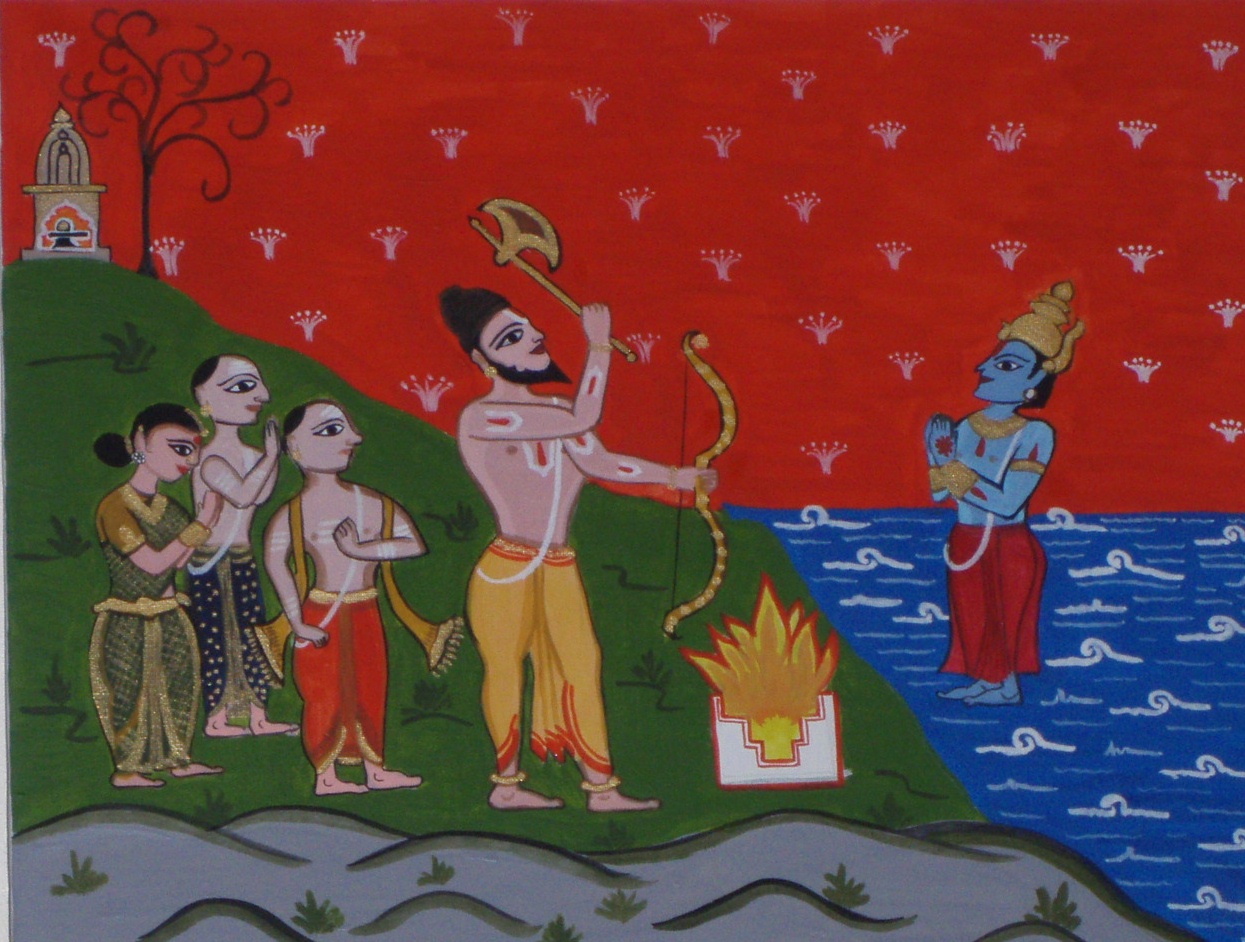
His primary action involves wielding a celestial axe. He engages in combat against kings who have become tyrannical. A central narrative describes him challenging Rama to a contest of strength involving a divine bow. Another account details his confrontation with Bhishma, where he attempts to enforce a marriage alliance through martial threat.
Tools and materials
The defining tool is his parashu, or battle axe. This weapon is described as having divine origins and immense destructive power. It is used to slay enemies and is also associated with the creation of land from the sea in regional folklore. The bow Sharanga is another significant instrument in his interactions with other deities.
Parashurama, drawn and placed
- Living
- Revived
- Fading
- Historical
- Legendary
- Performed
- Lineage
- Dashavatara
What it is for
His actions are aimed at restoring cosmic equilibrium. He intervenes when the warrior class abuses its authority. He also acts as a teacher, imparting knowledge of weapons and strategy to future heroes. His presence ensures that dharma is upheld through direct martial intervention when necessary.
Who does it
As a deity and mythic figure, he does not have living practitioners in the sense of a cult. He is studied by scholars of Hindu texts. In the narratives, he trains warriors like Drona and Karna. He is depicted as a celibate sage who has renounced worldly attachments after his violent deeds.
Peoples and places
He is central to Hindu mythology, particularly in the Ramayana and Mahabharata. Regional traditions in Kerala view him as the founder of the land, having reclaimed it from the sea. The Konkan coast is also linked to his legend. These stories vary slightly in detail but maintain his core identity as a powerful sage-warrior.
At a glance: who, where and when
Peoples
Belief worlds



What people believe
He represents the intersection of Brahminical knowledge and Kshatriya martial prowess. His dual nature allows him to wield both spiritual authority and physical force. Believers see him as a protector of order who eliminates corruption. His continued existence signifies the enduring presence of divine justice.
When it is done
His birth is associated with Akshaya Tritiya. He is venerated on Thursdays. His story is recited during religious festivals and rituals that honor Vishnu's avatars. Specific temples mark locations tied to his legendary deeds.
How scholars and sceptics see it
Researchers view Parashurama as a literary device representing the tension between priestly and royal classes. The narrative of killing Kshatriyas is interpreted as a symbolic assertion of Brahminical supremacy. Historians note the evolution of his character across different textual periods.
Cautions and what is closed
The legends contain graphic violence, including mass slaughter and matricide in some versions. These elements are treated as mythic symbolism rather than literal history. The stories emphasize the consequences of unchecked power and the necessity of righteous action.
Compare and confuse
He is often compared to Rama and Krishna as fellow avatars. However, he differs in his permanent earthly existence and his aggressive methods. His role as a guru contrasts with the more pacifist aspects of other incarnations. He shares traits with other warrior sages in Indian tradition.
Days linked to Parashurama
Questions people ask about Parashurama
Who is Parashurama?
He is the sixth avatar of Vishnu in Hinduism. He is known as a warrior sage who uses his axe to fight injustice. He remains alive today as one of the immortals.
Why did Parashurama kill the Kshatriyas?
According to legend, he destroyed them because they abused their power. He acted to restore balance and protect the world from tyranny. This act was seen as a necessary correction of cosmic order.
Where does Parashurama live now?
He is said to reside in the Mahendra Mountains. He spends his time in meditation and yoga. He awaits the end of the current age to guide the final avatar.
What is his connection to Kerala?
Regional folklore claims he created the Kerala coast. He threw his axe into the sea to reclaim land. This makes him a foundational figure in local cultural identity.
Good reading and sources
- Parashurama on WikipediaEncyclopedia
- More photos on Wikimedia CommonsPhotos and video
- Wikidata recordOpen data
The facts on this page come from the Wikipedia article "Parashurama", written by its contributors and used under the CC BY-SA 4.0 licence, and from its Wikidata record (CC0). EveryJaadu rewrote the text in its own words, with AI assistance, and compares every page with the article to make sure no passage is copied. It may be reused under the same CC BY-SA 4.0 licence with a link back.
It may contain mistakes. Names and customs differ from one community to the next, and some knowledge is closed to outsiders and left out here. This page describes belief and practice. It does not say that any of it works, it is not a how-to, and it is not medical advice. If something is wrong, tell us. Last refreshed 2026-10-05.
More from India
All the entries from India 🇮🇳 India and 5 morePretaप्रेत
A suffering spirit of insatiable hunger found in Asian religious traditionsBeing · Speaking with spirits and the dead Living
🇮🇳 IndiaAlakshmiदेवी अलक्ष्मी
A Hindu goddess of misfortune and the shadow opposite to LakshmiBeing · Cursing and harm Living
🇮🇳 India and 5 morePretaप्रेत
A suffering spirit of insatiable hunger found in Asian religious traditionsBeing · Speaking with spirits and the dead Living
🇮🇳 IndiaAlakshmiदेवी अलक्ष्मी
A Hindu goddess of misfortune and the shadow opposite to LakshmiBeing · Cursing and harm Living
 🇮🇳 IndiaTaraतारा (Sanskrit), তারা (Bengali)
A fierce Hindu goddess of protection and wisdom, central to the Mahavidya tradition.Being · Protection · Power and authority Living
🇮🇳 IndiaTaraतारा (Sanskrit), তারা (Bengali)
A fierce Hindu goddess of protection and wisdom, central to the Mahavidya tradition.Being · Protection · Power and authority Living
 🇮🇳 India and 1 moreLakshmiलक्ष्मी
A Hindu goddess of wealth, prosperity, and beauty, worshipped as the consort of Vishnu.Being · Luck and prosperity · Power and authority Living
🇮🇳 India and 1 moreLakshmiलक्ष्मी
A Hindu goddess of wealth, prosperity, and beauty, worshipped as the consort of Vishnu.Being · Luck and prosperity · Power and authority Living
Related elsewhere
All being 🇿🇦 South AfricaSympathetic magic
A magical principle based on imitation and contact to influence the worldTradition · Protection · Healing Historical
🇿🇦 South AfricaSympathetic magic
A magical principle based on imitation and contact to influence the worldTradition · Protection · Healing Historical
 🇮🇸 Iceland and 2 moreSeiðr
A Norse magic of fate and spirit, practiced by seers and sorcerers in the Viking Age.Tradition · Seeing and foretelling · Cursing and harm Revived
🇮🇸 Iceland and 2 moreSeiðr
A Norse magic of fate and spirit, practiced by seers and sorcerers in the Viking Age.Tradition · Seeing and foretelling · Cursing and harm Revived
 🇿🇦 South AfricaGrootslang
A legendary serpent from South Africa said to guard diamonds in a deep cave.Being · Cursing and harm · Power and authority Legendary
🇿🇦 South AfricaGrootslang
A legendary serpent from South Africa said to guard diamonds in a deep cave.Being · Cursing and harm · Power and authority Legendary