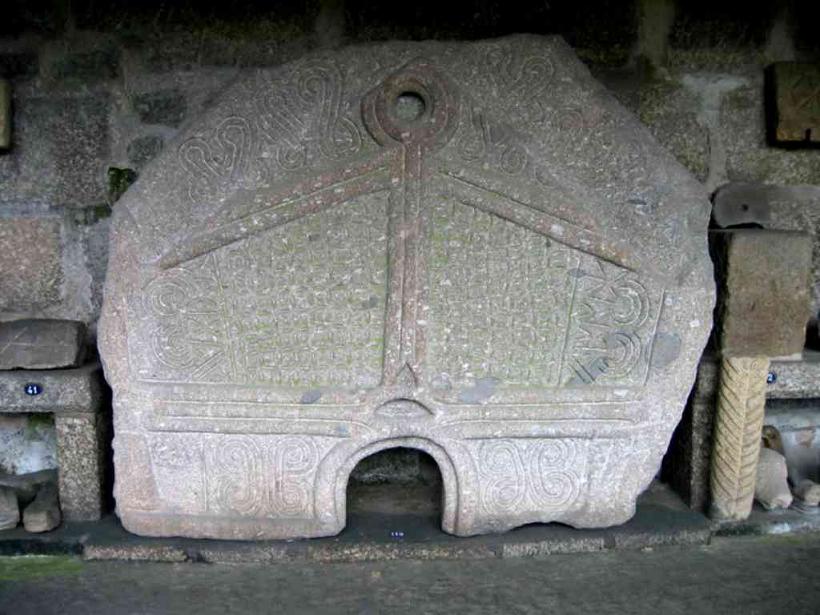
Enchanted Moura
In its own language: moura encantada
from Celtic *MRVOS (dead) or Latin maurus (Muslim)
A supernatural maiden from Portuguese and Galician folklore who guards treasures and ancient stones.
The Enchanted Moura is a beautiful female spirit in the fairy tales of Portugal and Galicia. She lives under a spell that keeps her guarding hidden gold or building megaliths. Local lore says she is the soul of a maiden left behind by male spirits heading to the Otherworld.
- She builds dolmens and hill forts by carrying stones on her head.
- She appears on St. John's Day to reveal treasures or spread yarn.
- Her name links to Celtic 'dead' and Latin 'Muslim' roots.
- She guards caves, wells, and bridges in Portuguese folklore.
- Breaking her spell requires saltless bread, milk, or a kiss.
What it is
The Enchanted Moura is a supernatural being found in the folklore of Portugal and Galicia. She appears as a young woman of striking beauty, often with long golden, black, or red hair. These spirits are shapeshifters who inhabit liminal spaces such as caves, wells, bridges, and hill forts. They are believed to possess immense strength, using it to build ancient stone monuments or guard buried treasures. The moura exists in a state of permanent enchantment, waiting for someone to break her spell. If freed, she promises great wealth or love to her liberator.
Where it comes from
Scholars trace these tales to pre-Roman, Indo-European Celtic traditions. The figures are linked to other Celtic water divinities and nature spirits. Some researchers suggest they absorbed characteristics of local nymphs. The lore was also used in the nineteenth century to locate archaeological sites, viewed as folk memory of pagan times erased by Christianization. Similar figures exist in Basque mythology, such as the Lamia, who also guard treasures and use golden combs.
How it is done
Legends describe the moura singing while combing her hair or spinning yarn on a distaff. She may appear as a washerwoman drying white clothes or as a snake offering milk. To free her, a person must perform specific acts, such as giving saltless bread, offering milk, or delivering a kiss. Success breaks the spell, allowing the moura to become human or vanish. Failure doubles the enchantment or causes the loss of the treasure. On St. John's Day, she may spread figs or yarn on rocks in moonlight.
Tools and materials
The moura uses a golden comb to maintain her beauty and a distaff to spin yarn. She is associated with white clothes, which she dries in the sun. Her treasures often include pots of gold, silver, or plague coins, sometimes hidden in funerary urns. She builds dolmens and hill forts, carrying heavy stones on her head. In some variants, she transforms into animals like snakes, dogs, or horses, requiring milk offerings.
Enchanted Moura, drawn and placed
- Living
- Revived
- Fading
- Historical
- Legendary
- Performed
- Lineage
- Galician mythology, Portuguese mythology
- Timing
- midsummer night
What it is for
People seek the moura to find lost treasures or gain magical power. The tales explain the origins of cities and historical events. They also serve as warnings about forbidden love and the dangers of breaking spiritual rules. The stories reflect a belief in an underground world where spirits reside. Lovers might be compared to those who drank from a moura fountain, symbolizing enchanted attraction.
Who does it
The moura is a figure of legend rather than active ritual practice. Scholars study these tales to understand Celtic roots and prehistoric beliefs. Archaeologists historically used the legends to identify megalithic sites. The spirits themselves are the subjects of the stories, not practitioners. They are described as maidens, princesses, or mothers, bound by male spirits or their own fathers.
Peoples and places
The tradition is central to Portuguese and Galician folklore. Almost every town has a tale involving a moura. Variants include the Princesa moura, a Muslim princess from the Reconquista era, and the Moura-fiandeira, a spinner of hills. The Pedra-moura lives inside stones, while the Moura-serpente takes animal forms. These stories differ slightly between regions but share core themes of enchantment, treasure, and ancient builders.
At a glance: who, where and when
Peoples
Occasions


What people believe
The moura belongs to a worldview where the earth holds hidden layers of reality. She guards the boundary between the living world and Mourama, the Otherworld of the dead. This realm is similar to fairyland, where time flows differently. The spirits are souls of the deceased or ancient beings trapped in stone. Their presence explains natural features and archaeological wonders as works of magic rather than human labor.
When it is done
The most significant day for the moura is St. John's Day, marking the summer solstice. On this night, she reveals treasures or spreads magical items on rocks. The timing connects to pagan sun worship and spring deities. The tales also reference Tempo da mouraria, an undefined past era when these spirits were active. Life events like weddings or births may invoke references to the moura's influence.
How scholars and sceptics see it
Researchers view the moura as a remnant of Celtic polytheism. José Leite de Vasconcelos described her as a being compelled by occult power. Pedroso called her a feminine water genie. Archaeologists like Martins Sarmento used the legends to map prehistoric monuments. Psychologists see the tales as expressions of collective memory regarding death and the afterlife. The confusion between Celtic and Moorish origins highlights cultural shifts in Iberia.
Cautions and what is closed
Failing to free the moura can double her spell or cause the loss of loved ones. Sitting on a pedra-moura stone might bring enchantment or kill household animals. The tales warn against greed and disrespect for spiritual boundaries. The moura's promises of wealth often come with trickery or tragic consequences. These stories function as moral guides, emphasizing the danger of crossing into the supernatural realm without proper respect.
Compare and confuse
The moura is often confused with the Mouros Encantados, male spirits who hide treasures. She is related to the Basque Lamia and Mairu, who share traits of beauty, combs, and stone-building. Unlike European fairies, she is explicitly tied to megaliths and funerary monuments. The term moura overlaps with 'Moor,' reflecting historical conflicts, but the spiritual role remains distinct from Islamic theology.
Law and persecution
There are no specific laws governing the moura, as she is a legendary figure. However, the sites she inhabits, such as dolmens and hill forts, are protected archaeological heritage. Modern tourism commercializes these legends, turning ancient sites into attractions. The tension between scientific preservation and folk belief continues to shape how these places are managed and interpreted today.
Questions people ask about Enchanted Moura
What is an Enchanted Moura?
She is a supernatural maiden from Portuguese and Galician folklore. She lives under a spell, guarding treasures or building ancient stones. She is believed to be the soul of a maiden left behind by male spirits.
Where do mouras live?
They inhabit liminal spaces like caves, wells, bridges, and hill forts. They are also said to live inside stones, known as pedras-mouras, or in the underground realm called Mourama.
How can you free an enchanted moura?
Legends say you must perform specific acts like giving saltless bread, offering milk, or giving a kiss. Success breaks the spell, but failure can double the enchantment or cause loss.
Why are they called mouras?
The word comes from Celtic *MRVOS meaning 'dead' or Latin maurus meaning 'Muslim'. This reflects both their connection to the dead and historical interactions with Moors in Iberia.
When do mouras appear?
They are most active on St. John's Day, the summer solstice. On this night, they may spread figs or yarn on rocks in the moonlight, revealing treasures to those who watch.
Good reading and sources
The facts on this page come from the Wikipedia article "Enchanted moura", written by its contributors and used under the CC BY-SA 4.0 licence, and from its Wikidata record (CC0). EveryJaadu rewrote the text in its own words, with AI assistance, and compares every page with the article to make sure no passage is copied. It may be reused under the same CC BY-SA 4.0 licence with a link back.
It may contain mistakes. Names and customs differ from one community to the next, and some knowledge is closed to outsiders and left out here. This page describes belief and practice. It does not say that any of it works, it is not a how-to, and it is not medical advice. If something is wrong, tell us. Last refreshed 2026-10-06.
More from Portugal
All the entries from Portugal 🇪🇸 Spain and 5 moreDuende
A humanoid spirit of Iberian and Latin American folklore, ranging from household pranksters to forest guardians.Being · Protection · Cursing and harm Living
🇪🇸 Spain and 5 moreDuende
A humanoid spirit of Iberian and Latin American folklore, ranging from household pranksters to forest guardians.Being · Protection · Cursing and harm Living
 🇬🇧 United Kingdom and 4 moreWyvern
A two-legged winged dragon common in European heraldry and fantasy fictionBeing · Power and authority Legendary
🇬🇧 United Kingdom and 4 moreWyvern
A two-legged winged dragon common in European heraldry and fantasy fictionBeing · Power and authority Legendary
 🇯🇵 Japan and 4 moreHousehold deity
A spirit or minor god believed to guard a home and its family members.Being · Protection · Speaking with spirits and the dead Historical
🇯🇵 Japan and 4 moreHousehold deity
A spirit or minor god believed to guard a home and its family members.Being · Protection · Speaking with spirits and the dead Historical
 🇫🇷 France and 3 moreLes LavandièresKannerez-Noz
Supernatural washerwomen who wash shrouds or bloodstained clothes for those about to die.Being · Seeing and foretelling Legendary
🇫🇷 France and 3 moreLes LavandièresKannerez-Noz
Supernatural washerwomen who wash shrouds or bloodstained clothes for those about to die.Being · Seeing and foretelling Legendary
Related elsewhere
All being 🇮🇳 India and 5 moreHoliहोली
A Hindu spring festival marked by coloured powders and bonfires to celebrate love and virtue.Tradition · Love and attraction · Cursing and harm Living
🇮🇳 India and 5 moreHoliहोली
A Hindu spring festival marked by coloured powders and bonfires to celebrate love and virtue.Tradition · Love and attraction · Cursing and harm Living
 🇪🇬 EgyptCurse
A spoken wish for misfortune to befall a person or placeBelief · Cursing and harm · Luck and prosperity Historical
🇪🇬 EgyptCurse
A spoken wish for misfortune to befall a person or placeBelief · Cursing and harm · Luck and prosperity Historical