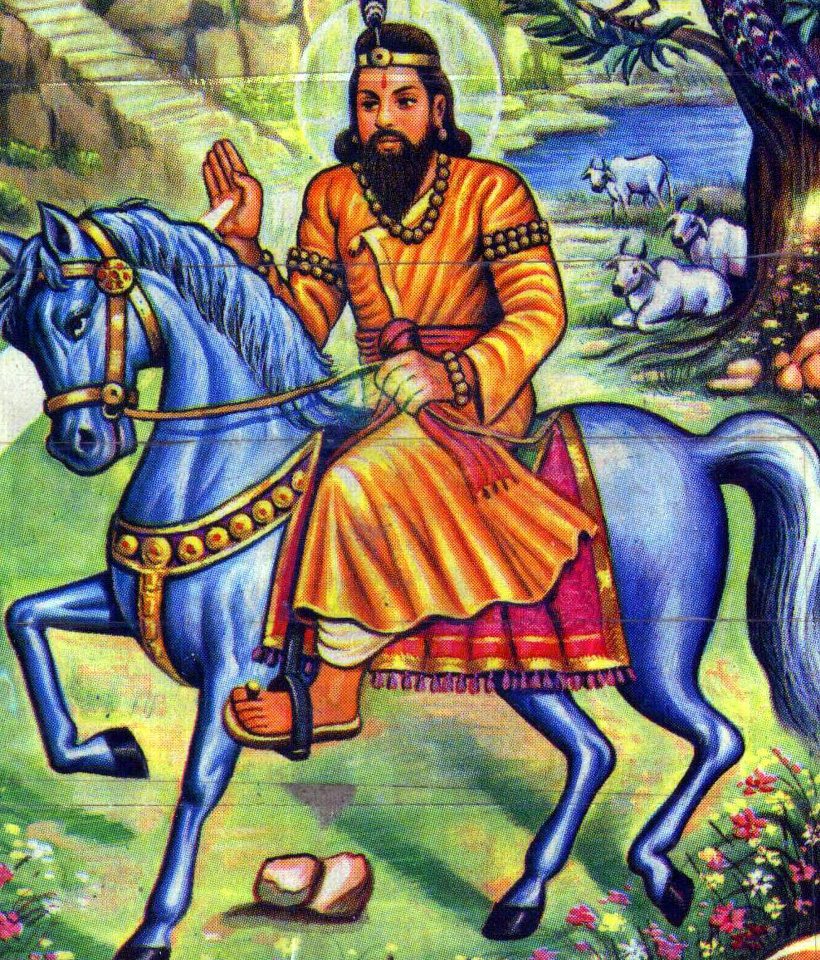
Baba Mohan Ram
In its own language: बाबा मोहन राम
Mohan, an epithet of Krishna carrying the sense of 'enchanting'
A folk form of Krishna worshipped at a cave shrine with a flame that never dies
A deity of northern India whom followers honour as Krishna come again for the present age. He is served at a cave on the Kali Kholi hill near Bhiwadi with an unbroken flame, and fairs on the monthly Doj day draw crowds from four states.
- Held by followers to be Krishna appearing again in the present age
- A flame in his Kali Kholi cave is never let die; devotees feed it ghee
- Legend grants wishes asked in his name for seven generations of Nandu's family
- His blue horse is believed to hold the serpent Shesha within it
- The March 2026 fair was expected to draw crowds above a million
What it is
Baba Mohan Ram is a deity honoured in north-west India, counted by his adherents as an appearance of the god Krishna. Devotional tradition says he first showed himself in the Dvapara Yuga, one of the long ages of Hindu time-keeping, and that he stands present again now in the Kali Yuga, the age people live in today; some devotees treat him as a distinct form made for this era. His cult centres on a cave on the Kali Kholi hill at Bhiwadi and a temple at Milakpur, where a flame is kept burning without pause. Worship there mixes temple rite with village vow-making: ghee poured on the fire, food and cow-dung cakes offered, and acts of service said to ease a petitioner's troubles. He is honoured as an emblem of love, right conduct and devotion.
Where it comes from
The founding story is set in the hills above Milakpur, where a Brahmin cowherd named Nandu kept his herd. A strange cow joined it by day and slipped away alone at dusk; following it into a cave, Nandu found a glowing sage sunk in meditation. The sage credited the year of care Nandu had given the cow, named him his chief devotee, and pledged that anyone asking for a blessing in his name, at Nandu's urging, would see wishes granted, a promise to run down seven generations of his family. Devotees read the figure as Krishna returned for the present age, though some traditions hold him a separate manifestation rather than Krishna himself. The Milakpur temple is said to have been raised at the deity's own command.
How it is done
At the Kali Kholi cave an akhand jyoti burns, a flame never allowed to die. Those who come pour ghee, clarified butter, into it, an offering believed to lift the troubles they carry. They also feed a dhuni, a sacred fire, with bhog, food presented to a deity, and uppla, cakes of dried cow dung; this too is said to set ills right. Service at the shrine is held to profit the doer: sweeping the floor, giving food to the poor, keeping the bird feeders filled, and feeding animals, cows above all.
Tools and materials
His images carry signs read by devotees: a gold crown and a peacock feather in his locks, marks of divine sovereignty, and a garland of pearls set with a single rudraksha seed, standing for purity, depth and protection. He rides a blue horse said to hold the serpent Shesha within it, a mount that speaks of strength, swiftness and rising beyond the ordinary world. He is dressed as a Brahmin in plain, dignified cloth with wooden slippers, a picture of groundedness amid grandeur. At the shrine, ghee, cow-dung cakes and food are the working offerings.
Baba Mohan Ram, drawn and placed
- Living
- Revived
- Fading
- Historical
- Legendary
- Performed
- Lineage
- Vaishnavism, the Krishna-worshipping strand of Hinduism
- Timing
- monthly on Doj; fairs around Holi and Raksha Bandhan
What it is for
Devotees come to have wishes met and troubles lifted. The offerings of ghee and cow-dung cakes are believed to remove the problems weighing on them, and the founding legend carries a standing pledge: blessings asked in his name through his devotees are held to be granted. Followers honour him as an emblem of love, right conduct and devotion, and take his appearance in the present age as guidance for seekers. He is also remembered for teaching that love and faith outweigh strict ritual, as in the words he gave Pandit Kanha.
Who does it
No ordered priesthood is described; the stories centre on devout laypeople. Nandu was a Brahmin who herded cows, and Pandit Kanha served a village cattle owner at Aalupur while keeping up household worship of sacred objects at home. The title Pandit marks an honoured or learned man rather than an office. Sekhu Mirasi, a cowherd, is remembered as a singer whose voice, silent at first, opened after an encounter with the deity; his songs of cosmic wisdom remain part of the devotional legacy. Women appear in the legends as wives who join or resist the worship.
Peoples and places
His following sits in Haryana, Rajasthan and Uttar Pradesh, with devotees also travelling from Delhi to the fairs. The two main seats are the cave on the Kali Kholi hill at Bhiwadi and the temple at Milakpur, village of his first devotee, Nandu. The shrine's setting is wooded and full of birds, and legend holds the whole place thick with marvels, so that any service done there does good. The gatherings reach a great scale: the three-day fair of March 2026 was expected to bring crowds above a million, with home-guard and police units, close to nine hundred strong, posted to keep order.
At a glance: who, where and when
Peoples
Belief worlds

What people believe
The worldview is Vaishnava, the strand of Hinduism centred on Krishna. Krishna is an incarnation of Vishnu, and Baba Mohan Ram is held to be Krishna showing himself again in the Kali Yuga, the current age, though some traditions count him a distinct manifestation made for this era. His blue horse is believed to carry the serpent Shesha. He shows himself in changing forms: to Nandu as the dwarf-child Vamana, to Kanha as a glowing boy with brown dreadlocks and lions at his side, and near the Kali Kholi pond, in a vision, as Krishna at play with the gopis in his divine sports. His teaching puts love and faith above rigid rite.
When it is done
Each month has its quieter meeting, Doj, kept on the Dwitiya, the month's second day by the moon. The great fairs cluster around two widely kept Hindu festivals, Holi, in its form called Dhulandi, and Raksha Bandhan. Two named melas belong to the lunar months Phalguna and Bhadra, kept as Phalguna Doj and Bhadra Doj. In March 2026 a three-day fair ran at the cave temple with crowds reckoned above a million and home-guard and police units on duty.
Compare and confuse
Devotees place him beside Krishna and Rama at once: his allure is said to recall Krishna, his moral bearing Rama. Some traditions set him apart from Krishna himself as a manifestation made for the present era. His forms overlap with other avatars, the dwarf Vamana among them, and his mount is tied to Shesha, the serpent on which Vishnu rests.
Days linked to Baba Mohan Ram
Questions people ask about Baba Mohan Ram
Who is Baba Mohan Ram?
A deity worshipped in northern India whom adherents count as an appearance of Krishna, one who first showed himself in the Dvapara Yuga and is held to be present again in the Kali Yuga, the current age. Devotees see Krishna's charm and Rama's virtues together in him.
Where is he worshipped?
Chiefly at a cave on the Kali Kholi hill at Bhiwadi, where an unbroken flame burns, and at a temple in Milakpur said to have been raised at his command. Fairs bring devotees from Rajasthan, Haryana, Uttar Pradesh and Delhi.
What do devotees offer him?
Ghee for the flame that never dies, and food with cakes of dried cow dung for the sacred fire, acts believed to lift their troubles. Service at the shrine, such as sweeping the floor or feeding cows, is also held to do the doer good.
Why is he called Mohan?
Some traditions treat him as a distinct manifestation of Krishna made for the present era rather than Krishna himself.
When are his fairs held?
Quiet meetings fall each month on Doj, the Dwitiya of the lunar month, while the largest fairs cluster around Holi and Raksha Bandhan. A three-day fair at the cave temple in March 2026 was set to draw crowds reckoned above a million.
Good reading and sources
The facts on this page come from the Wikipedia article "Baba Mohan Ram", written by its contributors and used under the CC BY-SA 4.0 licence, and from its Wikidata record (CC0). EveryJaadu rewrote the text in its own words, with AI assistance, and compares every page with the article to make sure no passage is copied. It may be reused under the same CC BY-SA 4.0 licence with a link back.
It may contain mistakes. Names and customs differ from one community to the next, and some knowledge is closed to outsiders and left out here. This page describes belief and practice. It does not say that any of it works, it is not a how-to, and it is not medical advice. If something is wrong, tell us. Last refreshed 2026-10-21.
More from India
All the entries from India 🇮🇳 India and 1 moreYoginiयोगिनी
A female master of yoga and tantra, or a fierce goddess aspect in Indian temples.Tradition · Power and authority · Protection Historical
 🇮🇳 IndiaParashuramaपरशुराम (Paraśurāma)
The warrior sage of Hinduism who wields a divine axe to restore cosmic balance.Being · Power and authority · Cursing and harm Legendary
 🇮🇳 India and 1 moreLakshmiलक्ष्मी
A Hindu goddess of wealth, prosperity, and beauty, worshipped as the consort of Vishnu.Being · Luck and prosperity · Power and authority Living
🇮🇳 India and 1 moreDaayanदायन
A vengeful female spirit from Indian folklore, often blamed for misfortune and witchcraft accusations.Being · Cursing and harm · Luck and prosperity Living
Related elsewhere
All being 🇲🇳 Mongolia and 2 moreMongolian shamanismBöö mörgöl
The animistic and shamanic ethnic religion of the Mongol peoples, centered on sky worship and ancestral spirits.Tradition · Protection · Healing Living
 🇵🇪 Peru and 5 morePachamama
The Andean mother goddess of space-time and the earthBeing · Protection · Healing Living
 🇰🇷 South Korea and 3 moreKorean shamanism무속
A Korean folk religion centered on ritual specialists who mediate between humans and spiritsTradition · Protection · Healing Living
 🇳🇬 Nigeria and 3 moreYemọjaYemoja
A mother spirit of rivers and oceans worshipped across Yoruba and diaspora traditionsBeing · Protection · Healing Living