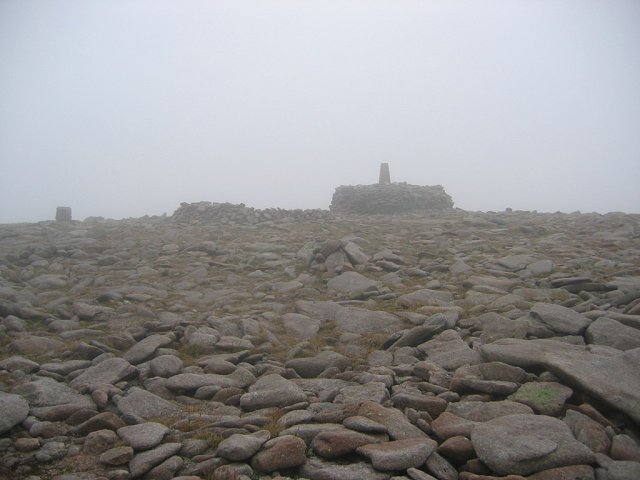
Am Fear Liath Mòr
Scottish Gaelic for 'Big Grey Man'
A mountain spirit said to haunt the misty peaks of the Scottish Cairngorms
Am Fear Liath Mòr is a legendary presence from Scottish folklore that haunts the summit and passes of Ben Macdui. Climbers report hearing footsteps and feeling dread in the fog, though few claim to have seen the creature clearly.
- Name means Big Grey Man in Scottish Gaelic
- Haunts Ben Macdui, the highest Cairngorm peak
- Witnesses hear crunching footsteps in the fog
- Footprint photos were later found to be natural erosion
- Similar to the Welsh Brenin Llwyd spirit
What it is
Am Fear Liath Mòr is a cryptid or supernatural presence in Scottish tradition. It is believed to dwell on the highest peak of the Cairngorms, known as Ben Macdui. The entity is described as a tall, thin figure with dark features and long limbs. Most witnesses never see it directly. Instead, they hear crunching sounds behind them in the fog. They also feel a sudden sense of terror. The legend suggests the being stalks climbers through the mist. Some compare it to the Welsh Brenin Llwyd, another mist-dwelling spirit. Unlike the Welsh version, this figure is tied to one specific mountain range.
Where it comes from
The name translates from Scottish Gaelic as the Big Grey Man. Folklore places the creature on Ben Macdui, the second-highest peak in the British Isles. Stories of encounters date back to at least the late eighteenth century. Poet James Hogg reported a shadow experience there in 1791. He initially feared a giant but realized it was his own reflection. Later accounts in the twentieth century expanded the legend into a stalking monster. The modern story likely grew from these early mountain tales and optical illusions.
How it is done
Witnesses describe the encounter rather than performing a ritual. Climbers often report hearing heavy footsteps on gravel when no one else is near. The sound seems to come from behind them. A thick fog usually hides the figure. Some people feel an oppressive pressure or intense dread. One climber claimed to see a dark silhouette against the moon. Another fired a revolver at a shape that did not stop. The experience is passive; the hiker simply walks into the presence of the spirit.
Tools and materials
The legend relies on environmental elements. Thick mountain fog acts as a cloak for the entity. Gravel underfoot provides the signature crunching sound. Photographs of large footprints were once cited as proof. These prints measured nearly fifty centimetres long. Later analysis showed they were natural erosion marks in snow. No physical tools are used by the creature itself.
Am Fear Liath Mòr, drawn and placed
- Living
- Revived
- Fading
- Historical
- Legendary
- Performed
- Lineage
- Scottish folklore
What it is for
The being is not sought out for help or healing. It is associated with fear and unease. Climbers view it as a hazard or a strange phenomenon. The spirit seems to prey on isolation and exhaustion. It creates anxiety in those who wander alone in the mist. There is no belief that it grants wishes or offers protection. It is simply a terrifying presence in the high mountains.
Who does it
No specific group worships or performs rites for Am Fear Liath Mòr. It is a subject of folklore and curiosity. Mountaineers and hikers are the primary witnesses. Scholars and psychologists study the reports as cultural phenomena. Researchers look at how altitude and weather affect human perception. The legend persists because of the dramatic stories shared by climbers.
Peoples and places
The legend is rooted in Scottish culture. It is specific to the Cairngorms region. Similar spirits exist in other Celtic traditions. The Welsh Brenin Llwyd shares traits like silence and mist-walking. However, the Scottish version is tied to a single peak. The story spread through local press and climbing communities. It became a famous part of British mountain lore.
At a glance: who, where and when
Peoples
Belief worlds

What people believe
Folklore holds that the mountain has a hidden life. The spirit is semi-corporeal, existing between solid and mist. It uses the weather to hide its approach. Some believe it feeds on fear or attention. Scientific explanations offer alternatives. Infrasound from wind can cause anxiety. Exhaustion and isolation lead to hallucinations. The Brocken spectre explains the visual giants. This optical illusion casts enlarged shadows onto clouds.
When it is done
The entity is active whenever conditions allow. Fog and mist are common on Ben Macdui. Encounters happen during climbs at any time. There are no specific festivals or holy days. The legend is tied to the geography rather than the calendar. Storms and low visibility create the perfect setting.
How scholars and sceptics see it
Psychologists suggest the sightings are misinterpretations. Isolation and fatigue distort sensory input. Wind-generated infrasound may trigger feelings of dread. Historians note that early reports focused on shadows. James Hogg’s account describes a Brocken spectre. Later writers transformed this optical effect into a monster. Anthropologists view it as a modern myth built on older mountain taboos.
Cautions and what is closed
The legend warns of the dangers of solo climbing. Mist can disorient hikers quickly. Extreme weather poses real risks in the Cairngorms. Some claims involve fraud or misunderstanding. No evidence proves a giant exists. The fear itself is the main impact on visitors.
Compare and confuse
Am Fear Liath Mòr is similar to the Welsh Brenin Llwyd. Both are grey, silent figures in the mist. The Lubber fiend and wild men share some traits. However, the Scottish version is unique to one peak. Other cultures have mountain spirits, but this one is distinct. It is often confused with simple optical illusions.
Questions people ask about Am Fear Liath Mòr
What is Am Fear Liath Mòr?
It is a legendary presence in Scottish folklore said to haunt Ben Macdui. Witnesses report hearing footsteps and feeling dread in the mountain mist.
Where does the legend come from?
The story originates in the Scottish Highlands. Early accounts mention shadows on Ben Macdui, which later evolved into a stalking creature legend.
What does the creature look like?
Descriptions vary, but it is often tall, thin, and dark. Most people never see it clearly, only hearing sounds or seeing vague shapes in fog.
Are the footprints real?
Photographs of large prints were published but later explained as natural erosion in snow. No scientific proof of a giant exists.
Good reading and sources
The facts on this page come from the Wikipedia article "Am Fear Liath Mòr", written by its contributors and used under the CC BY-SA 4.0 licence, and from its Wikidata record (CC0). EveryJaadu rewrote the text in its own words, with AI assistance, and compares every page with the article to make sure no passage is copied. It may be reused under the same CC BY-SA 4.0 licence with a link back.
It may contain mistakes. Names and customs differ from one community to the next, and some knowledge is closed to outsiders and left out here. This page describes belief and practice. It does not say that any of it works, it is not a how-to, and it is not medical advice. If something is wrong, tell us. Last refreshed 2026-10-06.
More from the United Kingdom
All the entries from the United Kingdom 🇬🇧 United KingdomCeridwenCerridwen
A Welsh enchantress and modern goddess of poetic inspiration and transformation.Being · Change and initiation Revived
🇬🇧 United KingdomCeridwenCerridwen
A Welsh enchantress and modern goddess of poetic inspiration and transformation.Being · Change and initiation Revived
 🇬🇧 United Kingdom and 1 moreEach-uisge
A fierce water spirit of the Scottish Highlands and Irish shores that takes the form of a horse.Being · Cursing and harm Legendary
🇬🇧 United Kingdom and 1 moreEach-uisge
A fierce water spirit of the Scottish Highlands and Irish shores that takes the form of a horse.Being · Cursing and harm Legendary
Related elsewhere
All being 🇪🇬 Egypt and 1 moreSphinx
A mythical hybrid with a human head and lion body, serving as guardian or riddler in Egyptian and Greek traditions.Being · Protection · Wonder and entertainment Legendary
🇪🇬 Egypt and 1 moreSphinx
A mythical hybrid with a human head and lion body, serving as guardian or riddler in Egyptian and Greek traditions.Being · Protection · Wonder and entertainment Legendary
 🇪🇬 Egypt and 1 moreLilithלִילִית
A feminine figure from Mesopotamian and Jewish mythology, often depicted as a night demon or spirit.Being · Cursing and harm Legendary
🇪🇬 Egypt and 1 moreLilithלִילִית
A feminine figure from Mesopotamian and Jewish mythology, often depicted as a night demon or spirit.Being · Cursing and harm Legendary
 🇨🇳 China and 3 moreChinese dragon龍
A legendary water deity and imperial symbol in East Asian cultureBeing · Protection · Luck and prosperity Historical
🇨🇳 China and 4 moreKitchen God灶君
The Chinese hearth deity who reports domestic conduct to the Jade EmperorBeing · Protection · Luck and prosperity Living
🇨🇳 China and 3 moreChinese dragon龍
A legendary water deity and imperial symbol in East Asian cultureBeing · Protection · Luck and prosperity Historical
🇨🇳 China and 4 moreKitchen God灶君
The Chinese hearth deity who reports domestic conduct to the Jade EmperorBeing · Protection · Luck and prosperity Living