
Akodessawa Fetish Market
In its own language: Marché des Féticheurs
A market in Togo selling ritual objects for Vodún practice
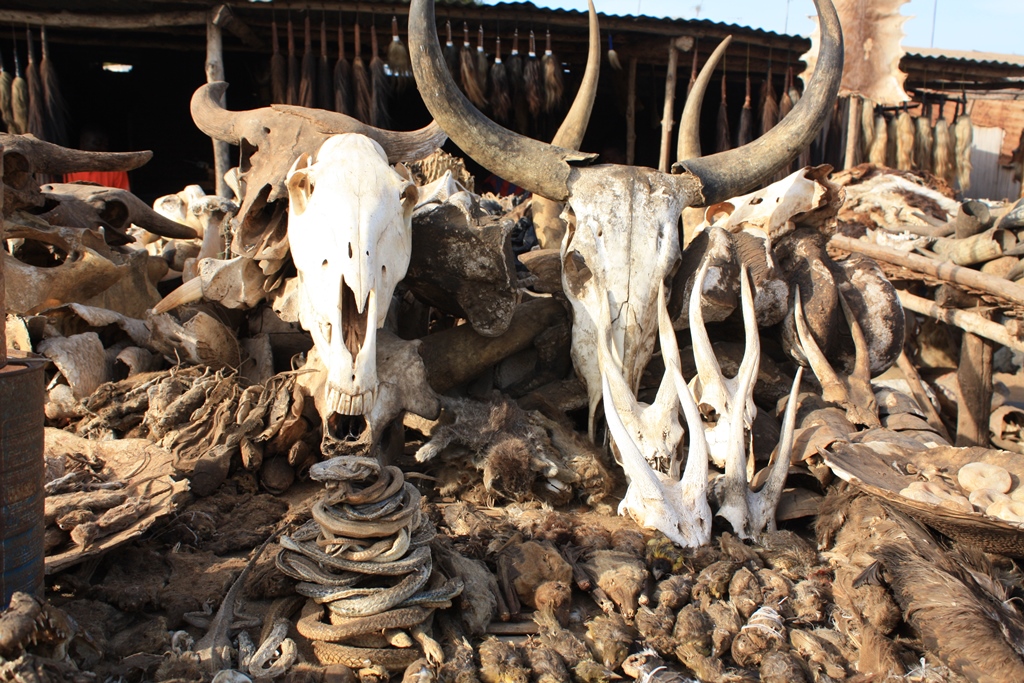
The Akodessawa Fetish Market is a trading place in Lomé, the capital of Togo. It is known as the largest market for items used in Vodún religious practice. The site sells animal parts and other materials believed to hold spiritual power.
- Located in Akodessawa, a district of Lomé, Togo
- Known as the world's largest voodoo market
- Sells monkey heads, skulls, and dead birds
- Items are activated through Vodún rituals
- Links Yoruba heritage with diasporic traditions
What it is
The Akodessawa Fetish Market operates in the Akodessawa district of Lomé, Togo. It functions as a commercial hub for goods central to Vodún worship. Vendors offer items such as monkey heads, skulls, dead birds, crocodile remains, and animal skins. These objects are classified as fetishes within the tradition. A fetish serves as a vessel for spiritual force. It may represent a deity, a human ancestor, a plant, or an animal. The object gains strength through specific rituals performed by practitioners.
Where it comes from
Vodún has deep roots in Togo. The tradition spread globally during the slave trade. Enslaved people carried Yoruba deities to the Caribbean and South America. In those regions, African gods merged with Christian saints and symbols. Over time, these mixed forms evolved into new cults. Some descendants of enslaved people later migrated back to West Africa. They established voodoo communities in their ancestral homelands, reconnecting with local traditions.
How it is done
Practitioners visit the market to acquire necessary components for their work. They select specific animal parts or natural materials. Once acquired, the items undergo activation rituals. These ceremonies strengthen the spiritual presence within the fetish. The process transforms a physical object into a powerful tool. The activation depends on the intended use and the specific ritual context. The market provides the raw materials for this transformation.
Tools and materials
The market trades in biological materials. Sellers offer monkey heads, skulls, dead birds, and crocodile bodies. Skins from various animals are also available. These items serve as physical anchors for spiritual energy. In Vodún belief, a fetish can be a god, a person, or a material object. The choice of item depends on the ritual's needs. Each component carries potential power that must be awakened through ceremony.
Akodessawa Fetish Market, drawn and placed
- Living
- Revived
- Fading
- Historical
- Legendary
- Performed
- Lineage
- Vodún
What it is for
Buyers seek these items for religious purposes. The objects support Vodún practices and rituals. They are used to connect with deities or ancestors. The market serves the community of practitioners who require these materials. The goods facilitate communication with the spirit world. They act as focal points for prayer and offering. The trade supports the ongoing maintenance of religious obligations.
Who does it
Shamans and ritual specialists frequent the market. They purchase items required for their duties. Training involves learning which materials suit specific rites. Practitioners understand how to activate the fetishes correctly. Gender roles within Vodún vary by region and lineage. The market caters to both male and female specialists. Status often determines access to rare or potent items.
Peoples and places
The market serves the Vodún community in Togo. The tradition links to Yoruba heritage. Yoruba gods traveled with enslaved people across the Atlantic. Their descendants maintained these beliefs abroad. Later migrations brought some practitioners back to Togo. This created a blend of local and diasporic influences. The market reflects this shared history. It stands as a center for both local and returning worshippers.
At a glance: who, where and when


What people believe
Vodún views the world as filled with spiritual forces. Fetishes embody these powers. An object becomes sacred through ritual action. It is not inherently magical but gains potency via ceremony. The belief system allows for diverse manifestations of divinity. Gods, humans, plants, and animals can all serve as fetishes. The flexibility of this concept allows for adaptation. Spiritual power resides in the relationship between the object and the practitioner.
When it is done
The market operates continuously. It serves daily needs of practitioners. There are no specific festivals mentioned for the market itself. However, Vodún rituals occur throughout the year. Practitioners buy supplies as needed for ceremonies. The flow of trade responds to religious demand rather than seasonal cycles.
How scholars and sceptics see it
Anthropologists study the market as a site of cultural exchange. Historians trace the movement of Vodún from Africa to the Americas and back. Scholars note the syncretism in diasporic religions. Researchers examine how traditional beliefs adapt in urban settings. The market illustrates the resilience of African spiritual systems. It shows how ancient practices survive modernization.
Cautions and what is closed
The trade involves animal parts and remains. Some items may carry health risks if handled improperly. Local regulations may restrict certain types of wildlife products. Outsiders should respect the sacred nature of the goods. The market is a religious space, not a tourist attraction. Visitors must observe etiquette and avoid disturbing rituals.
Compare and confuse
The Akodessawa market resembles other African fetish markets. Similar sites exist in Benin and Nigeria. The term 'fetish' originates from European colonial descriptions. Practitioners prefer terms like 'vodún' or 'sacred object'. The market differs from general bazaars by its specialized inventory. It focuses exclusively on ritual necessities.
Law and persecution
Local laws govern the sale of animal products. Wildlife protection regulations may apply to certain species. The government recognizes Vodún as a legitimate religion. The market operates legally within Togo. Authorities generally tolerate the trade in ritual items. Conflicts may arise regarding endangered species.
Today
The market remains active in Lomé. It attracts practitioners from across Togo. Tourism occasionally intersects with religious commerce. Some vendors cater to visitors interested in artifacts. The core function remains supplying Vodún devotees. The market preserves traditional knowledge of material culture.
Questions people ask about Akodessawa Fetish Market
What is the Akodessawa Fetish Market?
It is a market in Lomé, Togo, specializing in items used for Vodún religious practice. It is considered the largest market of its kind in the world.
What items are sold there?
Vendors sell monkey heads, skulls, dead birds, crocodile remains, and animal skins. These are used as fetishes in rituals.
What is a fetish in this context?
A fetish is an object, animal, or person activated through ritual. It holds spiritual power and serves as a vessel for deities or ancestors.
How did Vodún reach Togo?
Vodún has long existed in Togo. It also spread to the Americas via the slave trade, where it mixed with Christianity. Some practitioners later returned to Togo.
Good reading and sources
- Akodessawa Fetish Market on WikipediaEncyclopedia
- More photos on Wikimedia CommonsPhotos and video
- Wikidata recordOpen data
The facts on this page come from the Wikipedia article "Akodessawa Fetish Market", written by its contributors and used under the CC BY-SA 4.0 licence, and from its Wikidata record (CC0). EveryJaadu rewrote the text in its own words, with AI assistance, and compares every page with the article to make sure no passage is copied. It may be reused under the same CC BY-SA 4.0 licence with a link back.
It may contain mistakes. Names and customs differ from one community to the next, and some knowledge is closed to outsiders and left out here. This page describes belief and practice. It does not say that any of it works, it is not a how-to, and it is not medical advice. If something is wrong, tell us. Last refreshed 2026-10-06.
More from Togo
All the entries from Togo 🇳🇬 Nigeria and 5 moreIfá
A Yoruba divination system using palm nuts to access spiritual guidanceTradition · Seeing and foretelling · Speaking with spirits and the dead Living
🇳🇬 Nigeria and 5 moreIfá
A Yoruba divination system using palm nuts to access spiritual guidanceTradition · Seeing and foretelling · Speaking with spirits and the dead Living
 🇳🇬 Nigeria and 4 moreJuju
A West African spiritual belief system involving charms and ritualsTradition · Healing · Luck and prosperity Living
🇳🇬 Nigeria and 4 moreJuju
A West African spiritual belief system involving charms and ritualsTradition · Healing · Luck and prosperity Living
 🇧🇯 Benin and 3 moreZangbeto
A masked night-guardian tradition among the Ogu people of West AfricaTradition · Protection · Cursing and harm Living
🇧🇯 Benin and 3 moreZangbeto
A masked night-guardian tradition among the Ogu people of West AfricaTradition · Protection · Cursing and harm Living
 🇧🇯 Benin and 5 moreVodun art
Religious sculpture and temple painting from West African Vodun traditionsTradition · Protection · Speaking with spirits and the dead Living
🇧🇯 Benin and 5 moreVodun art
Religious sculpture and temple painting from West African Vodun traditionsTradition · Protection · Speaking with spirits and the dead Living
Related elsewhere
All tradition 🇫🇷 FranceHoly GrailSaint Graal
A cup or stone from Arthurian tales that grants healing and eternal lifeFigure · Healing · Luck and prosperity Legendary
🇫🇷 FranceHoly GrailSaint Graal
A cup or stone from Arthurian tales that grants healing and eternal lifeFigure · Healing · Luck and prosperity Legendary
 🇨🇳 China and 2 moreEight Immortals八仙
Eight legendary Taoist figures of China, each with a power and a vesselFigure · Protection · Healing Living
🇨🇳 China and 2 moreEight Immortals八仙
Eight legendary Taoist figures of China, each with a power and a vesselFigure · Protection · Healing Living
 🇮🇶 Iraq and 5 moreGrimoire
A textbook containing instructions for spells, rituals, and the creation of magical objects.Text · Protection · Healing Historical
🇮🇶 Iraq and 5 moreGrimoire
A textbook containing instructions for spells, rituals, and the creation of magical objects.Text · Protection · Healing Historical
 🇭🇹 Haiti and 2 moreHaitian VodouVodou
An Afro-Haitian religion blending West African traditions with Catholicism and FreemasonryTradition · Protection · Healing Living
🇭🇹 Haiti and 2 moreHaitian VodouVodou
An Afro-Haitian religion blending West African traditions with Catholicism and FreemasonryTradition · Protection · Healing Living