
Tyr
In its own language: Týr
from Proto-Germanic *Tīwaz, meaning 'god'
A Germanic deity of war and oaths, known for sacrificing his hand to a wolf
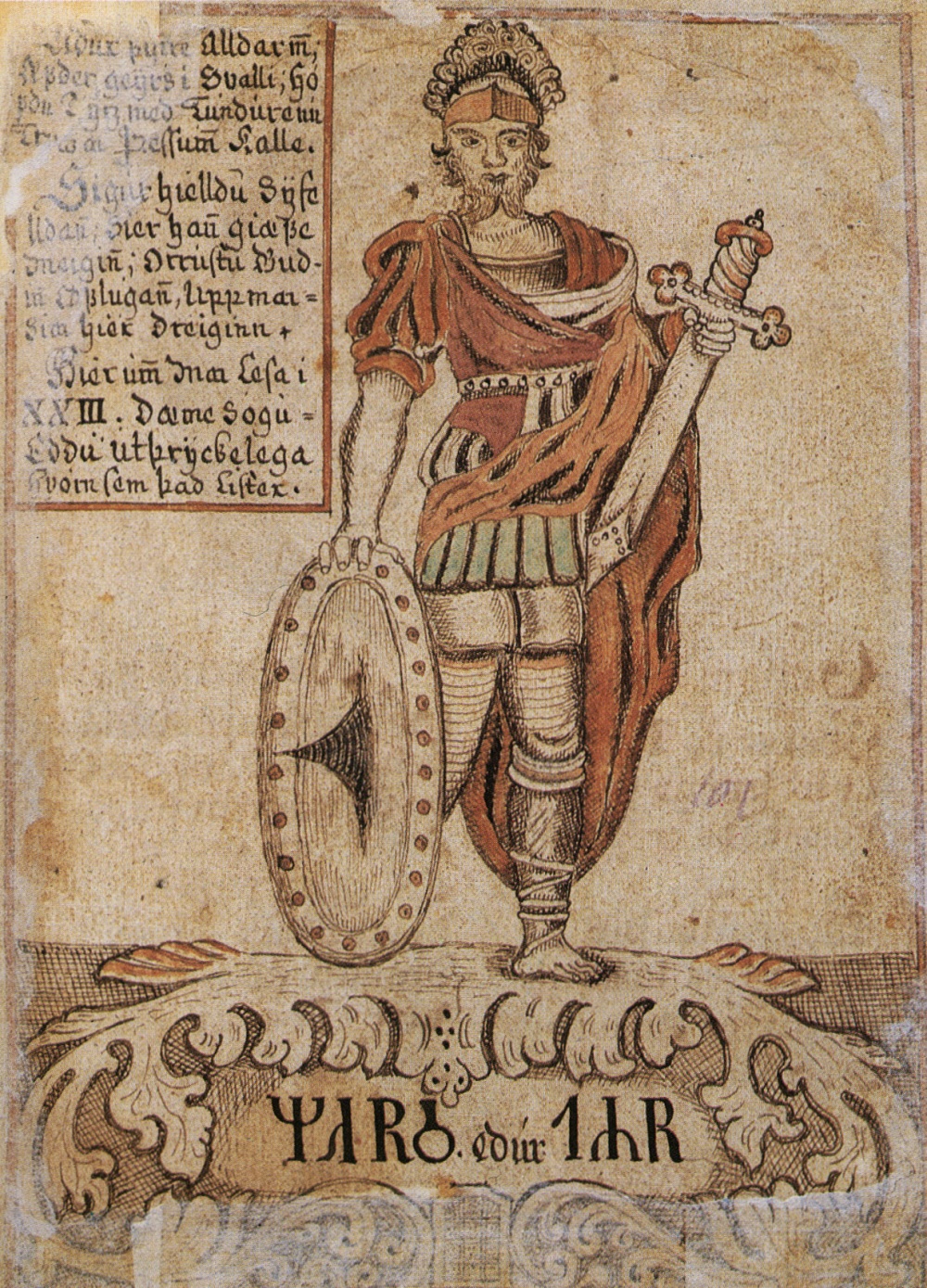
Tyr is a god in Germanic mythology and a member of the Æsir. He is best known for binding the monstrous wolf Fenrir by sacrificing his right hand. His name gives Tuesday its title in English and other Germanic languages.
- Tyr sacrificed his right hand to bind the wolf Fenrir
- His name gives Tuesday its title in English and Germanic languages
- Identified with the Roman god Mars as Mars Thincsus
- The Tiwaz rune (ᛏ) is named after him
- Originally meant 'god' in Proto-Germanic before becoming a specific name
What it is
Tyr stands as a prominent figure within Germanic mythology, specifically among the Æsir gods. He is widely recognized as a deity associated with war and justice. Ancient sources describe him as the one who sacrificed his right hand to the wolf Fenrir to ensure the beast was bound. This act highlights his role in maintaining order through personal sacrifice. Scholars often link him to the concept of formal agreements and legal assemblies. His presence in surviving texts suggests he held significant authority in early Germanic society, though his worship declined over time.
Where it comes from
The name Tyr derives from the Proto-Germanic word *Tīwaz, which simply meant 'god'. This term likely originated from an even older Indo-European root referring to a celestial or heavenly being. Originally, this word may have been a general title for deities rather than a specific name. Over time, it became attached to a particular god whose original identity has been lost to history. Linguistic evidence shows cognates in Old English as Tiw and Old High German as Ziu, indicating a shared heritage across Germanic tribes.
How it is done
Ancient practices linked to Tyr involved vows and oaths taken at formal assemblies known as things. These gatherings served as legislative bodies where disputes were settled. Sacrifices were made to appease him, particularly during times of conflict or when sealing important agreements. The myth of binding Fenrir serves as a symbolic representation of these oaths; just as Tyr risked his limb for the safety of the community, individuals were expected to uphold their promises. Rituals likely occurred at sacred sites dedicated to him.
Tools and materials
The Tiwaz rune (ᛏ) is closely associated with Tyr. This character appears in runic alphabets used by ancient Germanic peoples. Inscriptions bearing this rune often functioned as magical symbols or invocations. Votive altars found in Roman-era forts, such as Housesteads, bear Latin inscriptions linking Tyr to Mars. These stones serve as physical evidence of his veneration. Place names across Scandinavia also act as enduring markers of his presence, preserving his memory in the landscape itself.
Tyr, drawn and placed
- Living
- Revived
- Fading
- Historical
- Legendary
- Performed
- Lineage
- Germanic mythology
What it is for
People sought Tyr's favor to ensure victory in battle and the integrity of legal contracts. As a god of the thing, he protected the sanctity of oaths and social order. Warriors prayed to him for strength and success in combat. The sacrifice of his hand symbolizes the ultimate commitment required to maintain peace and bind dangerous forces. Communities relied on his authority to enforce judgments and resolve conflicts without violence, provided all parties honored their word.
Who does it
No living priesthood exists for Tyr today. In historical contexts, priests or chieftains likely presided over ceremonies at his shrines. The god was venerated by warriors and leaders who participated in the thing assemblies. Scholars study ancient texts and archaeological findings to reconstruct his role. The lack of detailed ritual instructions in surviving sources suggests that specific ceremonial knowledge may have been restricted or simply not recorded for posterity.
Peoples and places
Tyr was worshipped across various Germanic cultures. The Norse preserved his myths in the Poetic and Prose Eddas. Continental Germanic tribes identified him with the Roman god Mars, often using the epithet Thincsus. The Goths also revered him, viewing him as an ancestral figure. Place names in Denmark, Norway, and Sweden indicate regional cults. While Odin and Thor gained more prominence later, Tyr remained a foundational figure in early Germanic belief systems.
At a glance: who, where and when
Who does it
Peoples



What people believe
Germanic cosmology viewed Tyr as a guardian of cosmic order and human law. His binding of Fenrir represents the triumph of civilization over chaos. The wolf symbolizes destructive forces that must be restrained for society to function. Tyr's missing hand signifies the cost of maintaining this balance. Believers saw him as a fair judge who demanded honesty. His association with the sky and daylight stems from the etymological roots of his name, linking divine authority to natural order.
When it is done
Tuesday, named after Tyr, was traditionally associated with him. This day likely held significance for legal proceedings and military endeavors. Sacred sites like Viby in Denmark show evidence of long-term worship, possibly tied to seasonal cycles. However, specific festival dates are not clearly documented in surviving sources. Worship probably intensified during times of war or when establishing new treaties, aligning with his roles as a warrior and oath-keeper.
How scholars and sceptics see it
Researchers analyze linguistic patterns to trace Tyr's origins back to Proto-Indo-European sky gods. Some interpret him primarily as a war deity due to his connection with Mars. Others emphasize his role in justice and the thing assemblies. The scarcity of direct references compared to Odin or Thor leads some to suggest his importance faded or merged with other figures. Archaeological finds provide tangible links to his veneration, confirming his widespread influence across Germanic territories.
Cautions and what is closed
Modern interest in Tyr is largely academic or neo-pagan. There are no known dangers associated with studying his mythology. Historical accounts mention human sacrifices in his honor, reflecting the harsh realities of ancient warfare and religion. These practices are understood as historical facts rather than endorsements. Contemporary followers respect the cultural context of these beliefs without replicating harmful rituals.
Compare and confuse
Tyr is often confused with Mars due to Roman interpretations. Unlike Mars, who embodies aggressive warfare, Tyr represents lawful combat and oaths. He differs from Odin, who seeks wisdom through sacrifice, whereas Tyr's sacrifice ensures binding agreements. In Old English, he is known as Tiw, showing the same divine origin but distinct cultural evolution. His role as a sky god connects him to broader Indo-European traditions, yet his specific attributes remain unique to Germanic lore.
Questions people ask about Tyr
Who is Tyr in Germanic mythology?
Tyr is a god in Germanic mythology and a member of the Æsir. He is best known for sacrificing his right hand to the wolf Fenrir to ensure the beast was bound, symbolizing courage and the keeping of oaths.
Where does the name Tyr come from?
The name comes from the Proto-Germanic word *Tīwaz, meaning 'god'. It shares roots with Old English Tiw and Old High German Ziu, tracing back to an Indo-European term for a celestial being.
Why is Tuesday named after Tyr?
Tuesday derives from Old English tīwesdæg, meaning 'day of Tīw'. This reflects an early Germanic identification of Tyr with the Roman god Mars, whose day was Martis dies.
What is the Tiwaz rune?
The Tiwaz rune (ᛏ) is a character in the runic alphabet named after Tyr. It often appears on inscriptions as a magical symbol or invocation, representing the god's influence in ancient Germanic culture.
Good reading and sources
- Týr on WikipediaEncyclopedia
- More photos on Wikimedia CommonsPhotos and video
- Wikidata recordOpen data
The facts on this page come from the Wikipedia article "Týr", written by its contributors and used under the CC BY-SA 4.0 licence, and from its Wikidata record (CC0). EveryJaadu rewrote the text in its own words, with AI assistance, and compares every page with the article to make sure no passage is copied. It may be reused under the same CC BY-SA 4.0 licence with a link back.
It may contain mistakes. Names and customs differ from one community to the next, and some knowledge is closed to outsiders and left out here. This page describes belief and practice. It does not say that any of it works, it is not a how-to, and it is not medical advice. If something is wrong, tell us. Last refreshed 2026-10-06.
More from Sweden
All the entries from Sweden 🇸🇪 Sweden and 2 moreMjölnirMjǫllnir
The hammer of the Norse thunder god Thor, used as a weapon and for blessingsBeing · Cursing and harm · Protection Historical
🇸🇪 Sweden and 2 moreMjölnirMjǫllnir
The hammer of the Norse thunder god Thor, used as a weapon and for blessingsBeing · Cursing and harm · Protection Historical
 🇮🇸 Iceland and 3 moreDraugr
A malevolent undead revenant from Nordic folklore, often guarding buried treasure.Being · Cursing and harm · Luck and prosperity Legendary
🇮🇸 Iceland and 3 moreDraugr
A malevolent undead revenant from Nordic folklore, often guarding buried treasure.Being · Cursing and harm · Luck and prosperity Legendary
 🇳🇴 Norway and 1 moreHuldra
A seductive forest spirit of Scandinavian folklore with a hidden animal tail.Being · Protection Legendary
🇳🇴 Norway and 1 moreHuldra
A seductive forest spirit of Scandinavian folklore with a hidden animal tail.Being · Protection Legendary
 🇩🇪 Germany and 3 moreMare
A spirit that sits on sleepers to cause nightmares and physical distressBeing · Cursing and harm Historical
🇩🇪 Germany and 3 moreMare
A spirit that sits on sleepers to cause nightmares and physical distressBeing · Cursing and harm Historical
Related elsewhere
All being 🇮🇳 India and 5 moreAstrology
A divinatory practice that reads human fate through the positions of celestial bodies.Belief · Seeing and foretelling · Luck and prosperity Living
🇮🇳 India and 5 moreAstrology
A divinatory practice that reads human fate through the positions of celestial bodies.Belief · Seeing and foretelling · Luck and prosperity Living
 🇮🇳 India and 2 morePalmistry
A divination method that interprets the lines and shapes of the hand to predict fate or reveal character.Oracle · Seeing and foretelling · Power and authority Living
🇮🇳 India and 2 morePalmistry
A divination method that interprets the lines and shapes of the hand to predict fate or reveal character.Oracle · Seeing and foretelling · Power and authority Living
 🇨🇳 China and 3 moreChinese dragon龍
A legendary water deity and imperial symbol in East Asian cultureBeing · Protection · Luck and prosperity Historical
🇨🇳 China and 3 moreChinese dragon龍
A legendary water deity and imperial symbol in East Asian cultureBeing · Protection · Luck and prosperity Historical
 🇮🇳 India and 2 moreHomaहोम
A fire ritual found across Asian religions where offerings are burned as a votive exchange with the divine.Rite · Protection · Speaking with spirits and the dead Living
🇮🇳 India and 2 moreHomaहोम
A fire ritual found across Asian religions where offerings are burned as a votive exchange with the divine.Rite · Protection · Speaking with spirits and the dead Living