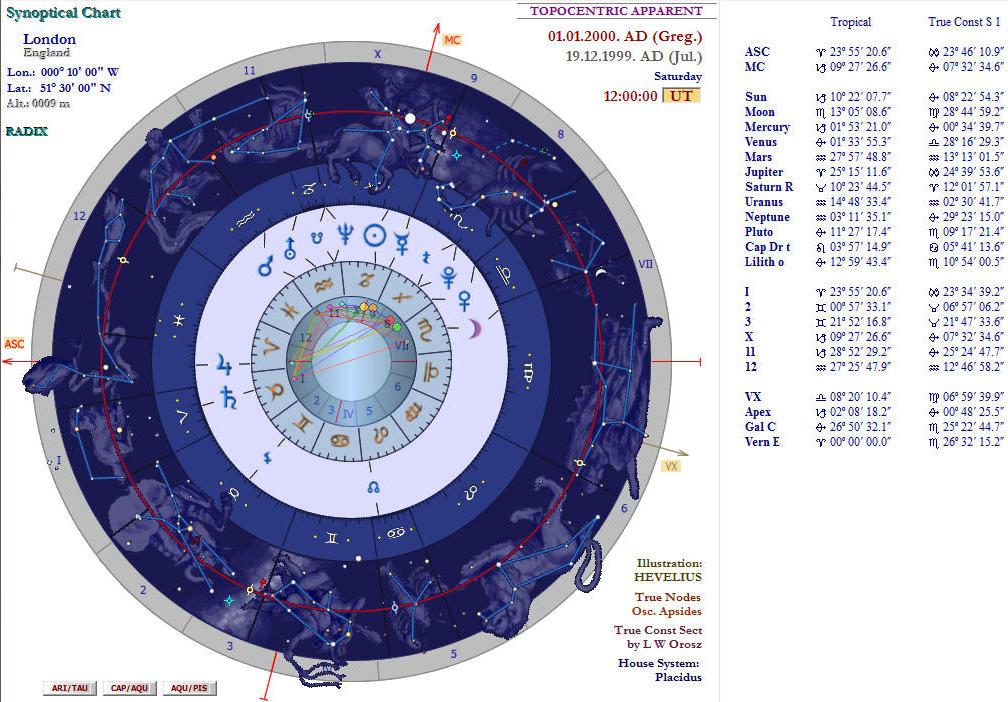
Synoptical astrology
An astrological system that overlays tropical, sidereal and constellational zodiacs
Created by Hungarian philosopher László Wladimir Orosz, synoptical astrology reads three zodiacal frames at once. The tropical path maps earthly life, the sidereal frame tracks spiritual states, and the real constellation zone records post-mortem conditions.
- Created by Hungarian philosopher László Wladimir Orosz
- Uses tropical, sidereal and constellational zodiacs together
- Tropical frame maps earthly life and physical health
- Sidereal frame tracks spiritual relations and dreams
- Constellational frame reveals post-mortem conditions
What it is
Synoptical astrology is a specific framework for reading natal charts that combines three different zodiacal systems into one view. Developed by the Hungarian thinker László Wladimir Orosz, it treats the tropical zodiac as the guide for personal, earthly life and physical health. It pairs this with the sidereal zodiac to map spiritual connections and the subtle body. Finally, it uses the actual, visible constellations to describe what happens after death. This method creates a layered portrait of a person’s existence across waking, dreaming and post-mortem states.
Where it comes from
The system was formulated by László Wladimir Orosz, a Hungarian philosopher and astrologer. He designed it to integrate multiple astronomical and astrological traditions simultaneously. The approach draws on established frameworks like the Fagan-Bradley ayanāṃśa for sidereal calculations. It also incorporates lunar mansion systems from Indian, Chinese, Arabic and Scythian traditions. These elements were combined to create a unique chart structure that separates planetary positions into distinct zones.
How it is done
A synoptical horoscope is drawn with three concentric rings. The innermost ring shows the tropical signs. The middle ring displays the sidereal zodiac. The outermost ring contains the real constellational zodiac. Because natural constellations vary in size, Orosz introduced 'dynamic degrees' to measure them accurately. Each sector begins at a fixed star and ends at the next marker star. Planets are placed according to their latitude relative to the ecliptic plane, which can shift which constellation they occupy.
Tools and materials
The primary tools are the three zodiacal frames: tropical, sidereal and constellational. The system relies on the Fagan-Bradley ayanāṃśa for sidereal alignment. It uses 'dynamic degrees' to handle unequal constellation sizes. Fixed stars serve as boundaries for each sector. The chart also integrates lunar mansion data from various cultures, including Indian and Chinese systems, mapped onto either the tropical or sidereal frames.
Synoptical astrology, drawn and placed
- Living
- Revived
- Fading
- Historical
- Legendary
- Performed
- Lineage
- Hungarian philosophical astrology
What it is for
Practitioners use this system to understand different layers of human experience. The tropical frame focuses on the gross body and waking life. The sidereal frame addresses the subtle body and dream states. The constellational frame reveals post-mortem conditions. It also considers arithmological characteristics of numbers dividing the 360-degree circle. Users seek clarity on spiritual relations and destiny through this multi-layered analysis.
Who does it
László Wladimir Orosz, a Hungarian philosopher and astrologer, created and taught this system. Scholars and researchers study his work as part of modern astrological theory. The method requires knowledge of multiple astronomical systems and cultural lunar calendars. It is not tied to a specific religious order but stands as a philosophical approach to chart interpretation.
Peoples and places
The system originates from Hungary through Orosz. However, it incorporates elements from diverse cultures. Indian, Chinese, Arabic and Scythian lunar mansion systems are integrated into the charts. The text mentions India specifically in the context of these lunar systems. The approach does not belong to a single ethnic group but synthesizes global astronomical traditions.
At a glance: who, where and when
Who does it
Belief worlds
What people believe
The framework assumes that different zodiacal systems reveal different aspects of reality. The tropical zodiac corresponds to the waking state and physical existence. The sidereal zodiac aligns with the dream state and spiritual connections. The real constellations reflect conditions after death. This belief structure treats astrology as a tool for mapping consciousness across multiple planes of being.
When it is done
The system does not prescribe specific festivals or calendar days for practice. Instead, it uses continuous astronomical cycles. Lunar mansions from various traditions are mapped onto the tropical or sidereal frames. These mansions follow their own historical cycles rather than a unified calendar. The focus remains on the natal chart rather than seasonal events.
How scholars and sceptics see it
Scholars view synoptical astrology as a niche theoretical development within modern astrology. Fred Gettings and Margaret Hone have referenced related concepts in their dictionaries and textbooks. The system is studied as an example of how astrologers attempt to reconcile different zodiacal standards. Researchers analyze its integration of cultural lunar systems and its unique chart design.
Cautions and what is closed
The system is complex and requires understanding of multiple astronomical frameworks. Misinterpretation can occur if users confuse the three zodiacal layers. The use of dynamic degrees and fixed star boundaries may challenge standard astrological training. Practitioners must be careful when applying lunar mansion data from different cultural traditions.
Compare and confuse
Synoptical astrology differs from standard tropical or sidereal astrology by using all three frames simultaneously. It shares features with constellational astrology but adds the tropical and sidereal layers. The integration of lunar mansions resembles traditional Vedic or Chinese astrology but places them in a Western chart structure. It is distinct from other modern systems due to its unique concentric design.
Questions people ask about Synoptical astrology
What is synoptical astrology?
It is an astrological system created by László Wladimir Orosz that combines tropical, sidereal and constellational zodiacs into one chart to map different aspects of life and spirit.
Where did this system originate?
It originated in Hungary through the work of philosopher and astrologer László Wladimir Orosz, who integrated various global astronomical traditions into a unique framework.
How is a synoptical horoscope drawn?
It uses three concentric rings: tropical signs inside, sidereal zodiac in the middle, and real constellations outside, with dynamic degrees measuring unequal sectors.
Good reading and sources
The facts on this page come from the Wikipedia article "Synoptical astrology", written by its contributors and used under the CC BY-SA 4.0 licence, and from its Wikidata record (CC0). EveryJaadu rewrote the text in its own words, with AI assistance, and compares every page with the article to make sure no passage is copied. It may be reused under the same CC BY-SA 4.0 licence with a link back.
It may contain mistakes. Names and customs differ from one community to the next, and some knowledge is closed to outsiders and left out here. This page describes belief and practice. It does not say that any of it works, it is not a how-to, and it is not medical advice. If something is wrong, tell us. Last refreshed 2026-10-06.
More from India
All the entries from India 🇮🇳 India and 1 moreMantraमन्त्रम्
A sacred sound or phrase repeated to focus the mind and invoke spiritual powerText · Speaking with spirits and the dead · Power and authority Living
🇮🇳 India and 1 moreMantraमन्त्रम्
A sacred sound or phrase repeated to focus the mind and invoke spiritual powerText · Speaking with spirits and the dead · Power and authority Living
 🇮🇳 India and 4 moreTantraतन्त्र
An esoteric yogic tradition from India focusing on ritual, mantra, and body-based spiritual practices.Tradition · Power and authority · Change and initiation Living
🇮🇳 India and 4 moreTantraतन्त्र
An esoteric yogic tradition from India focusing on ritual, mantra, and body-based spiritual practices.Tradition · Power and authority · Change and initiation Living
 🇮🇳 India and 2 moreKalachakraདུས་ཀྱི་འཁོར་ལོ།
A Tibetan Buddhist tantric deity and system of yogic time cyclesTradition · Change and initiation · Speaking with spirits and the dead Living
🇮🇳 India and 2 moreKalachakraདུས་ཀྱི་འཁོར་ལོ།
A Tibetan Buddhist tantric deity and system of yogic time cyclesTradition · Change and initiation · Speaking with spirits and the dead Living
 🇳🇵 Nepal and 1 moreMatsyendranathMacchindranāth, Mīnanātha
A yogi and rain deity revered across Hindu and Buddhist traditions in South Asia.Figure · Speaking with spirits and the dead · Power and authority Living
🇳🇵 Nepal and 1 moreMatsyendranathMacchindranāth, Mīnanātha
A yogi and rain deity revered across Hindu and Buddhist traditions in South Asia.Figure · Speaking with spirits and the dead · Power and authority Living
Related elsewhere
All text 🇨🇳 China and 3 moreTang-ki童乩 (tóngjī); 乩童 (jītóng)
A Chinese folk-religion medium whose body a deity is held to take overTradition · Speaking with spirits and the dead · Seeing and foretelling Living
🇨🇳 China and 3 moreTang-ki童乩 (tóngjī); 乩童 (jītóng)
A Chinese folk-religion medium whose body a deity is held to take overTradition · Speaking with spirits and the dead · Seeing and foretelling Living
 🇮🇹 ItalyEtruscan religion
The polytheistic beliefs and divination practices of the ancient Etruscans of ItalyTradition · Seeing and foretelling · Speaking with spirits and the dead Historical
🇮🇹 ItalyEtruscan religion
The polytheistic beliefs and divination practices of the ancient Etruscans of ItalyTradition · Seeing and foretelling · Speaking with spirits and the dead Historical
 🇳🇬 NigeriaOrunmilaỌ̀rúnmìlà
Yoruba deity of wisdom and the creator of the Ifá divination systemBeing · Seeing and foretelling · Speaking with spirits and the dead Living
🇳🇬 NigeriaOrunmilaỌ̀rúnmìlà
Yoruba deity of wisdom and the creator of the Ifá divination systemBeing · Seeing and foretelling · Speaking with spirits and the dead Living
 🇮🇹 ItalyCumaean SibylSibylla Cumana
The priestess of the Apollonian oracle at Cumae, famous in Roman legend for her prophetic books and underworld guidance.Figure · Seeing and foretelling · Speaking with spirits and the dead Legendary
🇮🇹 ItalyCumaean SibylSibylla Cumana
The priestess of the Apollonian oracle at Cumae, famous in Roman legend for her prophetic books and underworld guidance.Figure · Seeing and foretelling · Speaking with spirits and the dead Legendary