
Surtr
In its own language: Surtur
Old Norse Surtr, glossed as "black" or more narrowly "swart"
A fire giant of Norse myth who guards a burning realm and ends the world
Surtr is a fire giant, a jötunn of Norse mythology. Old Norse poems and Snorri Sturluson's Prose Edda put him at the border of Múspell, the flaming realm, and foretell that at Ragnarök he will ride out with a shining sword, fight the god Freyr and set the earth alight.
- The name is glossed as "black" or "swart", which may hint at a charred look
- Múspell, his realm, is said to be impassable to anyone not native to it
- At Ragnarök his sword is said to shine more brightly than the sun
- Cattle and sheep bones in Surtshellir point to rites held before 1000 AD
- Surtsey, raised by an eruption in 1963, is named after him
What it is
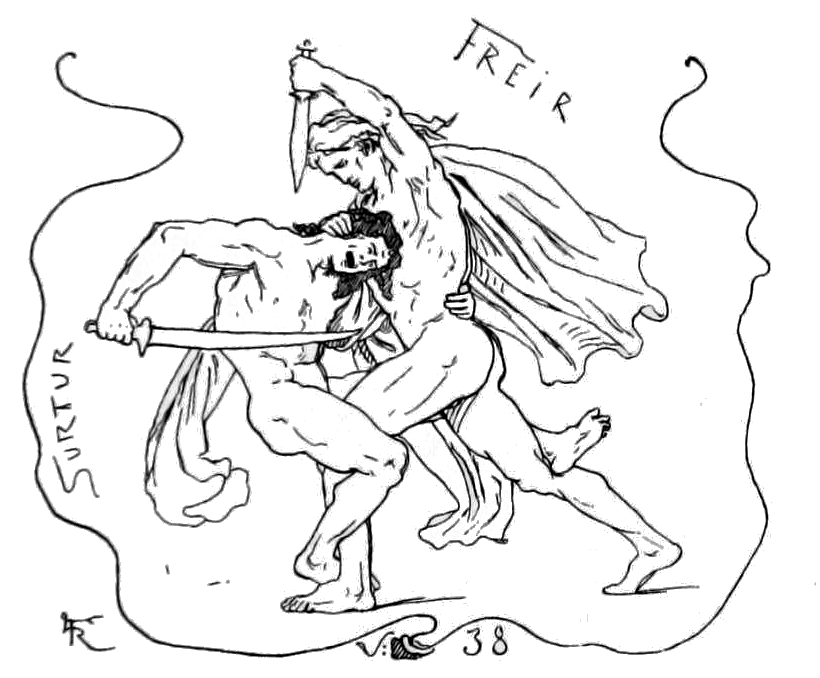
Surtr is a jötunn, one of the giant kind of Norse myth, and the texts give him charge of Múspell, the fiery region at the world's edge. He carries a sword whose light is said to outshine the sun. In the foretold last age, Ragnarök, he rides at the head of Múspell's sons, meets the god Freyr in battle, and sets the earth alight. Old Norse has him as Surtr, modern Icelandic as Surtur, and English writers sometimes shorten the name to Surt. It is usually glossed as "black" or "swart", which some take as a hint at a scorched colour.
Where it comes from
Two Icelandic works of the thirteenth century carry most of what is told of him. The Poetic Edda gathers older poems; the Prose Edda is the handbook written by Snorri Sturluson. Rudolf Simek argues that the figure is old, since tenth-century skalds, Eyvindr skáldaspillir and Hallfreðr vandræðaskáld, already used his name, and Surtshellir, the cave called after him, is entered in Landnámabók, the Book of Settlements. Where the story first formed is disputed: Simek doubts that the notion of a giant at war with the gods began in Iceland.
How it is done
The one rite attached to him comes from Landnámabók. A chieftain's son, Þorvaldur holbarki Þorðarson, is said to have crossed about 150 km of Iceland's interior to reach the cave known as hellisins Surts, Surt's cave, and there to have recited a drápa, a formal praise poem, to the giant believed to live inside. Work in the cave in 2001, 2012 and 2013 uncovered sheep and oxen bones once read as traces of outlaws; they are now understood as signs of ritual meals and offerings spread over 65 to 100 years before the country turned Christian around 1000 AD.
Tools and materials
Fire is his element and his weapon. The Prose Edda gives him a fine sword that shines more brightly than the sun, and says flames burn ahead of him and behind as he rides. In Völuspá he comes up from the south carrying a very bright blade. The sword he lacks matters too: Freyr is said to fall because he had parted with his own good sword, giving it to his servant Skírnir. Fire also works as a figure of speech, one skaldic line calling the depths of a mountain "Surt's deep vales".
Surtr, drawn and placed
- Living
- Revived
- Fading
- Historical
- Legendary
- Performed
- Lineage
- Norse mythology
- Timing
- at Ragnarök, the foretold end of the world
What it is for
The cave rites are read as an effort to keep the fire giant appeased, or else to lend the gods strength against him and the giants under his command. In the mythology his part is destruction and, beyond it, renewal. The flames he spreads are said to end the world, yet afterwards a green and living earth comes back out of the sea, the surviving gods meet again, and two people, Líf and Lífþrasir, emerge from hiding in the wood Hoddmímis holt.
Who does it
No class of priests or specialists serving Surtr is described. The Book of Settlements names one man, the chieftain's son Þorvaldur holbarki, said to have made the journey and spoken the praise poem himself. The skalds stand closest to him otherwise: Eyvindr skáldaspillir and Hallfreðr vandræðaskáld worked his name into verse, and Snorri Sturluson set down the prose account. The excavated bones point to repeated activity in the cave across decades rather than a single visit.
Peoples and places
The tradition belongs to Old Norse speakers, and Iceland is where the manuscripts, the placenames and the cave evidence sit. Surtshellir lies in the west of the country, and the giant's name is fixed to that landscape. Simek reads Icelandic writing as picturing Surtr as a powerful giant who governed the fire under the earth, the fire of volcanoes. Modern Icelandic keeps the name as Surtur. Whether the tale of a giant hostile to the gods reached Iceland from elsewhere is a question Simek raises.
At a glance: who, where and when
Belief worlds

What people believe
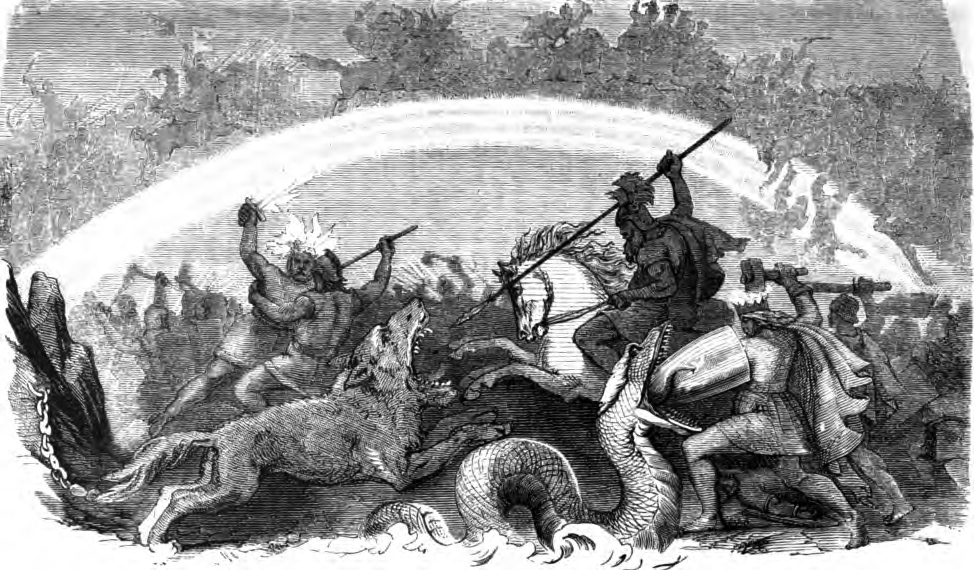
In the Prose Edda's account, Múspell is a bright, burning region older than Niflheim, the realm of cold, and nobody not native to it can cross. Surtr stands at its frontier with his sword. At Ragnarök the sky opens, Múspell's sons ride out with fire around them, and the bridge Bifröst breaks under their horses. The gods meet them on the field Vígríðr, said to stretch a hundred leagues in every direction. After the burning, Gimlé is named as a hall that will stand, and the world is said to be fertile again.
How scholars and sceptics see it
Bertha Phillpotts took Surtr for a demon of volcanoes, shaped by eruptions in Iceland. Andy Orchard finds the portrait in Gylfaginning owing something to biblical and patristic writing about an angel with a flaming sword who kept guard over Eden. John Lindow suggests the name points to a charred appearance. Simek groups Surtr with the fire-named giants Eldr, Eimnir, Logi and Brandingi, and notes that giants are usually placed in the east while Surtr comes from the south, a direction he ties to heat. Richard Cole compares Snorri's sons of Múspell with the Red Jews motif.
Compare and confuse
Stanza 24 of Fjölsvinnsmál has a line about Surtr that is hard to read; two words in it make no sense as written, and editors have emended them to give him a female companion, Sinmara, whom Lee Hollander tentatively calls his wife and places nowhere else. The name also serves as an ordinary noun for a giant. In the euhemerised reading in Skáldskaparmál, what people called Surt's fire was the burning of Troy.
Today
The idea of Surtr as a fire giant still lives in Iceland. Surtsey, the island raised by an eruption at Vestmannaeyjar in 1963, carries his name, as does Surtshellir. John Charles Dollman painted him on guard at Múspell's border. Beyond earth, a moon of Saturn is called Surtur and a volcano on Io is called Surt, and in 2019 a star and its planet were named Muspelheim and Surt. Marvel Comics used him from 1963, and he appears in the 2017 film Thor: Ragnarok.
Questions people ask about Surtr
What is Surtr?
A giant, or jötunn, of Norse myth. He guards Múspell, a flaming region at the edge of the world, and is foretold to lead its sons against the gods at Ragnarök, carrying a sword said to shine more brightly than the sun.
Where does the story of Surtr come from?
Mainly from two Icelandic books of the thirteenth century: the Poetic Edda, which collects older poems, and the Prose Edda by Snorri Sturluson. Tenth-century skalds already used his name, and a cave called Surtshellir appears in the Book of Settlements.
What happens between Surtr and Freyr?
The Prose Edda says the two meet in battle on the field Vígríðr, and that the fighting is harsh before Freyr falls. His death is put down to his having given away his own good sword to his servant Skírnir.
Was Surtr ever honoured with rites?
A chieftain's son is said to have crossed Iceland's interior to praise the giant in his cave, and bones found there are read as traces of ritual meals held over decades before the country turned Christian around 1000 AD.
Why is Surtr tied to fire and volcanoes?
His name is glossed as "black" or "swart", he carries a shining sword, and flames are said to surround him. Bertha Phillpotts argued that Icelandic eruptions shaped the figure, and Rudolf Simek notes that Icelandic writing pictures him ruling the fire beneath the earth.
Good reading and sources
- Surtr on WikipediaEncyclopedia
- More photos on Wikimedia CommonsPhotos and video
- Wikidata recordOpen data
The facts on this page come from the Wikipedia article "Surtr", written by its contributors and used under the CC BY-SA 4.0 licence, and from its Wikidata record (CC0). EveryJaadu rewrote the text in its own words, with AI assistance, and compares every page with the article to make sure no passage is copied. It may be reused under the same CC BY-SA 4.0 licence with a link back.
It may contain mistakes. Names and customs differ from one community to the next, and some knowledge is closed to outsiders and left out here. This page describes belief and practice. It does not say that any of it works, it is not a how-to, and it is not medical advice. If something is wrong, tell us. Last refreshed 2026-10-22.
More from Iceland
All the entries from Iceland 🇮🇸 Iceland and 3 moreDraugr
A malevolent undead revenant from Nordic folklore, often guarding buried treasure.Being · Cursing and harm · Luck and prosperity Legendary
 🇸🇪 Sweden and 2 moreMjölnirMjǫllnir
The hammer of the Norse thunder god Thor, used as a weapon and for blessingsBeing · Cursing and harm · Protection Historical
 🇮🇸 Iceland and 1 moreHidden-folkhuldufólk
Supernatural beings in Nordic folklore who live in a parallel world within the landscape.Being · Protection · Luck and prosperity Living
 🇩🇪 Germany and 3 moreMare
A spirit that sits on sleepers to cause nightmares and physical distressBeing · Cursing and harm Historical
Related elsewhere
All being 🇺🇸 United States and 5 moreSatanism
A modern set of beliefs using the figure of Satan as a symbol or deity.Tradition · Power and authority · Cursing and harm Living
 🇪🇬 Egypt and 1 moreLilithלִילִית
A feminine figure from Mesopotamian and Jewish mythology, often depicted as a night demon or spirit.Being · Cursing and harm Legendary
 🇪🇬 EgyptCurse
A spoken wish for harm, often backed by ritual or divine authorityBelief · Cursing and harm · Protection Historical
 🇹🇷 Turkey and 5 moreEvil eye
A curse caused by an envious look and the charms used to block itBelief · Protection · Cursing and harm Living