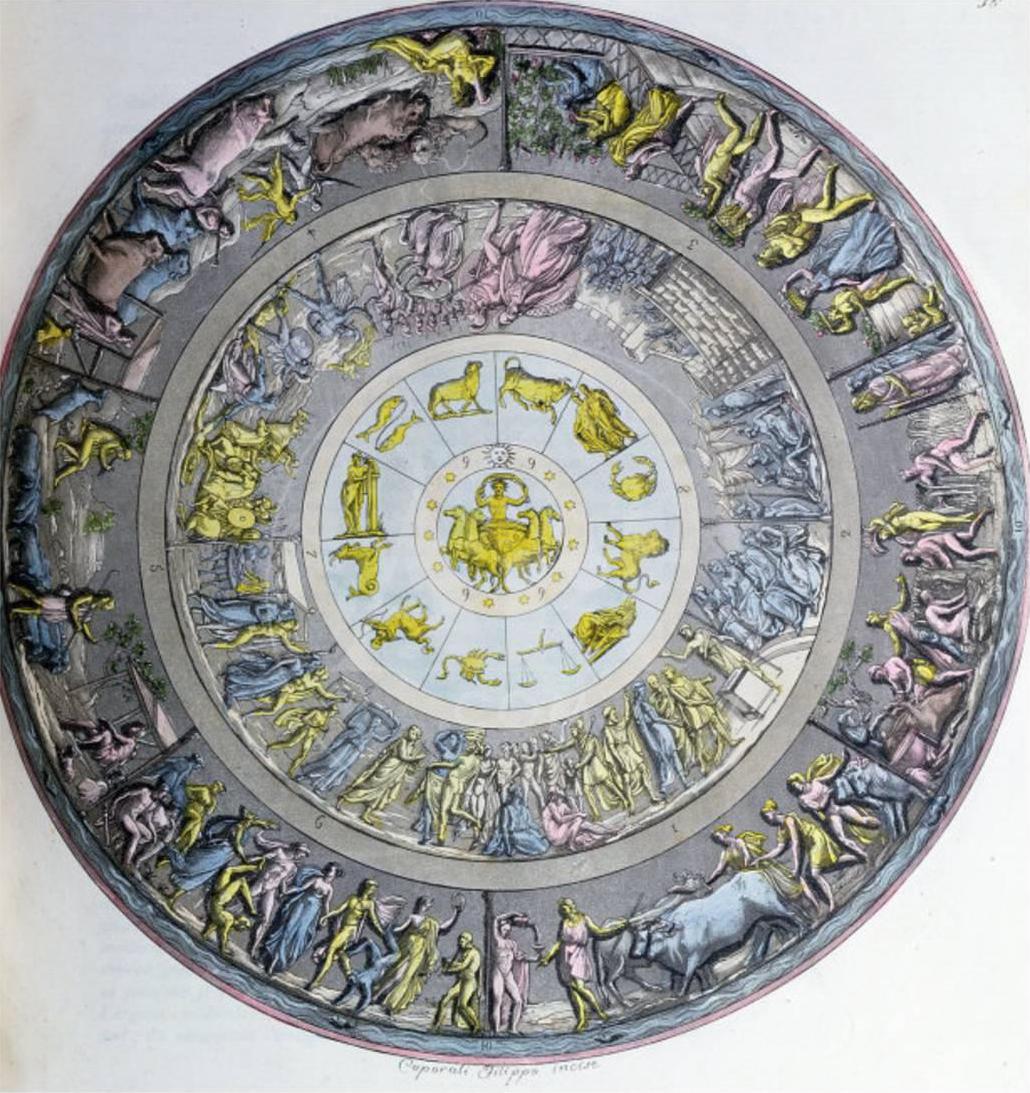
Shield of Achilles
A mythical shield forged by Hephaestus, decorated with a complete picture of the world and human life.
The Shield of Achilles is a legendary object from Greek mythology described in Homer's Iliad. It was forged by the god Hephaestus for the hero Achilles to replace his lost armor. The shield bears intricate scenes representing the entire cosmos and human civilization.
- First example of ekphrasis in ancient Greek poetry
- Forged by the god Hephaestus for Achilles
- Depicts Earth, sky, sea, and human cities
- Shows simultaneous sun and moon shining
- Acts as foreshadowing for Achilles' destiny
What it is
The Shield of Achilles is a famous mythical object from ancient Greek literature. It appears in Book 18 of Homer's Iliad. The hero Achilles uses it during his fight with Hector. His mother, the nymph Thetis, asks the god Hephaestus to forge new armor after Hector kills Patroclus. Hephaestus creates a shield with spectacular decorative imagery. This description is known as ekphrasis. It is a rhetorical device that describes a visual work of art in detail. The text allows readers to imagine an artwork they cannot see.
Where it comes from
The shield originates in the epic poem Iliad by Homer. It is the first example of ekphrasis in ancient Greek poetry. The passage influenced later works like the Shield of Heracles. Virgil modeled the shield of Aeneas in the Aeneid on this description. Scholars recognize the passage as the first cosmological mapping in Greek history. After the classical period, artists painted scenes like Thetis receiving the weapons. Since the eighteenth century, artisans have tried to recreate the shield in gold or bronze.
Tools and materials
Homer describes the imagery in concentric circles. The center shows the Earth, sky, sea, sun, moon, and constellations. Outer rings depict two cities. One city has a wedding and a law case. The other faces siege and battle. Other scenes include plowing fields, harvesting grain, and picking grapes. A herd of cattle fights lions. There is also a sheep farm and a dancing floor. The outermost ring is the great stream of Ocean.
Shield of Achilles, drawn and placed
- Living
- Revived
- Fading
- Historical
- Legendary
- Performed
- Lineage
- Greek mythology
What it is for
The shield provides protection for Achilles in battle. It endows him with special power for his second attempt at war. Some scholars read it as a microcosm of civilization. It shows all aspects of life, including social order and conflict. The simultaneous sun and moon suggest an understanding of the universe. The images act as cryptic parables. They link symbolism to predictions about future events. This gives Achilles an indication of his destiny.
Peoples and places
The subject belongs to Greek mythology. It is central to the story of Achilles in the Iliad. The imagery reflects Greek perceptions of the world. It contrasts war and peace, work and festival. German writer Wolfgang Schadewaldt argued these antitheses show civilized life. The shield is compared to Agamemnon's simpler shield with a Gorgon head. Achilles' shield reveals balanced and mature imagery rather than brute force.
At a glance: who, where and when
Peoples

What people believe
Fate in Greek mythology is unchangeable even by the gods. The Moirai spin human destiny like threads. The shield allegorizes this role of fate. Its construction serves as foreshadowing. The narrative technique underlines inevitable future events. The images raise anticipation in the audience. They conceal the hero's destiny on the very shield he carries. This connects creation, origins, and eternity to specific predictions.
How scholars and sceptics see it
Scholars interpret the shield in various ways. It represents a summation of human knowledge in the Homeric era. The depiction of law suggests social order. Feuding armies depict the darker side of humanity. The imagery reinforces beliefs about the cosmic order. Poetic descriptions allow audiences to envision unseen art. The shield's layers show intersecting antitheses. These contrast war with peace and work with festival. Scholars view this as making war visible in relation to peace.
Compare and confuse
The shield is often compared to other mythic arms. Agamemnon carried a shield with a bloody Gorgon head. That image projected common intimidating brute force. Achilles' shield offers diverse and balanced imagery. Virgil's shield of Aeneas in the Aeneid is clearly modeled on Homer. W. H. Auden wrote a poem reimagining the description in twentieth-century terms.
Questions people ask about Shield of Achilles
What is the Shield of Achilles?
It is a legendary shield from Greek mythology described in Homer's Iliad. It was forged by the god Hephaestus for the hero Achilles. The shield bears intricate scenes of the cosmos and human life.
Who made the Shield of Achilles?
The god Hephaestus made the shield. He created it at the request of Achilles' mother, the nymph Thetis. She needed replacement armor after her son's original gear was taken by Hector.
What images are on the shield?
The shield shows the Earth, sky, sea, sun, moon, and constellations. It also depicts cities, farms, vineyards, and dancing floors. The outer ring features the great stream of Ocean.
Why is the shield important?
It is the first example of ekphrasis in Greek poetry. It provides a detailed textual description of visual art. It also serves as cosmological mapping and foreshadows Achilles' fate.
Good reading and sources
- Shield of Achilles on WikipediaEncyclopedia
- More photos on Wikimedia CommonsPhotos and video
- Wikidata recordOpen data
The facts on this page come from the Wikipedia article "Shield of Achilles", written by its contributors and used under the CC BY-SA 4.0 licence, and from its Wikidata record (CC0). EveryJaadu rewrote the text in its own words, with AI assistance, and compares every page with the article to make sure no passage is copied. It may be reused under the same CC BY-SA 4.0 licence with a link back.
It may contain mistakes. Names and customs differ from one community to the next, and some knowledge is closed to outsiders and left out here. This page describes belief and practice. It does not say that any of it works, it is not a how-to, and it is not medical advice. If something is wrong, tell us. Last refreshed 2026-10-06.
More from Greece
All the entries from Greece 🇷🇸 Serbia and 5 moreVampire
An undead creature from folklore that feeds on the blood or life force of the livingBeing · Cursing and harm · Luck and prosperity Legendary
🇷🇸 Serbia and 5 moreVampire
An undead creature from folklore that feeds on the blood or life force of the livingBeing · Cursing and harm · Luck and prosperity Legendary
 🇮🇹 Italy and 1 morePietro d'Abano
A medieval physician and astrologer accused of heresy and magic.Text · Healing · Wonder and entertainment Historical
🇮🇹 Italy and 1 morePietro d'Abano
A medieval physician and astrologer accused of heresy and magic.Text · Healing · Wonder and entertainment Historical
 🇬🇷 GreeceCassandraΚασσάνδρα
A Trojan priestess cursed to speak truth that no one acceptsFigure · Seeing and foretelling Legendary
🇬🇷 GreeceCassandraΚασσάνδρα
A Trojan priestess cursed to speak truth that no one acceptsFigure · Seeing and foretelling Legendary
 🇬🇷 GreeceOrpheusὈρφεύς
A Thracian bard whose music charms nature and who journeys to the underworldFigure · Wonder and entertainment Legendary
🇬🇷 GreeceOrpheusὈρφεύς
A Thracian bard whose music charms nature and who journeys to the underworldFigure · Wonder and entertainment Legendary
Related elsewhere
All figure 🇮🇳 India and 5 moreAstrology
A divinatory practice that reads human fate through the positions of celestial bodies.Belief · Seeing and foretelling · Luck and prosperity Living
🇮🇳 India and 5 moreAstrology
A divinatory practice that reads human fate through the positions of celestial bodies.Belief · Seeing and foretelling · Luck and prosperity Living
 🇮🇳 India and 2 morePalmistry
A divination method that interprets the lines and shapes of the hand to predict fate or reveal character.Oracle · Seeing and foretelling · Power and authority Living
🇮🇳 India and 2 morePalmistry
A divination method that interprets the lines and shapes of the hand to predict fate or reveal character.Oracle · Seeing and foretelling · Power and authority Living
 🇨🇳 China and 3 moreChinese dragon龍
A legendary water deity and imperial symbol in East Asian cultureBeing · Protection · Luck and prosperity Historical
🇨🇳 China and 3 moreChinese dragon龍
A legendary water deity and imperial symbol in East Asian cultureBeing · Protection · Luck and prosperity Historical
 🇮🇳 India and 1 moreGarba
A Gujarati circle dance performed around a central symbol during NavaratriIllusion · Power and authority · Luck and prosperity Living
🇮🇳 India and 1 moreGarba
A Gujarati circle dance performed around a central symbol during NavaratriIllusion · Power and authority · Luck and prosperity Living