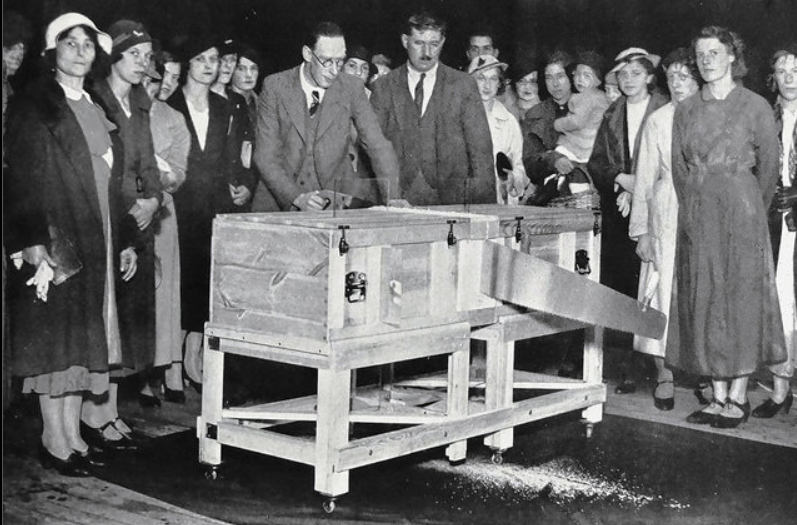
Sawing a woman in half
A stage illusion where an assistant appears to be cut into pieces inside a box or on a table
This is a generic term for stage magic tricks in which a person is apparently divided into two or more parts. The effect relies on misdirection and hidden compartments to create the impression of physical separation without harm.
- P. T. Selbit performed the first public version in London in 1921
- Horace Goldin introduced a modern box style in New York in 1921
- Audience volunteers often help secure the assistant with ropes
- Transparent boxes are used in modern variants like the Crystal Sawing
What it is
Sawing a woman in half is a classic form of stage magic entertainment. It involves a performer appearing to divide a human assistant into separate sections using a saw or dividing panels. The audience sees the assistant placed inside a container or on a table before being split. The effect creates a sense of shock and wonder by suggesting that the body has been physically severed. This is a performance art where the audience knows it is a trick, relying on skill and engineering rather than supernatural forces.
Where it comes from
Debates exist about the first performance. Some claim a magician named Torrini performed a version in 1809, but historians view this as likely fictional. Jean-Eugène Robert-Houdin wrote about it in 1858, possibly inventing the story. The earliest verifiable record is from January 1887 in Warminster. P. T. Selbit gave the first public demonstration in London in January 1921. Horace Goldin introduced a more modern version in the United States later that year, which became widely popular.
Tools and materials
Performers use wooden crates, boxes, or tables made of wood and metal. Glass plates or metal dividers are used to create the visual barrier between the assistant's body parts. Ropes, chains, and sturdy collars secure the assistant's wrists, ankles, and neck. Some variations use a large buzzsaw for dramatic effect. Transparent boxes are also used in modern versions to increase the difficulty of the illusion.
Sawing a woman in half, drawn and placed
- Living
- Revived
- Fading
- Historical
- Legendary
- Performed
What it is for
The primary intent is to entertain and amaze the audience. It is designed to create a moment of suspense and surprise. Magicians use it to showcase their technical skill and the quality of their props. The act builds tension by involving audience volunteers in the securing process. It serves as a major headline attraction in variety shows and magic theaters.
Who does it
Professional magicians perform this illusion. They require trained assistants who can follow precise instructions to remain safe. Assistants must be comfortable with confinement and physical restraint. Many performers develop their own versions of the apparatus. Some magicians patent their designs to prevent others from copying them. The role requires trust and coordination between the performer and the assistant.
Peoples and places
The trick originated in Europe and spread to the United States. British magicians like P. T. Selbit and Alan Wakeling developed early versions. American magicians such as Horace Goldin and Howard Thurston popularized the box style. The illusion is now performed globally by magicians of various backgrounds. Different cultures may adapt the presentation style while keeping the core mechanics similar.
At a glance: who, where and when
Who does it
What people believe
There is no spiritual or religious belief associated with this practice. It is purely a secular form of entertainment. The audience understands that the assistant is not actually harmed. Skeptics analyze the mechanical methods used to achieve the effect. Scholars study it as part of the history of theatrical magic and stagecraft.
When it is done
The illusion is performed during stage magic shows and variety acts. It does not have specific calendar dates or seasonal requirements. Performers schedule it based on tour dates and venue availability. It is often used as a climax in a magic program due to its high impact.
How scholars and sceptics see it
Historians of magic study the evolution of the trick and its inventors. Jim Steinmeyer and other researchers have documented the origins and development of the illusion. They analyze how the method changed over time to become more deceptive. Psychological studies look at how misdirection works in this context. Sceptics examine the mechanical explanations behind the apparent impossibility.
Cautions and what is closed
The act requires strict safety protocols to prevent injury. Assistants must be carefully positioned to avoid crushing or cutting. Magicians must ensure all mechanical parts function correctly. There is a risk of accident if restraints fail or mechanisms jam. Professional performers undergo rigorous training to manage these risks safely.
Compare and confuse
It is related to other containment illusions like the bullet catch or levitation. The Crystal Sawing variant uses transparent boxes to increase difficulty. Double sawing involves splitting two people simultaneously. These variations share the core concept of apparent physical division through hidden space manipulation.
Questions people ask about Sawing a woman in half
What is sawing a woman in half?
It is a stage magic illusion where an assistant appears to be cut into pieces inside a box or on a table. The performer uses hidden compartments and misdirection to create the effect of separation without harming the assistant.
Who invented the trick?
P. T. Selbit is credited with the first public performance in London in 1921. However, earlier unverified claims exist. Horace Goldin later developed a more popular version in the United States that influenced modern performances.
Is the assistant actually hurt?
No. The assistant remains completely safe throughout the performance. The method uses clever engineering and positioning to hide the assistant's body parts while creating the visual illusion of being cut.
How does the trick work?
The assistant hides in a specially designed box or folds into a hidden compartment. Dividing panels or saws pass through empty space next to the body. The audience sees the separation but cannot see the hidden mechanism.
Good reading and sources
- Split in two: magicians to celebrate 100 years of sawing people in halfThe Guardian, Article
- BBC Radio 4 - Woman's Hour, Debbie McGee and Dr Naomi Paxton, author Angie Thomas, Nurse Sarah Link who lived in a caravan for 9 months to pBBC, Article
- Sawing a woman in half on WikipediaEncyclopedia
- More photos on Wikimedia CommonsPhotos and video
- Wikidata recordOpen data
The facts on this page come from the Wikipedia article "Sawing a woman in half", written by its contributors and used under the CC BY-SA 4.0 licence, and from its Wikidata record (CC0). EveryJaadu rewrote the text in its own words, with AI assistance, and compares every page with the article to make sure no passage is copied. It may be reused under the same CC BY-SA 4.0 licence with a link back.
It may contain mistakes. Names and customs differ from one community to the next, and some knowledge is closed to outsiders and left out here. This page describes belief and practice. It does not say that any of it works, it is not a how-to, and it is not medical advice. If something is wrong, tell us. Last refreshed 2026-10-05.
More from the United Kingdom
All the entries from the United Kingdom 🇬🇧 United KingdomEgyptian Hall
A London exhibition hall known for magic shows and Egyptian-style architecture, demolished in 1905.Illusion · Wonder and entertainment Historical
🇬🇧 United Kingdom and 1 moreMetamorphosis
A stage illusion where a magician and assistant instantly swap places inside a locked container.Illusion · Wonder and entertainment Living
🇬🇧 United KingdomEgyptian Hall
A London exhibition hall known for magic shows and Egyptian-style architecture, demolished in 1905.Illusion · Wonder and entertainment Historical
🇬🇧 United Kingdom and 1 moreMetamorphosis
A stage illusion where a magician and assistant instantly swap places inside a locked container.Illusion · Wonder and entertainment Living
 🇩🇪 Germany and 2 morePhantasmagoria
A horror theatre using magic lanterns to project frightening images in the darkIllusion · Wonder and entertainment Historical
🇩🇪 Germany and 2 morePhantasmagoria
A horror theatre using magic lanterns to project frightening images in the darkIllusion · Wonder and entertainment Historical
 🇬🇧 United KingdomIsaac Fawkes
An English conjurer who moved magic from the fairground to fashionable London society.Illusion · Wonder and entertainment Historical
🇬🇧 United KingdomIsaac Fawkes
An English conjurer who moved magic from the fairground to fashionable London society.Illusion · Wonder and entertainment Historical
Related elsewhere
All illusion 🇪🇬 Egypt and 1 moreSphinx
A mythical hybrid with a human head and lion body, serving as guardian or riddler in Egyptian and Greek traditions.Being · Protection · Wonder and entertainment Legendary
🇨🇱 ChileChilean mythology
The myths and legends of Chile, blending indigenous roots with colonial influences.Tradition · Wonder and entertainment Living
🇷🇺 Russia and 3 moreNart sagaНарты кадджытæ
A collection of epic tales from the North Caucasus about a legendary group of heroes.Text · Wonder and entertainment Historical
🇪🇬 Egypt and 1 moreSphinx
A mythical hybrid with a human head and lion body, serving as guardian or riddler in Egyptian and Greek traditions.Being · Protection · Wonder and entertainment Legendary
🇨🇱 ChileChilean mythology
The myths and legends of Chile, blending indigenous roots with colonial influences.Tradition · Wonder and entertainment Living
🇷🇺 Russia and 3 moreNart sagaНарты кадджытæ
A collection of epic tales from the North Caucasus about a legendary group of heroes.Text · Wonder and entertainment Historical
 🇨🇳 ChinaLan Caihe藍采和
An ambiguous Taoist immortal known for a flower basket and wandering songsBeing · Wonder and entertainment Legendary
🇨🇳 ChinaLan Caihe藍采和
An ambiguous Taoist immortal known for a flower basket and wandering songsBeing · Wonder and entertainment Legendary