
Pan Twardowski
from Polish pan, meaning lord or sir, and twardy, meaning hard
A Polish sorcerer who bargained with the Devil and ended up on the Moon
Pan Twardowski is a legendary figure from Polish folklore who sold his soul for magical powers. The story shares roots with the Faust legend and features a nobleman who tricks the Devil but ultimately falls to the Moon.
- Twardowski made a pact with the Devil for magical powers.
- He tried to avoid Hell by restricting the Devil's claim to Rome.
- He fell onto the Moon after praying to the Virgin Mary.
- The legend inspired works by Adam Mickiewicz and Stanisław Moniuszko.
- A magic mirror is claimed to exist in a church in Węgrów.
What it is
Pan Twardowski is a central figure in Polish folklore, often described as a sorcerer or warlock. He is known for making a pact with the Devil to gain knowledge and magical abilities. The narrative follows his attempts to outwit the Devil and his eventual supernatural fate. This legend is a distinct Polish variation of the broader European Faust myth, focusing on cleverness and trickery rather than just damnation.
Where it comes from
The tale likely evolved from older Indo-European motifs, specifically the story of The Smith and the Devil. Over time, this was reshaped within Christian Europe into narratives about pacts with the Devil. While set in the sixteenth century, the earliest written versions appeared much later. Scholars have debated whether the character was inspired by historical figures such as John Dee or Edward Kelley, who lived in Kraków, or if he is a purely fictional creation.
How it is done
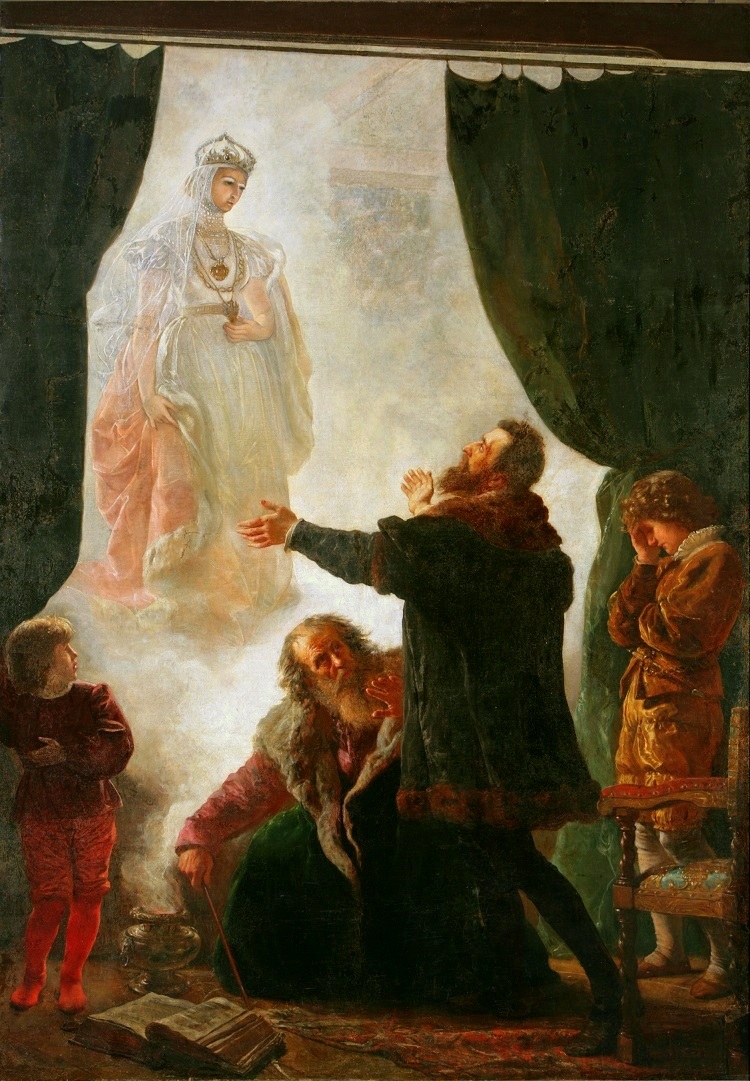
Twardowski is said to have used magic mirrors to summon spirits, including that of Queen Barbara Radziwiłł for King Sigismund Augustus. He also authored two books dictated by the Devil: one on magic and an encyclopedia. His primary method of survival involved inserting a clause in his contract that allowed the Devil to claim his soul only in Rome. He avoided this by staying in Poland until tricked into visiting an inn named Rzym.
Tools and materials
The magic mirror is a key tool in the legend, used for divination and summoning the dead. A polished metal plate in Węgrów is claimed to be this mirror. Other items include the contract itself, which contained the specific geographical loophole. Twardowski also kept a sidekick, whom he transformed into a spider, to bring him news from Earth while he remained on the Moon.
Pan Twardowski, drawn and placed
- Living
- Revived
- Fading
- Historical
- Legendary
- Performed
- Lineage
- Indo-European Smith and the Devil motif
What it is for
The legend explores themes of ambition, knowledge, and the limits of human cunning. Twardowski seeks power and status, serving as a courtier to the Polish king. The story serves as a cautionary tale about dealing with dark forces, yet it also celebrates the protagonist's wit. It reflects cultural fascination with the boundary between the mortal world and the supernatural.
Who does it
As a legendary figure, Twardowski does not have living practitioners. However, scholars and historians have studied his potential historical basis. Some suggest he may have been a German nobleman named Lorenz Dhur who studied in Wittenberg. Others link him to real occultists who visited Poland. The character has become a symbol of Polish literary and artistic identity.
Peoples and places
The legend is primarily Polish but has spread to Czech, Ukrainian, Russian, and German cultures. Each culture has adapted the story for their own literature and arts. In Poland, Twardowski appears in nativity scenes and folk art. The variations often highlight local values, such as the importance of wit in overcoming overwhelming odds. The name has been localized in different languages, reflecting its wide appeal.
At a glance: who, where and when
Belief worlds

What people believe
The worldview behind the legend involves a structured hierarchy of spiritual beings, including the Devil, angels, and spirits. Twardowski’s journey to the Moon suggests a belief in a populated cosmos beyond Earth. The intervention of the Virgin Mary highlights the role of divine mercy in folk theology. The story treats the afterlife and celestial realms as physical places where characters can reside.
When it is done
The legend is not tied to specific festivals or calendar dates. It is a narrative told for entertainment and moral reflection. However, it is frequently referenced in cultural events and artistic performances throughout the year. The story remains relevant in modern Polish culture through films, games, and literature.
How scholars and sceptics see it
Historians and folklorists analyze the legend as a variant of the Faust type. They examine how the story reflects changing attitudes toward magic and religion in Poland. Some researchers focus on the historical plausibility of Twardowski’s existence, comparing him to known alchemists and magicians. The legend is also studied for its influence on national identity and literature.
Cautions and what is closed
The legend warns against the dangers of selling one’s soul and seeking forbidden knowledge. It illustrates the consequences of trying to cheat death or divine judgment. While fictional, the story resonates with real-world fears about occult practices and moral corruption. It serves as a cultural reminder of the limits of human power.
Compare and confuse
Pan Twardowski is closely related to the legend of Faust, sharing the core motif of a pact with the Devil. Unlike Faust, who often faces eternal torment, Twardowski finds a unique, albeit isolated, salvation on the Moon. He is also compared to Simon Magus and Theophilus of Adana, other figures associated with magic and demonic contracts in Christian tradition.
Questions people ask about Pan Twardowski
Who is Pan Twardowski?
Pan Twardowski is a legendary Polish sorcerer who sold his soul to the Devil for magical powers. He is a central figure in Polish folklore, similar to Faust, known for his clever attempts to escape damnation.
Where does the legend come from?
The legend originates in Poland and is based on older Indo-European motifs like The Smith and the Devil. It evolved in Christian Europe and has been adapted by Czech, Ukrainian, Russian, and German cultures.
How did Pan Twardowski end up on the Moon?
After being caught by the Devil near an inn named Rzym, Twardowski prayed to the Virgin Mary. She caused the Devil to drop him midway to Hell, landing him on the Moon, where he lives today with a spider companion.
Is Pan Twardowski a real historical person?
His existence is disputed. Some scholars suggest he may have been inspired by historical figures like John Dee or a German nobleman named Lorenz Dhur. Most view him as a fictional character created for folklore and literature.
What tools did Pan Twardowski use?
He is said to have used a magic mirror to summon spirits and wrote two books dictated by the Devil. A polished metal plate in Węgrów is claimed to be this mirror, though its authenticity is legendary.
Good reading and sources
- Pan Twardowski on WikipediaEncyclopedia
- More photos on Wikimedia CommonsPhotos and video
- Wikidata recordOpen data
The facts on this page come from the Wikipedia article "Pan Twardowski", written by its contributors and used under the CC BY-SA 4.0 licence, and from its Wikidata record (CC0). EveryJaadu rewrote the text in its own words, with AI assistance, and compares every page with the article to make sure no passage is copied. It may be reused under the same CC BY-SA 4.0 licence with a link back.
It may contain mistakes. Names and customs differ from one community to the next, and some knowledge is closed to outsiders and left out here. This page describes belief and practice. It does not say that any of it works, it is not a how-to, and it is not medical advice. If something is wrong, tell us. Last refreshed 2026-10-06.
More from Poland
All the entries from Poland 🇷🇺 Russia and 3 moreFirebird
A glowing bird of Slavic folklore that brings both fortune and peril to those who seek itFigure · Wonder and entertainment · Luck and prosperity Legendary
🇷🇺 Russia and 3 moreFirebird
A glowing bird of Slavic folklore that brings both fortune and peril to those who seek itFigure · Wonder and entertainment · Luck and prosperity Legendary
 🇬🇧 United Kingdom and 3 moreEdward Kelley
An English occultist and scryer who worked with John Dee to contact angels and practice alchemy.Figure · Power and authority · Wonder and entertainment Historical
🇬🇧 United Kingdom and 3 moreEdward Kelley
An English occultist and scryer who worked with John Dee to contact angels and practice alchemy.Figure · Power and authority · Wonder and entertainment Historical
 🇵🇱 Poland and 4 moreMoranaМорена
A Slavic goddess of winter and death, whose effigy is drowned to welcome springFigure · Cursing and harm · Power and authority Living
🇵🇱 PolandWitch trials in Poland
A historical record of sorcery prosecutions and executions in Poland from the 15th to the 19th century.Belief · Cursing and harm Historical
🇵🇱 Poland and 4 moreMoranaМорена
A Slavic goddess of winter and death, whose effigy is drowned to welcome springFigure · Cursing and harm · Power and authority Living
🇵🇱 PolandWitch trials in Poland
A historical record of sorcery prosecutions and executions in Poland from the 15th to the 19th century.Belief · Cursing and harm Historical
Related elsewhere
All figure 🇮🇳 India and 5 moreAstrology
A divinatory practice that reads human fate through the positions of celestial bodies.Belief · Seeing and foretelling · Luck and prosperity Living
🇮🇳 India and 5 moreAstrology
A divinatory practice that reads human fate through the positions of celestial bodies.Belief · Seeing and foretelling · Luck and prosperity Living
 🇮🇳 India and 2 morePalmistry
A divination method that interprets the lines and shapes of the hand to predict fate or reveal character.Oracle · Seeing and foretelling · Power and authority Living
🇮🇳 India and 2 morePalmistry
A divination method that interprets the lines and shapes of the hand to predict fate or reveal character.Oracle · Seeing and foretelling · Power and authority Living
 🇨🇳 China and 3 moreChinese dragon龍
A legendary water deity and imperial symbol in East Asian cultureBeing · Protection · Luck and prosperity Historical
🇨🇳 China and 3 moreChinese dragon龍
A legendary water deity and imperial symbol in East Asian cultureBeing · Protection · Luck and prosperity Historical
 🇮🇳 IndiaMahakaleshwar JyotirlingaMahākāleśvara
A sacred Shiva shrine in Ujjain, India, known for its south-facing idol and ancient origins.Tradition · Protection · Power and authority Living
🇮🇳 IndiaMahakaleshwar JyotirlingaMahākāleśvara
A sacred Shiva shrine in Ujjain, India, known for its south-facing idol and ancient origins.Tradition · Protection · Power and authority Living